

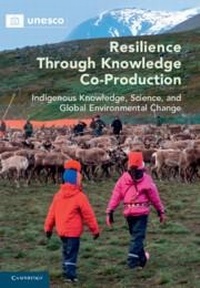
Resilience through Knowledge Co-Production
Indigenous Knowledge, Science, and Global Environmental Change
Published on 30. June 2022
Book
Hardback
412 pages
978-1-108-83830-6 (ISBN)
Description
Confronted with the complex environmental crises of the Anthropocene, scientists have moved towards an interdisciplinary approach to address challenges that are both social and ecological. Several arenas are now calling for co-production of new transdisciplinary knowledge by combining Indigenous knowledge and science. This book revisits epistemological debates on the notion of co-production and assesses the relevant methods, principles and values that enable communities to co-produce. It explores the factors that determine how indigenous-scientific knowledge can be rooted in equity, mutual respect and shared benefits. Resilience through Knowledge Co-Production includes several collective papers co-authored by Indigenous experts and scientists, with case studies involving Indigenous communities from the Arctic, Pacific islands, the Amazon, the Sahel and high altitude areas. Offering guidance to indigenous peoples, scientists, decision-makers and NGOs, this book moves towards a decolonised co-production of knowledge that unites indigenous knowledge and science to address global environmental crises.
Reviews / Votes
'... Krupnik's epilogue of the book provides an excellent sum-mary of the ideas discussed and lays out how DKC may develop fur-ther in the future.' Geoffrey Hodges, Indigenous Religious TraditionsMore details
Language
English
Place of publication
Cambridge
United Kingdom
Product notice
sewn/stitched
Cloth over boards
Illustrations
Worked examples or Exercises
Dimensions
Height: 254 mm
Width: 178 mm
Thickness: 19 mm
Weight
771 gr
ISBN-13
978-1-108-83830-6 (9781108838306)
Copyright in bibliographic data and cover images is held by Nielsen Book Services Limited or by the publishers or by their respective licensors: all rights reserved.
Schweitzer Classification
Other editions
Additional editions

Marie Roue
Resilience Through Knowledge Co-Production
Indigenous Knowledge, Science, and Global Environmental Change
E-Book
06/2022
Cambridge University Press
€57.99
Available for download
Marie Roue | Douglas Nakashima | Igor Krupnik
Resilience through Knowledge Co-Production
Indigenous Knowledge, Science, and Global Environmental Change
E-Book
06/2022
Cambridge University Press
€57.99
Available for download
Persons
Content
1. Co-production between Indigenous Knowledge and Science: Introducing a Decolonized Approach Marie Roue and Douglas Nakashima; Part I. From Practice to Principles: Methods and Challenges for Decolonized Knowledge Co-Production (DKC): 2. The Progression from Collaboration to Co-Production: Case Studies from Alaska Henry P. Huntington, George Noongwook, Anne K. Salomon, Nick M. Tanape, Sr.; 3. Learning about Sea Ice from the Kifikmiut: A Decade of Ice Seasons at Wales, 2006-2016 Hajo Eicken, Igor Krupnik, Winton Weyapuk, Jr., Matthew L. Druckenmiller; 4. Shaping the Long View: Inupiat Experts and Scientists Share Ocean Knowledge on Alaska's North Slope Matthew L. Druckenmiller; 5. Indigenous Ice Dictionaries: Sharing Knowledge for a Changing World Igor Krupnik; 6. Mapping Land Use with Sami Reindeer Herders: Co-Production in an Era of Climate Change Marie Roue, Lars-Evert Nutti, Nils-Johan Utsi, Samuel Roturier; 7. Sami Herders' Knowledge and Forestry: Ecological Restoration of Reindeer Lichen Pastures in Northern Sweden Samuel Roturier, Lars-Evert Nutti, Hans Winsa; Part II. Indigenous Perspectives on Environmental Change: The Climate Agreements: What We Have Achieved and the Gaps That Remain Hindou Oumarou Ibrahim; 9. Reinforcing Traditional Knowledge in the City: Canoe Building and Navigation in the Changing Pacific Tikoidelaimakotu Tuimoce Fuluna; Reindeer Herding in a Time of Growing Adversity Anders BONGO; 11. Herders and Drought in the Sahel of Burkina Faso: Traditional Knowledge and Resilience Hanafi Amirou DICKO; Part III. Global Change and Indigenous Responses: 12. Competing Paradigms of Himalayan Climate Change and Adaptations: Indigenous Knowledge versus Economics Jan Salick; 13. Coping with a Warming Winter Climate in Arctic Russia: Patterns of Extreme Weather Affecting Nenets Reindeer Nomadism Bruce C. Forbes, Timo Kumpala, Nina Meschtyb, Roza Laptander, Marc Macias-Fauria, Pentti Zetterberg, Mariana Verdonen, Anna Skarin, Kwang-Yul Kim, Linette N. Boisvert, Julienne C. Stroeve, Annett Bartsch; 14. Rising Above the Flood: Modifications in Agricultural Practices and Livelihood Systems in Central Amazonia - Perspectives from Ribeirinho and Indigenous Communities Angela May Steward, Rafael Barbi Costa e Santos, Camille Rognant, Fernanda Maria de Freitas Viana, Julia Vieira da Cunha Avila, Jessica Poliane Gomes dos Santos, Jacson Rodrigues, Samis Viera; 15. Indigenous Storytelling and Climate Change Adaptation Alvaro Fernandez-Llamazares, Mar Cabeza; 16. Indigenous Knowledge and the Coloniality of Reality: Climate Change Otherwise in the Bolivian Andes Anders Burman; 17. Negotiating Co-Production: Climbing the Learning Curve Igor Krupnik; Index.