

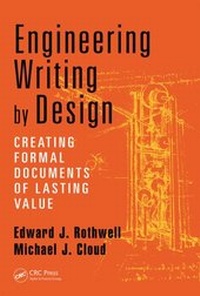
Engineering Writing by Design
Creating Formal Documents of Lasting Value
1st Edition
Published on 28. May 2014
Book
Paperback/Softback
199 pages
978-1-4822-3431-2 (ISBN)
Description
Engineers are smart people. Their work is important, which is why engineering material should be written as deliberately and carefully as it will be read.
Engineering Writing by Design: Creating Formal Documents of Lasting Value demonstrates how effective writing can be achieved through engineering-based thinking. Based on the authors' combined experience as engineering educators, the book presents a novel approach to technical writing, positioning formal writing tasks as engineering design problems with requirements, constraints, protocols, standards, and customers (readers) to satisfy. Specially crafted for busy engineers and engineering students, this quick-reading, conversational text:
Describes how to avoid logical fallacies and use physical reasoning to catch mistakes in claims
Covers the essentials of technical grammar and style as well as the elements of mathematical exposition
Emphasizes the centrality of the target audience, and thus the need for clear and concise prose
Engineering Writing by Design: Creating Formal Documents of Lasting Value addresses the specific combination of thinking and writing skills needed to succeed in modern engineering. Its mantra is: to write like an engineer, you must think like an engineer. Featuring illustrative examples, chapter summaries and exercises, quick-reference tables, and recommendations for further reading, this book is packed with valuable tips and information practicing and aspiring engineers need to become effective writers.
Engineering Writing by Design: Creating Formal Documents of Lasting Value demonstrates how effective writing can be achieved through engineering-based thinking. Based on the authors' combined experience as engineering educators, the book presents a novel approach to technical writing, positioning formal writing tasks as engineering design problems with requirements, constraints, protocols, standards, and customers (readers) to satisfy. Specially crafted for busy engineers and engineering students, this quick-reading, conversational text:
Describes how to avoid logical fallacies and use physical reasoning to catch mistakes in claims
Covers the essentials of technical grammar and style as well as the elements of mathematical exposition
Emphasizes the centrality of the target audience, and thus the need for clear and concise prose
Engineering Writing by Design: Creating Formal Documents of Lasting Value addresses the specific combination of thinking and writing skills needed to succeed in modern engineering. Its mantra is: to write like an engineer, you must think like an engineer. Featuring illustrative examples, chapter summaries and exercises, quick-reference tables, and recommendations for further reading, this book is packed with valuable tips and information practicing and aspiring engineers need to become effective writers.
Reviews / Votes
"Teaching technical writing is challenging, as most engineering students feel that it isn't important, because they are studying engineering not English. A book that teaches the logic behind technical writing combined with basic writing rules/tips is an asset."-Raenita A. Fenner, Loyola University Maryland, Baltimore, USA
"This book places the value of good writing in an engineering context-both in terms of methodology (by using the design process) and in terms of the need for good writing in engineering. ... I'm not aware of other engineering-based [writing] texts that go much past the mechanics of writing."
-Fred DePiero, California Polytechnic State University, San Luis Obispo, USA
More details
Language
English
Place of publication
Oakville
Canada
Target group
College/higher education
All current and aspiring engineers who wish to write in the English language.
Illustrations
12 s/w Abbildungen, 14 s/w Tabellen
14 Tables, black and white; 12 Illustrations, black and white
Dimensions
Height: 235 mm
Width: 156 mm
Weight
340 gr
ISBN-13
978-1-4822-3431-2 (9781482234312)
Copyright in bibliographic data and cover images is held by Nielsen Book Services Limited or by the publishers or by their respective licensors: all rights reserved.
Schweitzer Classification
Other editions
New editions
Edward J. Rothwell | Michael J. Cloud
Engineering Writing by Design
Creating Formal Documents of Lasting Value, Second Edition
Book
01/2020
2nd Edition
CRC Press
€79.30
Shipment within 15-20 days
Additional editions
Book
07/2017
1st Edition
CRC Press
€222.84
Article exhausted; check for reprint
Persons
Edward J. Rothwell received his BS from Michigan Technological University, Houghton, USA; MS and EE from Stanford University, California, USA; and Ph.D from Michigan State University, East Lansing, USA; all in electrical engineering. He has been a faculty member in the Department of Electrical and Computer Engineering at Michigan State University since 1985, and currently holds the rank of professor. Beforehand, he worked for Raytheon Co., Waltham, Massachusetts, USA and the Massachusetts Institute of Technology Lincoln Laboratory, Lexington, USA. Dr. Rothwell previously coauthored a book on electromagnetics and has published numerous journal articles on related subjects. He is a member of Phi Kappa Phi, Sigma Xi, and URSI Commission B, and is an IEEE fellow.
Michael J. Cloud received his BS, MS, and Ph.D in electrical engineering from Michigan State University, East Lansing, USA. Since 1987, he has been a faculty member in the Department of Electrical and Computer Engineering at Lawrence Technological University, Southfield, Michigan, USA. He currently holds the rank of associate professor. Dr. Cloud has coauthored 11 other books, primarily in the field of engineering mathematics. He is a senior member of the IEEE.
Michael J. Cloud received his BS, MS, and Ph.D in electrical engineering from Michigan State University, East Lansing, USA. Since 1987, he has been a faculty member in the Department of Electrical and Computer Engineering at Lawrence Technological University, Southfield, Michigan, USA. He currently holds the rank of associate professor. Dr. Cloud has coauthored 11 other books, primarily in the field of engineering mathematics. He is a senior member of the IEEE.
Content
Preface
Authors
To the Reader
Introduction
Why Bother?
Think, Then Write, Like an Engineer
Quick Review of Some Design Concepts
Chapter Recap
Exercises
Clearly Understand the Goal
What is the Goal?
How the Information Resides in Your Mind
Your Audience
Other Aspects of Situational Awareness
If Persuasion is Part of the Picture
Chapter Recap
Exercises
Mindset for Technical Writing
See Rules as Helpful Tools
Think Clearly Before Starting to Write
Again, Keep Your Reader in View!
Getting Started With a Mind Map
Chapter Recap
Exercises
Avoid the Worst Thinking Traps
Claims vs. Facts
Logical Fallacies
Additional Checks on Correctness
Other Ways to Be Careful
Chapter Recap
Exercises
Some Points of Grammar and Style
Rules and Suggestions
Chapter Recap
Exercises
Keep Your Reader in Mind
More Rules and Suggestions
Chapter Recap
Exercises
Write Your Math Well
What's Wrong with My Math?
Getting Started
Writing Math Well
The Value of Abstraction
Chapter Recap
Exercises
Further Reading
Quick Reference
Index
Authors
To the Reader
Introduction
Why Bother?
Think, Then Write, Like an Engineer
Quick Review of Some Design Concepts
Chapter Recap
Exercises
Clearly Understand the Goal
What is the Goal?
How the Information Resides in Your Mind
Your Audience
Other Aspects of Situational Awareness
If Persuasion is Part of the Picture
Chapter Recap
Exercises
Mindset for Technical Writing
See Rules as Helpful Tools
Think Clearly Before Starting to Write
Again, Keep Your Reader in View!
Getting Started With a Mind Map
Chapter Recap
Exercises
Avoid the Worst Thinking Traps
Claims vs. Facts
Logical Fallacies
Additional Checks on Correctness
Other Ways to Be Careful
Chapter Recap
Exercises
Some Points of Grammar and Style
Rules and Suggestions
Chapter Recap
Exercises
Keep Your Reader in Mind
More Rules and Suggestions
Chapter Recap
Exercises
Write Your Math Well
What's Wrong with My Math?
Getting Started
Writing Math Well
The Value of Abstraction
Chapter Recap
Exercises
Further Reading
Quick Reference
Index