

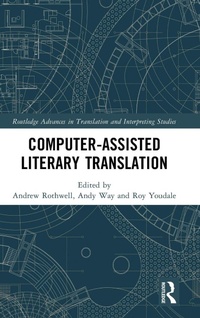
Computer-Assisted Literary Translation
1st Edition
Published on 30. November 2023
Book
Hardback
290 pages
978-1-032-41300-6 (ISBN)
Description
This collection surveys the state of the art of computer-assisted literary translation (CALT), making the case for its potential to enhance literary translation research and practice.
The volume brings together early career and established scholars from around the world in countering prevailing notions around the challenges of effectively implementing contemporary CALT applications in literary translation practice which has traditionally followed the model of a single translator focused on a single work. The book begins by addressing key questions on the definition of literary translation, examining its sociological dimensions and individual translator perspective. Chapters explore the affordances of technological advancements and availability of new tools in such areas as post-edited machine translation (PEMT) in expanding the boundaries of what we think of when we think of literary translation, looking to examples from developments in co-translation, collaborative translation, crowd-sourced translation and fan translation.
As the first book of its kind dedicated to the contribution CALT in its various forms can add to existing and future scholarship, this volume will be of interest to students and scholars in Translation Studies, especially those working in literary translation, machine translation and translation technologies.
The volume brings together early career and established scholars from around the world in countering prevailing notions around the challenges of effectively implementing contemporary CALT applications in literary translation practice which has traditionally followed the model of a single translator focused on a single work. The book begins by addressing key questions on the definition of literary translation, examining its sociological dimensions and individual translator perspective. Chapters explore the affordances of technological advancements and availability of new tools in such areas as post-edited machine translation (PEMT) in expanding the boundaries of what we think of when we think of literary translation, looking to examples from developments in co-translation, collaborative translation, crowd-sourced translation and fan translation.
As the first book of its kind dedicated to the contribution CALT in its various forms can add to existing and future scholarship, this volume will be of interest to students and scholars in Translation Studies, especially those working in literary translation, machine translation and translation technologies.
More details
Series
Language
English
Place of publication
London
United Kingdom
Publishing group
Taylor & Francis Ltd
Target group
College/higher education
Postgraduate
Illustrations
30 s/w Abbildungen, 30 s/w Zeichnungen, 26 s/w Tabellen
26 Tables, black and white; 30 Line drawings, black and white; 30 Illustrations, black and white
Dimensions
Height: 235 mm
Width: 157 mm
Thickness: 21 mm
Weight
594 gr
ISBN-13
978-1-032-41300-6 (9781032413006)
Copyright in bibliographic data and cover images is held by Nielsen Book Services Limited or by the publishers or by their respective licensors: all rights reserved.
Schweitzer Classification
Other editions
Additional editions
Andrew Rothwell | Andy Way | Roy Youdale
Computer-Assisted Literary Translation
Book
04/2025
1st Edition
Routledge
€67.80
Shipment within 10-20 days
Andrew Rothwell | Andy Way | Roy Youdale
Computer-Assisted Literary Translation
E-Book
11/2023
1st Edition
Routledge
€60.49
Available for download
Andrew Rothwell | Andy Way | Roy Youdale
Computer-Assisted Literary Translation
E-Book
11/2023
1st Edition
Routledge
€60.49
Available for download
Persons
Andrew Rothwell is Professor Emeritus of French and Translation Studies at Swansea University, UK.
Andy Way is Professor in the School of Computing and Deputy Director of the Adapt Centre at Dublin City University, Ireland.
Roy Youdale is Research Associate in Translation Studies at the University of Bristol, UK.
Andy Way is Professor in the School of Computing and Deputy Director of the Adapt Centre at Dublin City University, Ireland.
Roy Youdale is Research Associate in Translation Studies at the University of Bristol, UK.
Content
Introduction
ANDREW ROTHWELL, ANDY WAY AND ROY YOUDALE
Part 1: The Automated and Post-Edited Machine Translation of Literature
1 Literary-Adapted Machine Translation in a Well-Resourced Language Pair: Explorations with More Data and Wider Contexts
ANTONIO TORAL, ANDREAS VAN CRANENBURGH, AND TIA NUTTERS
2 'I Am a Bit Surprised': Literary Translation and Post-Editing Processes Compare
WALTRAUD KOLB
3 Mark My Keywords: A Translator-Specific Exploration of Style in Literary Machine Translation
MARION WINTERS AND DOROTHY KENNY
Part 2: Machine Translation Applications in Literary Translation
4 MT and CAT: Challenges, Irrelevancies or Opportunities for Literary Translation?
JAMES LUKE HADLEY
5 Retranslating Proust Using CAT, MT and Other Tools
ANDREW ROTHWELL
6 Author-Tailored Neural Machine Translation Systems for Literary Works
ANTONI OLIVER
7 Machine Translation of Chinese Fantasy (Xianxia) Novels: An Investigation Into the Leading Websites Translating Chinese Internet Literature Into English
SHUYIN ZHANG
8 Up and About, or Betwixt and Between?: The Poetry of a Translation Machine
TIM VAN DE CRUYS
9 Metaphor in Literary Machine Translation: Style, Creativity and Literariness
ALETTA G. DORST
Part 3: Corpus Linguistics, Text-Visualisation and Literary Translation
10 KonText in Trilingual Studies-Supporting Phraseology Translation Based on the EPB Corpus
ANGELIKA PELJAK-LAPINSKA
11 Voyant Tools' Little Outing: How a Text Reading and Analysis Environment Can Help Literary Translators
LISA HORENBERG
12 (Re)creating Equivalence of Stylistic Effect: A Corpus-Aided Methodology
TEREZA SPLICHALOVA
Part 4: Applying Specialised Electronic Tools to Literary Translation
13 The Experiment
AVRAHAM J. ROOS
14 Augmenting and Informing the Translation Process through Workflow-Enabled CALT Tools
SASHA MILE RUDAN, EUGENIA KELBERT, LAZAR KOVACEVIC, MATTHEW REYNOLDS, AND SINISHA RUDAN
ANDREW ROTHWELL, ANDY WAY AND ROY YOUDALE
Part 1: The Automated and Post-Edited Machine Translation of Literature
1 Literary-Adapted Machine Translation in a Well-Resourced Language Pair: Explorations with More Data and Wider Contexts
ANTONIO TORAL, ANDREAS VAN CRANENBURGH, AND TIA NUTTERS
2 'I Am a Bit Surprised': Literary Translation and Post-Editing Processes Compare
WALTRAUD KOLB
3 Mark My Keywords: A Translator-Specific Exploration of Style in Literary Machine Translation
MARION WINTERS AND DOROTHY KENNY
Part 2: Machine Translation Applications in Literary Translation
4 MT and CAT: Challenges, Irrelevancies or Opportunities for Literary Translation?
JAMES LUKE HADLEY
5 Retranslating Proust Using CAT, MT and Other Tools
ANDREW ROTHWELL
6 Author-Tailored Neural Machine Translation Systems for Literary Works
ANTONI OLIVER
7 Machine Translation of Chinese Fantasy (Xianxia) Novels: An Investigation Into the Leading Websites Translating Chinese Internet Literature Into English
SHUYIN ZHANG
8 Up and About, or Betwixt and Between?: The Poetry of a Translation Machine
TIM VAN DE CRUYS
9 Metaphor in Literary Machine Translation: Style, Creativity and Literariness
ALETTA G. DORST
Part 3: Corpus Linguistics, Text-Visualisation and Literary Translation
10 KonText in Trilingual Studies-Supporting Phraseology Translation Based on the EPB Corpus
ANGELIKA PELJAK-LAPINSKA
11 Voyant Tools' Little Outing: How a Text Reading and Analysis Environment Can Help Literary Translators
LISA HORENBERG
12 (Re)creating Equivalence of Stylistic Effect: A Corpus-Aided Methodology
TEREZA SPLICHALOVA
Part 4: Applying Specialised Electronic Tools to Literary Translation
13 The Experiment
AVRAHAM J. ROOS
14 Augmenting and Informing the Translation Process through Workflow-Enabled CALT Tools
SASHA MILE RUDAN, EUGENIA KELBERT, LAZAR KOVACEVIC, MATTHEW REYNOLDS, AND SINISHA RUDAN