

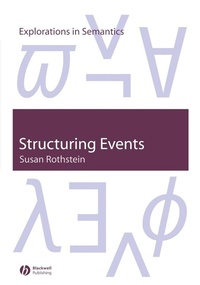
Structuring Events
A Study in the Semantics of Lexical Aspect
1st Edition
Published on 28. November 2003
Book
Paperback/Softback
224 pages
978-1-4051-0668-9 (ISBN)
Description
Structuring Events presents a novel semantic theory of lexical aspect for anyone interested in the study of verb meanings.
Provides an introduction to aspectual classes and aspectual distinctions.
Utilizes case studies to present a novel semantic theory of lexical aspect and compare it with alternative theories.
Useful for students and scholars in semantics and syntax as well as the neighboring fields of pragmatics and philosophy of language.
Provides an introduction to aspectual classes and aspectual distinctions.
Utilizes case studies to present a novel semantic theory of lexical aspect and compare it with alternative theories.
Useful for students and scholars in semantics and syntax as well as the neighboring fields of pragmatics and philosophy of language.
Reviews / Votes
"This is the most important book on lexical aspect since David Dowty's seminal Word Meaning and Montague Grammar." Angelika Kratzer, University of Massachusetts-Amherst"As well as providing a clear introduction to the subject, this excellent book extends our knowledge of the lexical aspectual properties of verbs and verb phrases in new and original directions. Rothstein's careful exploitation of the flexibility of event-based semantics in providing a solid foundation for the interpretation of verbal aspect establishes the theory as central to any explanation of this often difficult - but ever fascinating - topic." Ronnie Cann, University of Edinburgh
"This outstanding book represents a new breakthrough in the general theory of lexical aspect. The discussions of the previous research are distinguished by clarity as well as new challenges and insights. In a highly engaging way Rothstein also advances new solutions to some of the most thorny issues - including aspectual shifts, progressive achievements, and resultative predication - which will shape the future research in lexical aspect." Hana Filip, Stanford University
"Rothstein's book contains many observations, deep intuitions and exciting analyses which will doubtless be very influential in a variety of areas. Empirically, the book contains a treasure trove of interesting data that will no doubt be mulled over for years to come." Lingua
More details
Series
Language
English
Place of publication
Hoboken
United Kingdom
Publishing group
John Wiley and Sons Ltd
Target group
Professional and scholarly
Product notice
Paperback (trade)
Unsewn / adhesive bound
Dimensions
Height: 254 mm
Width: 178 mm
Thickness: 12 mm
Weight
424 gr
ISBN-13
978-1-4051-0668-9 (9781405106689)
Copyright in bibliographic data and cover images is held by Nielsen Book Services Limited or by the publishers or by their respective licensors: all rights reserved.
Schweitzer Classification
Other editions
Additional editions
E-Book
05/2008
Wiley-Blackwell
€55.99
Available for download
Book
11/2003
1st Edition
Wiley
€160.88
Shipment within 3-4 weeks
Person
Susan Rothstein is Professor of Linguistics at Bar-Ilan University. She has published widely on such issues as syntax, semantics, and the syntax-semantics interface. She is author of Predicates and Their Subjects (2000), and editor of Events and Grammar (1998) and Perspectives on Phrase Structure: Heads and Licensing (1991).
Content
Preface vii
1. Verb Classes and Aspectual Classification 1
2. Progressive Achievements 36
3. Resultative Predication 59
4. The Structure of Accomplishments 91
5. The Interpretation of Derived Accomplishments 123
6. Quantization, Telicity and Change 148
7. Telicity and Atomicity 157
8. Event Structure and Aspectual Classification 183
References 198
Index 202
1. Verb Classes and Aspectual Classification 1
2. Progressive Achievements 36
3. Resultative Predication 59
4. The Structure of Accomplishments 91
5. The Interpretation of Derived Accomplishments 123
6. Quantization, Telicity and Change 148
7. Telicity and Atomicity 157
8. Event Structure and Aspectual Classification 183
References 198
Index 202