

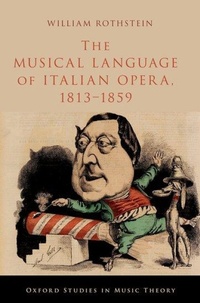
The Musical Language of Italian Opera, 1813-1859
Published on 22. December 2022
Book
Hardback
600 pages
978-0-19-760968-2 (ISBN)
Description
Though studying opera often requires attention to aesthetics, libretti, staging, singers, compositional history, and performance history, the music itself is central. This book examines operatic music by five Italian composers-Rossini, Bellini, Mercadante, Donizetti, and Verdi-and one non-Italian, Meyerbeer, during the period from Rossini's first international successes to Italian unification. Detailed analyses of form, rhythm, melody, and harmony reveal concepts of musical structure different from those usually discussed by music theorists, calling into question the notion of a common practice. Taking an eclectic analytical approach, author William Rothstein uses ideas originating in several centuries, from the sixteenth to the twenty-first, to argue that operatic music can be heard not only as passionate vocality but also in terms of musical forms, pitch structures, and rhythmic patterns-that is, as carefully crafted music worth theoretical attention. Although no single theory accounts for everything, Rothstein's analysis shows how certain recurring principles define a distinctively Italian practice, one that left its mark on the German repertoire more familiar to music theorists.
Reviews / Votes
To say that this book is highly anticipated is an understatement. Rothstein, a brilliant music theorist, engages with a vast array of past and present scholars, providing historical research and context for his operatic investigations. There is a lot of variety in this scholarly buffet-something for everyone's taste. * Deborah Burton, Associate Professor, Boston University * Students and scholars studying the history of Western music theory will appreciate Rothstein's comprehensive and wide-ranging review of the contributions made by many important music theorists mentioned throughout MLIO. * Steven D. Mathews, Notes: the Quarterly Journal of the Music Library Association. *More details
Series
Language
English
Place of publication
New York
United States
Target group
Professional and scholarly
Product notice
sewn/stitched
Cloth over boards
Illustrations
428 examples, 45 tables
Dimensions
Height: 237 mm
Width: 163 mm
Thickness: 42 mm
Weight
1007 gr
ISBN-13
978-0-19-760968-2 (9780197609682)
Copyright in bibliographic data and cover images is held by Nielsen Book Services Limited or by the publishers or by their respective licensors: all rights reserved.
Schweitzer Classification
Other editions
Additional editions
William Rothstein
The Musical Language of Italian Opera, 1813-1859
E-Book
11/2022
OUP eBook
€73.99
Available for download
William Rothstein
The Musical Language of Italian Opera, 1813-1859
E-Book
11/2022
OUP eBook
€73.99
Available for download
Person
William Rothstein is Professor of Music Theory at Queens College and The Graduate Center of the City University of New York. He previously taught at Amherst College, Oberlin College, and the University of Michigan. He is author of Phrase Rhythm in Tonal Music and co-author (with Charles Burkhart) of Anthology for Musical Analysis. He has written and lectured extensively on music of the eighteenth and nineteenth centuries, with special emphasis on musical rhythm, Schenkerian theory and analysis, and nineteenth-century Italian opera.
Content
Preface
Acknowledgments
Introduction: What is there to analyze?
Part One: La Via Italiana
Chapter 1. The Anvil Chorus
Chapter 2. Theoretical contexts I: Nineteenth-century theory
Chapter 3. Theoretical contexts II: Schenker and Riemann
Chapter 4. Rhythm and meter
Chapter 5. Musical form
Part Two: Rossini
Chapter 6. Rossini's mediants
Chapter 7. Tonal coherence in Rossini's Italian operas
Chapter 8. Guillaume Tell
Part Three: Between Rossini and Verdi
Chapter 9. Bellini and the new diatonicism
Chapter 10. Meyerbeer and the new chromaticism
Chapter 11. Around 1840: Mercadante and Donizetti
Part Four: Verdi's Sedici Anni
Chapter 12. Ernani to Attila (1844-1846)
Chapter 13. Rigoletto and Il trovatore (1851-1853)
Chapter 14. Les vepres siciliennes to Un ballo in maschera (1854-1859)
Afterword: Verdi and His Predecessors
Selected bibliography
Index
Acknowledgments
Introduction: What is there to analyze?
Part One: La Via Italiana
Chapter 1. The Anvil Chorus
Chapter 2. Theoretical contexts I: Nineteenth-century theory
Chapter 3. Theoretical contexts II: Schenker and Riemann
Chapter 4. Rhythm and meter
Chapter 5. Musical form
Part Two: Rossini
Chapter 6. Rossini's mediants
Chapter 7. Tonal coherence in Rossini's Italian operas
Chapter 8. Guillaume Tell
Part Three: Between Rossini and Verdi
Chapter 9. Bellini and the new diatonicism
Chapter 10. Meyerbeer and the new chromaticism
Chapter 11. Around 1840: Mercadante and Donizetti
Part Four: Verdi's Sedici Anni
Chapter 12. Ernani to Attila (1844-1846)
Chapter 13. Rigoletto and Il trovatore (1851-1853)
Chapter 14. Les vepres siciliennes to Un ballo in maschera (1854-1859)
Afterword: Verdi and His Predecessors
Selected bibliography
Index