

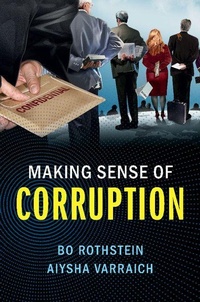
Making Sense of Corruption
Published on 9. March 2017
Book
Hardback
184 pages
978-1-107-16370-6 (ISBN)
Description
Corruption is a serious threat to prosperity, democracy and human well-being, with mounting empirical evidence highlighting its detrimental effects on society. Yet defining this threat has resulted in profound disagreement, producing a multidimensional concept. Tackling this important and provocative topic, the authors provide an accessible and systematic analysis of how our understanding of corruption has evolved. They identify gaps in the research and make connections between related concepts such as clientelism, patronage, patrimonialism, particularism and state capture. A fundamental issue discussed is how the opposite of corruption should be defined. By arguing for the possibility of a universal understanding of corruption, and specifically what corruption is not, an innovative solution to this problem is presented. This book provides an accessible overview of corruption, allowing scholars and students alike to see the far reaching place it has within academic research.
Reviews / Votes
'At a time when the anti-corruption movement is in need of critical self-assessment, Rothstein and Varraich offer an important analysis. We know we do not want corruption - but what do we want? Can we, and should we, disentangle corruption from the many other related difficulties undermining the well-being of people and societies in many parts of the world? How do we know where corruption is worst, and whether our reforms are helping, hurting, or having any effects at all? Scholars and policy makers alike will find the insights offered by Rothstein and Varraich essential as their anti-corruption work enters new phases.' Michael Johnston, Colgate University, New York 'Defining the core issue as one of the quality of government and the idea that a non-corrupt government is 'based on the principle of impartiality in the exercise of public power,' [Rothstein and Varraich] relate the theory of corruption to real world problems. This is a small book, dense in its coverage of issues of philosophy, sociology, and political science, but it will probably cause anyone who has glibly used the term to have second thoughts and, hopefully, rethink their core assumptions.' E. V. Schneier, CHOICEMore details
Language
English
Place of publication
Cambridge
United Kingdom
Target group
Professional and scholarly
Illustrations
5 Tables, black and white; 3 Line drawings, black and white
Dimensions
Height: 235 mm
Width: 157 mm
Thickness: 15 mm
Weight
429 gr
ISBN-13
978-1-107-16370-6 (9781107163706)
Copyright in bibliographic data and cover images is held by Nielsen Book Services Limited or by the publishers or by their respective licensors: all rights reserved.
Schweitzer Classification
Other editions
Additional editions
Bo Rothstein
Making Sense of Corruption
E-Book
02/2017
Cambridge University Press
€18.49
Available for download
Bo Rothstein | Aiysha Varraich
Making Sense of Corruption
Book
02/2017
Cambridge University Press
€31.40
Shipment within 15-20 days
Bo Rothstein | Aiysha Varraich
Making Sense of Corruption
E-Book
02/2017
Cambridge University Press
€20.49
Available for download
Persons
Bo Rothstein is Professor of Government and Public Policy at the Blavatnik School of Government and Professorial Fellow of Nuffield College at the University of Oxford. Since 2012 he has been a member of the Royal Swedish Academy of Sciences. In 2003, he was awarded a Leading Scholars grant by the Swedish Science Council and in 2013 he received an Advanced Research Grant from the European Research Council. Aiysha Varraich received her Master of Science degree from the International Administration and Global Governance Program at Goeteborgs Universitet, Sweden in 2011. In 2014, she entered the PhD program in Political Science at Goeteborgs Universitet and is writing a thesis about clientelism and its effects on democratic processes within new democracies.
Content
Preface and acknowledgements; 1. Corruption and the relevance of political science; 2. Mapping related disciplines; 3. The evolution of corruption as a concept; 4. Corruption and human rights; 5. Corruption and clientelism; 6. Corruption and patronage; 7. Corruption and patrimonialism; 8. Corruption, state capture and political particularism; 9. The Chinese exception and alternative; 10. In conclusion: what is the opposite of corruption?; Bibliography.