

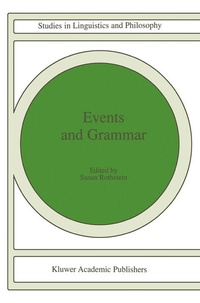
Events and Grammar
Published on 31. July 1998
Book
Hardback
V, 386 pages
978-0-7923-4940-2 (ISBN)
Description
In recent years, the study of events and their role as implicit arguments of predicates has been at the center of much important work in semantics and the syntax/semantics interface. This volume brings together fourteen original studies by leading scholars in semantics and the syntax/semantics interface, covering a broad spectrum of research into the role of events in grammar. The papers extensively address the following topics, among others: event arguments and thematic argument structure; the role of events in verbal aspectual distinctions; events and the distinction between stage and individual level predicates; the role of events in the analysis of plurality and scope relations, the mass/count distinction, and propositional attitudes.
More details
Series
Edition
1998 ed.
Language
English
Place of publication
Dordrecht
Netherlands
Target group
Professional and scholarly
Research
Product notice
sewn/stitched
Cloth over boards
Illustrations
V, 386 p.
Dimensions
Height: 241 mm
Width: 160 mm
Thickness: 26 mm
Weight
758 gr
ISBN-13
978-0-7923-4940-2 (9780792349402)
DOI
10.1007/978-94-011-3969-4
Schweitzer Classification
Other editions
Additional editions
Susan Rothstein
Events and Grammar
Book
11/2001
Kluwer Academic Publishers
€160.49
Shipment within 15-20 days
Content
Generalizing Tense Semantics for Future Contexts.- Thematic Roles and the Individuation of Events.- Plurality of Mass Nouns and the Notion of "Semantic Parameter".- Progressives, States and Backgrounding.- An Overt Syntactic Marker for Genericity in Hebrew.- On Generic and Existential Bare Plurals and the Classification of Predicates.- Scope or Pseudoscope? Are there Wide-scope Indefinites?.- The Origins of Telicity.- Plurals and Maximalization.- Events in the Semantics of Collectivizing Adverbials.- Stativity and Theticity.- Cognate Objects as Reflections of Davidsonian Event Arguments.- Subject-oriented Adverbs are Thematically Dependent.- Aspect Shift.- Index of Names.- Index of Subjects.