

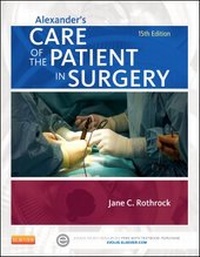
Alexander's Care of the Patient in Surgery
15th Edition
Published on 27. February 2014
Book
Paperback/Softback
1248 pages
978-0-323-08942-5 (ISBN)
Description
Alexander's Care of the Patient in Surgery is the most dependable source for comprehensive perioperative information.? Well-known author and educator, Jane C. Rothrock, continues to provide step-by-step instructions for over 400 surgical procedures, including many minimally invasive methods, all backed by the latest research.? More than 1,000 full-color illustrations and photos depict current techniques, as well as surgical anatomy and instrumentation.? This edition adds cutting-edge information to reflect new concepts for both invasive and non-invasive surgical procedures, whether the location is in a hospital, outpatient clinic, or doctor's office.
Over 400 specialty surgical interventions are included, as well as many minimally-invasive surgical procedures.
A clear and consistent chapter format makes it easy to find information, including general discussions of surgical anatomy and perioperative nursing considerations, followed by more specific discussions of procedural considerations and operative procedure for each surgical intervention.
Cutting-edge information keeps you up-to-date with the latest technological advances related to surgical procedures, both invasive and non-invasive, whether the location is in a hospital, outpatient clinic, or in a doctor's office.
Updated coverage includes new surgical procedures and techniques, new care standards, and the importance of integrating evidence and research into patient care.
1,000 full-color illustrations and photos show surgical anatomy, procedures, and methods.
Comprehensive discussions of perioperative nursing considerations cover assessment, nursing diagnosis, outcome identification, planning, implementation, evaluation, patient and family education, and discharge planning.
Full-color design highlights special features and makes it easier to focus on essential concepts.
Patient Safety boxes highlight Joint Commission initiatives and important safety topics.
Evidence for Practice boxes apply scientific research to perioperative nursing.
Research Highlight boxes provide the latest research and apply it to patient care.
Patient and Family Education boxes include specific guidelines for preprocedural and postprocedural care, side effects and complications, home care, discharge/follow-up care, psychosocial care, and referrals.
Surgical Pharmacology tables summarize and offer quick reference to the drugs most commonly used for specific surgical procedures, including generic and trade names, purpose/description, and pharmacokinetics.
Ambulatory Surgery Consideration boxes highlight patient selection criteria, special anesthesia considerations, and patient assessment implications for outpatient surgical procedures.
Sample plans of care include nursing diagnosis, outcome, and interventions, linking specific interventions to clearly identified outcomes.
An emphasis on patient and workplace safety includes protocols from the major safety agencies and coalitions, perioperative nursing safety issues, patient rights, and safe patient handling and movement.
Coverage of cross-specialty areas includes special considerations for pediatric, geriatric, and trauma surgeries, as well as interventional and image-guided procedures, and complementary and alternative therapy.
NEW and UNIQUE! Patient-Centered Care boxes feature simplified conversations that you can have with patients to help them better understand their surgical procedure.
NEW! A Critical Thinking Question at the end of every chapter tests your understanding of chapter content.
NEW! Key Points at the end of every chapter help you retain important concepts from the text.
NEW! Laboratory Values appendix contains all laboratory value information in one convenient location
Over 400 specialty surgical interventions are included, as well as many minimally-invasive surgical procedures.
A clear and consistent chapter format makes it easy to find information, including general discussions of surgical anatomy and perioperative nursing considerations, followed by more specific discussions of procedural considerations and operative procedure for each surgical intervention.
Cutting-edge information keeps you up-to-date with the latest technological advances related to surgical procedures, both invasive and non-invasive, whether the location is in a hospital, outpatient clinic, or in a doctor's office.
Updated coverage includes new surgical procedures and techniques, new care standards, and the importance of integrating evidence and research into patient care.
1,000 full-color illustrations and photos show surgical anatomy, procedures, and methods.
Comprehensive discussions of perioperative nursing considerations cover assessment, nursing diagnosis, outcome identification, planning, implementation, evaluation, patient and family education, and discharge planning.
Full-color design highlights special features and makes it easier to focus on essential concepts.
Patient Safety boxes highlight Joint Commission initiatives and important safety topics.
Evidence for Practice boxes apply scientific research to perioperative nursing.
Research Highlight boxes provide the latest research and apply it to patient care.
Patient and Family Education boxes include specific guidelines for preprocedural and postprocedural care, side effects and complications, home care, discharge/follow-up care, psychosocial care, and referrals.
Surgical Pharmacology tables summarize and offer quick reference to the drugs most commonly used for specific surgical procedures, including generic and trade names, purpose/description, and pharmacokinetics.
Ambulatory Surgery Consideration boxes highlight patient selection criteria, special anesthesia considerations, and patient assessment implications for outpatient surgical procedures.
Sample plans of care include nursing diagnosis, outcome, and interventions, linking specific interventions to clearly identified outcomes.
An emphasis on patient and workplace safety includes protocols from the major safety agencies and coalitions, perioperative nursing safety issues, patient rights, and safe patient handling and movement.
Coverage of cross-specialty areas includes special considerations for pediatric, geriatric, and trauma surgeries, as well as interventional and image-guided procedures, and complementary and alternative therapy.
NEW and UNIQUE! Patient-Centered Care boxes feature simplified conversations that you can have with patients to help them better understand their surgical procedure.
NEW! A Critical Thinking Question at the end of every chapter tests your understanding of chapter content.
NEW! Key Points at the end of every chapter help you retain important concepts from the text.
NEW! Laboratory Values appendix contains all laboratory value information in one convenient location
More details
Edition
15th Revised edition
Language
English
Place of publication
St Louis
United States
Publishing group
Elsevier - Health Sciences Division
Target group
College/higher education
Edition type
Revised edition
Illustrations
Approx. 700 illustrations (700 in full color)
Dimensions
Height: 276 mm
Width: 216 mm
ISBN-13
978-0-323-08942-5 (9780323089425)
Copyright in bibliographic data and cover images is held by Nielsen Book Services Limited or by the publishers or by their respective licensors: all rights reserved.
Schweitzer Classification
Other editions
New editions
Jane C. Rothrock
Alexander's Care of the Patient in Surgery
Book
04/2018
16th Edition
Elsevier
€143.59
Article exhausted; check for reprint
Previous edition
Jane C. Rothrock
Alexander's Care of the Patient in Surgery
Book
06/2010
14th Edition
Mosby
€96.55
Article exhausted; check for reprint
Person
Content
Unit I: Foundations for Practice 1. Concepts Basic to Perioperative Nursing 2. Patient Safety and Risk Management 3. Workplace Issues and Staff Safety 4. Infection Prevention and Control 5. Anesthesia 6. Positioning the Patient for Surgery 7. Sutures, Needles, and Instruments 8. Surgical Modalities 9. Wound Healing, Dressings, and Drains 10. Postoperative Patient Care and Pain Management Unit II: Surgical Interventions 11. Gastrointestinal Surgery 12. Surgery of the Liver, Biliary Tract, Pancreas, and Spleen 13. Repair of Hernias 14. Gynecologic and Obstetric Surgery 15. Genitourinary Surgery 16. Thyroid and Parathyroid Surgery 17. Breast Surgery 18. Ophthalmic Surgery 19. Otorhinolarygologic Surgery 20. Orthopedic Surgery 21. Neurosurgery 22. Reconstructive and Aesthetic Plastic Surgery 23. Thoracic Surgery 24. Vascular Surgery 25. Cardiac Surgery Unit III: Special Considerations 26. Pediatric Surgery 27. Geriatric Surgery 28. Trauma Surgery 29. Interventional and Image-Guided Procedures 30. Integrated Health Practices: Complementary and Alternative Therapies Appendix A: Laboratory Values