

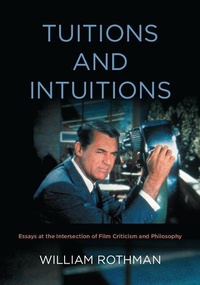
Tuitions and Intuitions
Essays at the Intersection of Film Criticism and Philosophy
Published on 1. November 2019
Book
Hardback
412 pages
978-1-4384-7579-0 (ISBN)
Description
Makes the case that philosophy has an essential role to play in the serious study of film.
William Rothman has long been considered one of the seminal figures in the field of film-philosophy. From his landmark book Hitchcock: The Murderous Gaze, now in its second edition, to the essays collected here in Tuitions and Intuitions, Rothman has been guided by two intuitions: first, that his kind of film criticism is philosophy; and second, that such a marriage of criticism and philosophy has an essential part to play in the serious study of film. In this book, he aspires, borrowing a formulation from Emerson, to "pay the tuition" for these intuitions.
Thoughtful, philosophically sophisticated, and provocative, the essays included here address a wide range of films, including classical Hollywood movies; the work of "auteur" directors like Alfred Hitchcock, George Cukor, Yasujiro Ozu, and Woody Allen; performances by John Barrymore and James Stewart; unconventional works by Jean Genet, Chantal Akerman, Terrence Malick, and the Dardenne brothers; the television series Justified; and documentaries by Jean Rouch, Ross McElwee, and Robert Gardner. All the essays address questions of philosophical significance and, taken together, manifest Rothman's lifelong commitment when writing about a film, to respect the film's own ideas; to remain open to the film's ways of expressing its ideas; and to let the film help teach him how to view it, how to think about it, and how to discover what he has at heart to say about it.
William Rothman has long been considered one of the seminal figures in the field of film-philosophy. From his landmark book Hitchcock: The Murderous Gaze, now in its second edition, to the essays collected here in Tuitions and Intuitions, Rothman has been guided by two intuitions: first, that his kind of film criticism is philosophy; and second, that such a marriage of criticism and philosophy has an essential part to play in the serious study of film. In this book, he aspires, borrowing a formulation from Emerson, to "pay the tuition" for these intuitions.
Thoughtful, philosophically sophisticated, and provocative, the essays included here address a wide range of films, including classical Hollywood movies; the work of "auteur" directors like Alfred Hitchcock, George Cukor, Yasujiro Ozu, and Woody Allen; performances by John Barrymore and James Stewart; unconventional works by Jean Genet, Chantal Akerman, Terrence Malick, and the Dardenne brothers; the television series Justified; and documentaries by Jean Rouch, Ross McElwee, and Robert Gardner. All the essays address questions of philosophical significance and, taken together, manifest Rothman's lifelong commitment when writing about a film, to respect the film's own ideas; to remain open to the film's ways of expressing its ideas; and to let the film help teach him how to view it, how to think about it, and how to discover what he has at heart to say about it.
Reviews / Votes
"Tuitions and Intuitions is simply indispensable to anyone interested in philosophy and in film as philosophy. This book as a whole expresses and exemplifies moral perfectionism through the exploration of what our self becomes with this experience of cinema." - Sandra Laugier, University Pantheon Sorbonne, Paris"Bringing Rothman's work together highlights patterns and consistent concerns that may not otherwise be obvious to readers. The book will be invaluable to current and future Rothman scholars." - Kyle Stevens, author of Mike Nichols: Sex, Language, and the Reinvention of Psychological Realism
More details
Series
Language
English
Place of publication
Albany, NY
United States
Target group
College/higher education
US School Grade: From College Freshman to College Graduate Student
Product notice
sewn/stitched
Cloth over boards
Illustrations
287 Illustrations, black and white
Dimensions
Height: 257 mm
Width: 183 mm
Thickness: 30 mm
Weight
885 gr
ISBN-13
978-1-4384-7579-0 (9781438475790)
Copyright in bibliographic data and cover images is held by Nielsen Book Services Limited or by the publishers or by their respective licensors: all rights reserved.
Schweitzer Classification
Other editions
Additional editions
E-Book
11/2019
1st Edition
State University of New York Press
from
€91.99
Available for download
Person
William Rothman is Professor of Cinema and Interactive Media at the University of Miami. His previous books include, as author, Hitchcock: The Murderous Gaze; as editor, Cavell on Film and Three Documentary Filmmakers: Errol Morris, Ross McElwee, and Jean Rouch; and as coeditor, with Rebecca Meyers and Charles Warren, Looking with Robert Gardner, all published by SUNY Press.
Content
Acknowledgments
Preface
Introduction: How John the Baptist Kept His Head, or My Life in Film Philosophy
Part I. A Philosophical Perspective
1. Why Not Realize Your World? William Rothman interviewed by Jeffrey Crouse
2. Silence and Stasis
3. Film and Modernity
4. Andre Bazin as Cavellian Realist
5. What Becomes of the Camera in the World on Film?
Part II. Studies in Criticism
6. "I Never Thought I Should Sink So Low as to Become an Actor": John Barrymore in Twentieth Century
7. "I Look Up, I Look Down": James Stewart in Vertigo
8. Hats Off for George Cukor!
9. Woody Allen's New York
10. Blood is Thicker than Water: The Family in Hitchcock
11. Space and Speech in the Films of Yasujiro? Ozu
12. Romance, Eroticism, and the Camera's Gaze in Jean Genet's Un Chant d'amour
13. Face to Face with Chantal Akerman
14. Precious Memories in Philosophy and Film
15. Seeing the Light in The Tree of Life
16. A Film That Is Also a Handshake: Philosophy in the Films of the Dardenne Brothers
17. Justifying Justified
18. Documentary Film in Boston in the 1970s and 1980s
19. Sometimes Daddies Don't Talk about Things Like That: Ross McElwee's Bright Leaves
20. Jean Rouch as Film Artist: Turu and Bitti, Funeral at Bongo: The Old Anai (1848-1972), Ambara Dama
21. Dancing with Gardner: Robert Gardner's Films on Art
22. Dead Birds Re-Encountered: A Journey of Return
Notes
References
Index
Preface
Introduction: How John the Baptist Kept His Head, or My Life in Film Philosophy
Part I. A Philosophical Perspective
1. Why Not Realize Your World? William Rothman interviewed by Jeffrey Crouse
2. Silence and Stasis
3. Film and Modernity
4. Andre Bazin as Cavellian Realist
5. What Becomes of the Camera in the World on Film?
Part II. Studies in Criticism
6. "I Never Thought I Should Sink So Low as to Become an Actor": John Barrymore in Twentieth Century
7. "I Look Up, I Look Down": James Stewart in Vertigo
8. Hats Off for George Cukor!
9. Woody Allen's New York
10. Blood is Thicker than Water: The Family in Hitchcock
11. Space and Speech in the Films of Yasujiro? Ozu
12. Romance, Eroticism, and the Camera's Gaze in Jean Genet's Un Chant d'amour
13. Face to Face with Chantal Akerman
14. Precious Memories in Philosophy and Film
15. Seeing the Light in The Tree of Life
16. A Film That Is Also a Handshake: Philosophy in the Films of the Dardenne Brothers
17. Justifying Justified
18. Documentary Film in Boston in the 1970s and 1980s
19. Sometimes Daddies Don't Talk about Things Like That: Ross McElwee's Bright Leaves
20. Jean Rouch as Film Artist: Turu and Bitti, Funeral at Bongo: The Old Anai (1848-1972), Ambara Dama
21. Dancing with Gardner: Robert Gardner's Films on Art
22. Dead Birds Re-Encountered: A Journey of Return
Notes
References
Index