

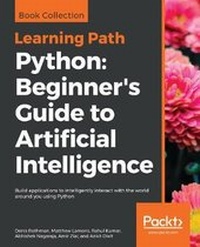
Python: Beginner's Guide to Artificial Intelligence
Build applications to intelligently interact with the world around you using Python
Published on 24. December 2018
Book
Paperback/Softback
676 pages
978-1-78995-732-7 (ISBN)
Description
Develop real-world applications powered by the latest advances in intelligent systems
Key Features
Gain real-world contextualization using deep learning problems concerning research and application
Get to know the best practices to improve and optimize your machine learning systems and algorithms
Design and implement machine intelligence using real-world AI-based examples
Book Description
This Learning Path offers practical knowledge and techniques you need to create and contribute to machine learning, deep learning, and modern data analysis. You will be introduced to various machine learning and deep learning algorithms from scratch, and show you how to apply them to practical industry challenges using realistic and interesting examples. You will learn to build powerful, robust, and accurate predictive models with the power of TensorFlow, combined with other open-source Python libraries.
Throughout the Learning Path, you'll learn how to develop deep learning applications for machine learning systems. Discover how to attain deep learning programming on GPU in a distributed way.
By the end of this Learning Path, you know the fundamentals of AI and have worked through a number of case studies that will help you apply your skills to real-world projects.
This Learning Path includes content from the following Packt products:
Artificial Intelligence By Example by Denis Rothman
Python Deep Learning Projects by Matthew Lamons, Rahul Kumar, and Abhishek Nagaraja
Hands-On Artificial Intelligence with TensorFlow by Amir Ziai, Ankit Dixit
What you will learn
Use adaptive thinking to solve real-life AI case studies
Rise beyond being a modern-day factory code worker
Understand future AI solutions and adapt quickly to them
Master deep neural network implementation using TensorFlow
Predict continuous target outcomes using regression analysis
Dive deep into textual and social media data using sentiment analysis
Who this book is for
This Learning Path is for anyone who wants to understand the fundamentals of Artificial Intelligence and implement it practically by devising smart solutions. You will learn to extend your machine learning and deep learning knowledge by creating practical AI smart solutions. Prior experience with Python and statistical knowledge is essential to make the most out of this Learning Path.
Key Features
Gain real-world contextualization using deep learning problems concerning research and application
Get to know the best practices to improve and optimize your machine learning systems and algorithms
Design and implement machine intelligence using real-world AI-based examples
Book Description
This Learning Path offers practical knowledge and techniques you need to create and contribute to machine learning, deep learning, and modern data analysis. You will be introduced to various machine learning and deep learning algorithms from scratch, and show you how to apply them to practical industry challenges using realistic and interesting examples. You will learn to build powerful, robust, and accurate predictive models with the power of TensorFlow, combined with other open-source Python libraries.
Throughout the Learning Path, you'll learn how to develop deep learning applications for machine learning systems. Discover how to attain deep learning programming on GPU in a distributed way.
By the end of this Learning Path, you know the fundamentals of AI and have worked through a number of case studies that will help you apply your skills to real-world projects.
This Learning Path includes content from the following Packt products:
Artificial Intelligence By Example by Denis Rothman
Python Deep Learning Projects by Matthew Lamons, Rahul Kumar, and Abhishek Nagaraja
Hands-On Artificial Intelligence with TensorFlow by Amir Ziai, Ankit Dixit
What you will learn
Use adaptive thinking to solve real-life AI case studies
Rise beyond being a modern-day factory code worker
Understand future AI solutions and adapt quickly to them
Master deep neural network implementation using TensorFlow
Predict continuous target outcomes using regression analysis
Dive deep into textual and social media data using sentiment analysis
Who this book is for
This Learning Path is for anyone who wants to understand the fundamentals of Artificial Intelligence and implement it practically by devising smart solutions. You will learn to extend your machine learning and deep learning knowledge by creating practical AI smart solutions. Prior experience with Python and statistical knowledge is essential to make the most out of this Learning Path.
More details
Language
English
Place of publication
Birmingham
United Kingdom
Target group
Professional and scholarly
Dimensions
Height: 93 mm
Width: 75 mm
ISBN-13
978-1-78995-732-7 (9781789957327)
Copyright in bibliographic data and cover images is held by Nielsen Book Services Limited or by the publishers or by their respective licensors: all rights reserved.
Schweitzer Classification
Persons
Denis Rothman graduated from l'Universite Paris-Sorbonne and l'Universite Paris-Diderot, writing one of the very first word2matrix embedding solutions. He began his career authoring one of the first AI cognitive NLP chatbots applied as a language teacher for Moet et Chandon and other companies. He authored an AI resource optimizer for IBM and apparel producers. He then authored an Advanced Planning and Scheduling (APS) solution used worldwide.
Matthew Lamons's background is in experimental psychology and deep learning. Founder and CEO of Skejul-the AI platform to help people manage their activities. Named by Gartner, Inc. as a "Cool Vendor" in the "Cool Vendors in Unified Communication, 2017" report. He founded The Intelligence Factory to build AI strategy, solutions, insights, and talent for enterprise clients and incubate AI tech startups based on the success of his Applied AI MasterMinds group. Matthew's global community of more than 85 K are leaders in AI, forecasting, robotics, autonomous vehicles, marketing tech, NLP, computer vision, reinforcement, and deep learning. Matthew invites you to join him on his mission to simplify the future and to build AI for good.
Rahul Kumar is an AI scientist, deep learning practitioner, and independent researcher. His expertise in building multilingual NLU systems and large-scale AI infrastructures has brought him to Copenhagen, where he leads a large team of AI engineers as Chief AI Scientist at Jatana. Often invited to speak at AI conferences, he frequently travels between India, Europe, and the US where, among other research initiatives, he collaborates with The Intelligence Factory as NLP data science fellow. Keen to explore the ramifications of emerging technologies for his next book, he's currently involved in various research projects on Quantum Computing (QC), high-performance computing (HPC), and the brain-computer interaction (BCI).
Abhishek Nagaraja was born and raised in India. Graduated Magna Cum Laude from the University of Illinois at Chicago, United States, with a Masters Degree in Mechanical Engineering with a concentration in Mechatronics and Data Science. Abhishek specializes in Keras and TensorFlow for building and evaluation of custom architectures in deep learning recommendation models. His deep learning skills and interest span computational linguistics and NLP to build chatbots to computer vision and reinforcement learning. He has been working as a Data Scientist for Skejul Inc. building an AI-powered activity forecast engine and engaged as a Deep Learning Data Scientist with The Intelligence Factory building solutions for enterprise clients.
Amir Ziai is a senior data scientist at Netflix, where he works on streaming security involving petabyte-scale machine learning platforms and applications. He has worked as a data scientist in AdTech, HealthTech, and FinTech companies. He holds a master's degree in data science from UC Berkeley.
Ankit Dixit is a deep learning expert at AIRA Matrix in Mumbai, India and having an experience of 7 years in the field of computer vision and machine learning. He is currently working on the development of full slide medical image analysis solutions in his organization. His work involves designing and implementation of various customized deep neural networks for image segmentation as well as classification tasks. He has worked with different deep neural network architectures such as VGG, ResNet, Inception, Recurrent Neural Nets (RNN) and FRCNN. He holds a masters degree in computer vision specialization. He has also authored an AI/ML book.
Matthew Lamons's background is in experimental psychology and deep learning. Founder and CEO of Skejul-the AI platform to help people manage their activities. Named by Gartner, Inc. as a "Cool Vendor" in the "Cool Vendors in Unified Communication, 2017" report. He founded The Intelligence Factory to build AI strategy, solutions, insights, and talent for enterprise clients and incubate AI tech startups based on the success of his Applied AI MasterMinds group. Matthew's global community of more than 85 K are leaders in AI, forecasting, robotics, autonomous vehicles, marketing tech, NLP, computer vision, reinforcement, and deep learning. Matthew invites you to join him on his mission to simplify the future and to build AI for good.
Rahul Kumar is an AI scientist, deep learning practitioner, and independent researcher. His expertise in building multilingual NLU systems and large-scale AI infrastructures has brought him to Copenhagen, where he leads a large team of AI engineers as Chief AI Scientist at Jatana. Often invited to speak at AI conferences, he frequently travels between India, Europe, and the US where, among other research initiatives, he collaborates with The Intelligence Factory as NLP data science fellow. Keen to explore the ramifications of emerging technologies for his next book, he's currently involved in various research projects on Quantum Computing (QC), high-performance computing (HPC), and the brain-computer interaction (BCI).
Abhishek Nagaraja was born and raised in India. Graduated Magna Cum Laude from the University of Illinois at Chicago, United States, with a Masters Degree in Mechanical Engineering with a concentration in Mechatronics and Data Science. Abhishek specializes in Keras and TensorFlow for building and evaluation of custom architectures in deep learning recommendation models. His deep learning skills and interest span computational linguistics and NLP to build chatbots to computer vision and reinforcement learning. He has been working as a Data Scientist for Skejul Inc. building an AI-powered activity forecast engine and engaged as a Deep Learning Data Scientist with The Intelligence Factory building solutions for enterprise clients.
Amir Ziai is a senior data scientist at Netflix, where he works on streaming security involving petabyte-scale machine learning platforms and applications. He has worked as a data scientist in AdTech, HealthTech, and FinTech companies. He holds a master's degree in data science from UC Berkeley.
Ankit Dixit is a deep learning expert at AIRA Matrix in Mumbai, India and having an experience of 7 years in the field of computer vision and machine learning. He is currently working on the development of full slide medical image analysis solutions in his organization. His work involves designing and implementation of various customized deep neural networks for image segmentation as well as classification tasks. He has worked with different deep neural network architectures such as VGG, ResNet, Inception, Recurrent Neural Nets (RNN) and FRCNN. He holds a masters degree in computer vision specialization. He has also authored an AI/ML book.
Content
Table of Contents
Become an Adaptive Thinker
Think Like a Machine
Apply Machine Thinking to a Human Problem
Become an Unconventional Innovator
Manage the Power of Machine Learning and Deep Learning
Focus on Optimizing Your Solutions
When and How to Use Artificial Intelligence
Revolutions Designed for Some Corporations and Disruptive Innovations for Small to Large Companies
Getting Your Neurons to Work
Applying Biomimicking to Artificial Intelligence
Conceptual Representation Learning
Optimizing Blockchains with AI
Cognitive NLP Chatbots
Improve the Emotional Intelligence Deficiencies of Chatbots
Building Deep Learning Environments
Training NN for Prediction Using Regression
Generative Language Model for Content Creation
Building Speech Recognition with DeepSpeech2
Handwritten Digits Classification Using ConvNets
Object Detection Using OpenCV and TensorFlow
Building Face Recognition Using FaceNet
Generative Adversarial Networks
From GPUs to Quantum computing - AI Hardware
TensorFlow Serving
Become an Adaptive Thinker
Think Like a Machine
Apply Machine Thinking to a Human Problem
Become an Unconventional Innovator
Manage the Power of Machine Learning and Deep Learning
Focus on Optimizing Your Solutions
When and How to Use Artificial Intelligence
Revolutions Designed for Some Corporations and Disruptive Innovations for Small to Large Companies
Getting Your Neurons to Work
Applying Biomimicking to Artificial Intelligence
Conceptual Representation Learning
Optimizing Blockchains with AI
Cognitive NLP Chatbots
Improve the Emotional Intelligence Deficiencies of Chatbots
Building Deep Learning Environments
Training NN for Prediction Using Regression
Generative Language Model for Content Creation
Building Speech Recognition with DeepSpeech2
Handwritten Digits Classification Using ConvNets
Object Detection Using OpenCV and TensorFlow
Building Face Recognition Using FaceNet
Generative Adversarial Networks
From GPUs to Quantum computing - AI Hardware
TensorFlow Serving