

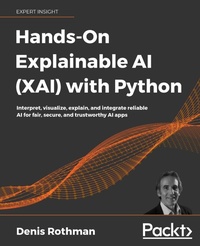
Hands-On Explainable AI (XAI) with Python
Interpret, visualize, explain, and integrate reliable AI for fair, secure, and trustworthy AI apps
Published on 31. July 2020
Book
Paperback/Softback
454 pages
978-1-80020-813-1 (ISBN)
Description
Resolve the black box models in your AI applications to make them fair, trustworthy, and secure. Familiarize yourself with the basic principles and tools to deploy Explainable AI (XAI) into your apps and reporting interfaces.
Key Features
Learn explainable AI tools and techniques to process trustworthy AI results
Understand how to detect, handle, and avoid common issues with AI ethics and bias
Integrate fair AI into popular apps and reporting tools to deliver business value using Python and associated tools
Book DescriptionEffectively translating AI insights to business stakeholders requires careful planning, design, and visualization choices. Describing the problem, the model, and the relationships among variables and their findings are often subtle, surprising, and technically complex.
Hands-On Explainable AI (XAI) with Python will see you work with specific hands-on machine learning Python projects that are strategically arranged to enhance your grasp on AI results analysis. You will be building models, interpreting results with visualizations, and integrating XAI reporting tools and different applications.
You will build XAI solutions in Python, TensorFlow 2, Google Cloud's XAI platform, Google Colaboratory, and other frameworks to open up the black box of machine learning models. The book will introduce you to several open-source XAI tools for Python that can be used throughout the machine learning project life cycle.
You will learn how to explore machine learning model results, review key influencing variables and variable relationships, detect and handle bias and ethics issues, and integrate predictions using Python along with supporting the visualization of machine learning models into user explainable interfaces.
By the end of this AI book, you will possess an in-depth understanding of the core concepts of XAI.What you will learn
Plan for XAI through the different stages of the machine learning life cycle
Estimate the strengths and weaknesses of popular open-source XAI applications
Examine how to detect and handle bias issues in machine learning data
Review ethics considerations and tools to address common problems in machine learning data
Share XAI design and visualization best practices
Integrate explainable AI results using Python models
Use XAI toolkits for Python in machine learning life cycles to solve business problems
Who this book is forThis book is not an introduction to Python programming or machine learning concepts. You must have some foundational knowledge and/or experience with machine learning libraries such as scikit-learn to make the most out of this book.
Some of the potential readers of this book include:
Professionals who already use Python for as data science, machine learning, research, and analysis
Data analysts and data scientists who want an introduction into explainable AI tools and techniques
AI Project managers who must face the contractual and legal obligations of AI Explainability for the acceptance phase of their applications
Key Features
Learn explainable AI tools and techniques to process trustworthy AI results
Understand how to detect, handle, and avoid common issues with AI ethics and bias
Integrate fair AI into popular apps and reporting tools to deliver business value using Python and associated tools
Book DescriptionEffectively translating AI insights to business stakeholders requires careful planning, design, and visualization choices. Describing the problem, the model, and the relationships among variables and their findings are often subtle, surprising, and technically complex.
Hands-On Explainable AI (XAI) with Python will see you work with specific hands-on machine learning Python projects that are strategically arranged to enhance your grasp on AI results analysis. You will be building models, interpreting results with visualizations, and integrating XAI reporting tools and different applications.
You will build XAI solutions in Python, TensorFlow 2, Google Cloud's XAI platform, Google Colaboratory, and other frameworks to open up the black box of machine learning models. The book will introduce you to several open-source XAI tools for Python that can be used throughout the machine learning project life cycle.
You will learn how to explore machine learning model results, review key influencing variables and variable relationships, detect and handle bias and ethics issues, and integrate predictions using Python along with supporting the visualization of machine learning models into user explainable interfaces.
By the end of this AI book, you will possess an in-depth understanding of the core concepts of XAI.What you will learn
Plan for XAI through the different stages of the machine learning life cycle
Estimate the strengths and weaknesses of popular open-source XAI applications
Examine how to detect and handle bias issues in machine learning data
Review ethics considerations and tools to address common problems in machine learning data
Share XAI design and visualization best practices
Integrate explainable AI results using Python models
Use XAI toolkits for Python in machine learning life cycles to solve business problems
Who this book is forThis book is not an introduction to Python programming or machine learning concepts. You must have some foundational knowledge and/or experience with machine learning libraries such as scikit-learn to make the most out of this book.
Some of the potential readers of this book include:
Professionals who already use Python for as data science, machine learning, research, and analysis
Data analysts and data scientists who want an introduction into explainable AI tools and techniques
AI Project managers who must face the contractual and legal obligations of AI Explainability for the acceptance phase of their applications
More details
Language
English
Place of publication
Birmingham
United Kingdom
Target group
Professional and scholarly
US School Grade: College Graduate Student
Dimensions
Height: 235 mm
Width: 191 mm
Thickness: 25 mm
Weight
841 gr
ISBN-13
978-1-80020-813-1 (9781800208131)
Copyright in bibliographic data and cover images is held by Nielsen Book Services Limited or by the publishers or by their respective licensors: all rights reserved.
Schweitzer Classification
Other editions
Additional editions
Denis Rothman
Hands-On Explainable AI (XAI) with Python
Interpret, visualize, explain, and integrate reliable AI for fair, secure, and trustworthy AI apps
E-Book
09/2024
Packt Publishing
€32.99
Available for download
Person
Denis Rothman graduated from Sorbonne University and Paris-Diderot University, designing one of the very first word2matrix patented embedding and patented AI conversational agents. He began his career authoring one of the first AI cognitive Natural Language Processing (NLP) chatbots applied as an automated language teacher for Moet et Chandon and other companies. He authored an AI resource optimizer for IBM and apparel producers. He then authored an Advanced Planning and Scheduling (APS) solution used worldwide.
Content
Table of Contents
Explaining Artificial Intelligence with Python
White Box XAI for AI Bias and Ethics
Explaining Machine Learning with Facets
Microsoft Azure Machine Learning Model Interpretability with SHAP
Building an Explainable AI Solution from Scratch
AI Fairness with Google's What-If Tool (WIT)
A Python Client for Explainable AI Chatbots
Local Interpretable Model-Agnostic Explanations (LIME)
The Counterfactual Explanations Method
Contrastive XAI
Anchors XAI
Cognitive XAI
Explaining Artificial Intelligence with Python
White Box XAI for AI Bias and Ethics
Explaining Machine Learning with Facets
Microsoft Azure Machine Learning Model Interpretability with SHAP
Building an Explainable AI Solution from Scratch
AI Fairness with Google's What-If Tool (WIT)
A Python Client for Explainable AI Chatbots
Local Interpretable Model-Agnostic Explanations (LIME)
The Counterfactual Explanations Method
Contrastive XAI
Anchors XAI
Cognitive XAI