

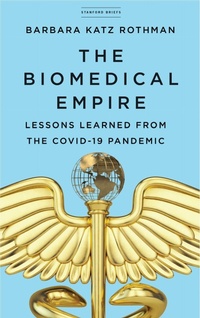
The Biomedical Empire
Lessons Learned from the COVID-19 Pandemic
Published on 22. June 2021
Book
Paperback/Softback
164 pages
978-1-5036-2881-6 (ISBN)
Description
We are all citizens of the Biomedical Empire, though few of us know it, and even fewer understand the extent of its power. In this book, Barbara Katz Rothman clarifies that critiques of biopower and the "medical industrial complex" have not gone far enough, and asserts that the medical industry is nothing short of an imperial power. Factors as fundamental as one's citizenship and sex identity-drivers of our access to basic goods and services-rely on approval and legitimation by biomedicine. Moreover, a vast and powerful global market has risen up around the empire, making it one of the largest economic forces in the world. Katz Rothman shows that biomedicine has the key elements of an imperial power: economic leverage, the faith of its citizens, and governmental rule. She investigates the Western colonial underpinnings of the empire and its rapid intrusion into everyday life, focusing on the realms of birth and death. This provides her with a powerful vantage point from which to critically examine the current moment, when the COVID-19 pandemic has exposed the power structures of the empire in unprecedented ways while sparking the most visible resistance it has ever seen.
Reviews / Votes
"Women have always been healers, the wise women. Barbara Katz Rothman shows how medicine has taken over the gates of life, the care of our bodies, and what has cost communities and cultures around the world."-Barbara Ehrenreich, author of Natural Causes "After the post-colonial critique of empire and the Foucauldian critique of biopower, Katz Rothman exposes the insidious reach of the biomedical empire, a global industry that has appropriated our capacity to care, commodified our sense of well-being, and seized full control over the beginning and end of life. Essential sociological reading for anyone interested in rescuing critical medical sociology from the clutches of right-wing populism."-Finn Bowring, Cardiff University "This book identifies the Biomedical Empire as the global leviathan monopolizing control of medicalized/industrialized healthcare, a truly imperial system defined by the bottom-line logic of 21st-century corporate- and finance-dominated global capitalism. This short, provocative account wonderfully illustrates how all this top-down-controlled machinery impacts intimate human events like birth, death, and the lonely terror of COVID-19 pandemic victims."-David Smith, University of California, Irvine "This work is a crisp critique of biomedicine which shows hope for a way out of the Biomedical Empire wherein the public, health and care may be infused back into public health."-Meghna Roy, Sociology of Health and Illness "While the book primarily draws on examples from the United States and the author's own lived experience, Rothman makes the case that the biomedical empire is transnational and transcends the nation-state. Unfolding over ten chapters, the book contributes to existing work in the sociology of medicine and scholarship on empire in contemporary contexts."-Durgesh Solanki, Journal of World-Systems Research "This book provides a compelling argument that only by naming the Biomedical Empire and recognizing biomedical citizenship can we begin to transform societies to act on the fundamental determinants of health."-Crystal Adams, Contemporary Sociology "Taken together... this book is a powerful damnation of contemporary health care systems, particularly in the United States where every service is itemized and billed."-Jill Thistlethwaite, Fulbright Chronicles "In a nutshell, [Katz Rothman's] book is a must-have not just for scholars and researchers interested in medical sociology but also for anybody seeking to familiarize themselves with the biomedical empire. Anyone who has visited a hospital or used biomedical services will be able to connect to the book. As a result, practically everyone should read the book."-Pankaj Singh, H-Death "[The Biomedical Empire is] an invitation to us all to rethink how we theorize the local and the global, class and power, and our subjection to persistent, escalating inequality worldwide."-Lenore Manderson, American Journal of SociologyMore details
Edition
New edition
Language
English
Place of publication
United States
Publishing group
Stanford University Press
Target group
Professional and scholarly
Edition type
New edition
Product notice
Paperback (trade)
Dimensions
Height: 201 mm
Width: 124 mm
Thickness: 10 mm
Weight
186 gr
ISBN-13
978-1-5036-2881-6 (9781503628816)
Copyright in bibliographic data and cover images is held by Nielsen Book Services Limited or by the publishers or by their respective licensors: all rights reserved.
Schweitzer Classification
Other editions
Additional editions
Book
08/2021
Stanford Briefs
€18.50
Shipment within 15-20 days
E-Book
08/2021
Stanford Briefs
€19.99
Available for download

E-Book
06/2021
Stanford Briefs
€19.99
Available for download
Book
09/2020
Stanford Briefs
€18.00
Shipment within 15-20 days
Person
Barbara Katz Rothman is Professor of Sociology, at the City University of New York. She has served as President of Sociologists for Women in Society; the Society for the Study of Social Problems, and the Eastern Sociological Society. Her awards include the Jesse Bernard Award of the American Sociological Association, and an award for "Midwifing the Movement" from the Midwives Alliance of North America, and a distinguished Chair in Health Sciences from the Fulbright Association. She is the author of numerous books, most recently A Bun in the Oven: How the Food and Birth Movements Resist Industrialization (2016).
Content
Contents and Abstracts1A Moment of Crisis chapter abstractThe covid pandemic has laid bare many of the structural problems and inequalities of biomedicine as a global industry. Inequalities across nation-states as well as within them have been made apparent, as have some of the dehumanizing and isolating practices of medical treatment. We must both acknowledge the good that medicine does and recognize its failures.
2A Sociologist Walks into a Pandemic chapter abstractThis chapter lays out the basic elements of sociological thinking, the understanding of structural and cultural factors. It explains the concept of 'social construction' and shows how that is applied to medicine.
3Bringing Medical Sociology into the 21st Century chapter abstractSociology must go beyond thinking of individual 'societies' and understand the globalization of power. This applies to biopower, the ways that the imperial power of Biomedicine has expanded its reach. Biomedicine functions globally in much the way we think of other imperial powers, from the Roman Empire to the British and onward, colonizing arenas of knowledge and practice, and turning them into sources of income for the colonizer.
4The Three Elements of an Empire chapter abstractTo understand Biomedicine as an Imperial power means seeing it as not only one of the largest industries on earth, but also as a governmental force and as a religious force. This chapter details the wide economic reach of biomedicine as one of the largest industries on earth, which also has a rule of law, bestowing citizenship, legitimating individuals as having the right to have rights; certifying both birth and death certificates; and legitimating mental states of being. Biomedicine also functions as a religion, a source of belief and comfort.
5What Have We Lost? Where Did the Care Go? chapter abstractWe must distinguish 'health care' from 'medical services.' Public health is increasingly presented as access to medical services, the 'ask your doctor' approach. Public health in its origins was about creating a health-enabling environment, providing clean air, water, safe housing and this chapter argues we must return to that. Within biomedical control, individuals are best understood as 'patients,' consumers of medical services. The language of 'patient' is itself explored.
6The Land of the Sick chapter abstractThis chapter builds on Sontag's words, identifying illness as 'land of the sick.' Diagnosis serves the administrative purpose of admitting, or denying admission, to that land, via the 'sick role,' the position of patient. Where in traditional societies religion stood at the gates of life, welcoming and legitimating newly created people and ushering out the dying, in the contemporary world Biomedicine has taken over that function. This is apparent in the world of procreation, in which biomedicine controls the definition of embryonic and fetal personhood, and in death in which a medical declaration and certificate is required. Birth and death have become procedural moments under biomedical control.
7Death and Dying: Seen Through the Lens of Covid-19 chapter abstractThis chapter discusses sudden death and the history of attempts at resuscitation; slow death, the increasing movement of death into hospital-management; and the slowest death, the growth of nursing homes and long-term-care facilities. The role of nursing home in covid deaths has been dramatic, and the inherent risks of these facilities laid clear.
8The Other Gate: Birth in the Time of Covid chapter abstractBirth was one of the early examples of colonization in medicine, as doctors pushed midwives out of practice and turned birth into a medical procedure, with (contrary to popular belief) increased risks and loss of life. As the pandemic made the dangers of hospitalization more clear, the contemporary movement for out-of-hospital birth received more attention. The risks of hospitalization are not randomly distributed, social class and -in the United States in particular - race are risk factors for medical mistreatment.
9The Empire Strikes Back chapter abstractAmong the more dramatic images to come out of the covid epidemic have been the isolation of the sick, elderly and the dying. The absence of caring attention has become apparent as people are blocked from bedside presence. Some attempts were made to move outside of the 'hot bed' of infection that hospitals are, the place where the infectious and sick are congregated. And attempts were made to control the spread of the disease using variations on 'lockdowns,' closing borders and limiting interpersonal connection in what was called 'social distancing,' all with limited success.
10Lessons Learned chapter abstractPoints of resistance to the control of biomedicine as an imperial power can be seen in different communities around the globe and can give indications of how such resistance might be furthered. In this as in the rest of the book, the good that medicine can do is recognized. The development of a vaccine is a powerful force for good, but resistance or fear can be best understood in the context of the larger imperial power. We must put a focus on health, and a valuing of care, into what is called 'healthcare' but should more accurately be called 'medical services'.
2A Sociologist Walks into a Pandemic chapter abstractThis chapter lays out the basic elements of sociological thinking, the understanding of structural and cultural factors. It explains the concept of 'social construction' and shows how that is applied to medicine.
3Bringing Medical Sociology into the 21st Century chapter abstractSociology must go beyond thinking of individual 'societies' and understand the globalization of power. This applies to biopower, the ways that the imperial power of Biomedicine has expanded its reach. Biomedicine functions globally in much the way we think of other imperial powers, from the Roman Empire to the British and onward, colonizing arenas of knowledge and practice, and turning them into sources of income for the colonizer.
4The Three Elements of an Empire chapter abstractTo understand Biomedicine as an Imperial power means seeing it as not only one of the largest industries on earth, but also as a governmental force and as a religious force. This chapter details the wide economic reach of biomedicine as one of the largest industries on earth, which also has a rule of law, bestowing citizenship, legitimating individuals as having the right to have rights; certifying both birth and death certificates; and legitimating mental states of being. Biomedicine also functions as a religion, a source of belief and comfort.
5What Have We Lost? Where Did the Care Go? chapter abstractWe must distinguish 'health care' from 'medical services.' Public health is increasingly presented as access to medical services, the 'ask your doctor' approach. Public health in its origins was about creating a health-enabling environment, providing clean air, water, safe housing and this chapter argues we must return to that. Within biomedical control, individuals are best understood as 'patients,' consumers of medical services. The language of 'patient' is itself explored.
6The Land of the Sick chapter abstractThis chapter builds on Sontag's words, identifying illness as 'land of the sick.' Diagnosis serves the administrative purpose of admitting, or denying admission, to that land, via the 'sick role,' the position of patient. Where in traditional societies religion stood at the gates of life, welcoming and legitimating newly created people and ushering out the dying, in the contemporary world Biomedicine has taken over that function. This is apparent in the world of procreation, in which biomedicine controls the definition of embryonic and fetal personhood, and in death in which a medical declaration and certificate is required. Birth and death have become procedural moments under biomedical control.
7Death and Dying: Seen Through the Lens of Covid-19 chapter abstractThis chapter discusses sudden death and the history of attempts at resuscitation; slow death, the increasing movement of death into hospital-management; and the slowest death, the growth of nursing homes and long-term-care facilities. The role of nursing home in covid deaths has been dramatic, and the inherent risks of these facilities laid clear.
8The Other Gate: Birth in the Time of Covid chapter abstractBirth was one of the early examples of colonization in medicine, as doctors pushed midwives out of practice and turned birth into a medical procedure, with (contrary to popular belief) increased risks and loss of life. As the pandemic made the dangers of hospitalization more clear, the contemporary movement for out-of-hospital birth received more attention. The risks of hospitalization are not randomly distributed, social class and -in the United States in particular - race are risk factors for medical mistreatment.
9The Empire Strikes Back chapter abstractAmong the more dramatic images to come out of the covid epidemic have been the isolation of the sick, elderly and the dying. The absence of caring attention has become apparent as people are blocked from bedside presence. Some attempts were made to move outside of the 'hot bed' of infection that hospitals are, the place where the infectious and sick are congregated. And attempts were made to control the spread of the disease using variations on 'lockdowns,' closing borders and limiting interpersonal connection in what was called 'social distancing,' all with limited success.
10Lessons Learned chapter abstractPoints of resistance to the control of biomedicine as an imperial power can be seen in different communities around the globe and can give indications of how such resistance might be furthered. In this as in the rest of the book, the good that medicine can do is recognized. The development of a vaccine is a powerful force for good, but resistance or fear can be best understood in the context of the larger imperial power. We must put a focus on health, and a valuing of care, into what is called 'healthcare' but should more accurately be called 'medical services'.