

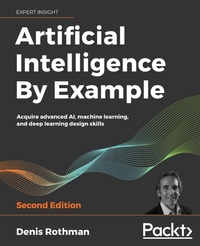
Artificial Intelligence By Example
Acquire advanced AI, machine learning, and deep learning design skills, 2nd Edition
2nd Edition
Published on 28. February 2020
Book
Paperback/Softback
578 pages
978-1-83921-153-9 (ISBN)
Description
Understand the fundamentals and develop your own AI solutions in this updated edition packed with many new examples
Key Features
AI-based examples to guide you in designing and implementing machine intelligence
Build machine intelligence from scratch using artificial intelligence examples
Develop machine intelligence from scratch using real artificial intelligence
Book DescriptionAI has the potential to replicate humans in every field. Artificial Intelligence By Example, Second Edition serves as a starting point for you to understand how AI is built, with the help of intriguing and exciting examples.
This book will make you an adaptive thinker and help you apply concepts to real-world scenarios. Using some of the most interesting AI examples, right from computer programs such as a simple chess engine to cognitive chatbots, you will learn how to tackle the machine you are competing with. You will study some of the most advanced machine learning models, understand how to apply AI to blockchain and Internet of Things (IoT), and develop emotional quotient in chatbots using neural networks such as recurrent neural networks (RNNs) and convolutional neural networks (CNNs).
This edition also has new examples for hybrid neural networks, combining reinforcement learning (RL) and deep learning (DL), chained algorithms, combining unsupervised learning with decision trees, random forests, combining DL and genetic algorithms, conversational user interfaces (CUI) for chatbots, neuromorphic computing, and quantum computing.
By the end of this book, you will understand the fundamentals of AI and have worked through a number of examples that will help you develop your AI solutions.
What you will learn
Apply k-nearest neighbors (KNN) to language translations and explore the opportunities in Google Translate
Understand chained algorithms combining unsupervised learning with decision trees
Solve the XOR problem with feedforward neural networks (FNN) and build its architecture to represent a data flow graph
Learn about meta learning models with hybrid neural networks
Create a chatbot and optimize its emotional intelligence deficiencies with tools such as Small Talk and data logging
Building conversational user interfaces (CUI) for chatbots
Writing genetic algorithms that optimize deep learning neural networks
Build quantum computing circuits
Who this book is forDevelopers and those interested in AI, who want to understand the fundamentals of Artificial Intelligence and implement them practically. Prior experience with Python programming and statistical knowledge is essential to make the most out of this book.
Key Features
AI-based examples to guide you in designing and implementing machine intelligence
Build machine intelligence from scratch using artificial intelligence examples
Develop machine intelligence from scratch using real artificial intelligence
Book DescriptionAI has the potential to replicate humans in every field. Artificial Intelligence By Example, Second Edition serves as a starting point for you to understand how AI is built, with the help of intriguing and exciting examples.
This book will make you an adaptive thinker and help you apply concepts to real-world scenarios. Using some of the most interesting AI examples, right from computer programs such as a simple chess engine to cognitive chatbots, you will learn how to tackle the machine you are competing with. You will study some of the most advanced machine learning models, understand how to apply AI to blockchain and Internet of Things (IoT), and develop emotional quotient in chatbots using neural networks such as recurrent neural networks (RNNs) and convolutional neural networks (CNNs).
This edition also has new examples for hybrid neural networks, combining reinforcement learning (RL) and deep learning (DL), chained algorithms, combining unsupervised learning with decision trees, random forests, combining DL and genetic algorithms, conversational user interfaces (CUI) for chatbots, neuromorphic computing, and quantum computing.
By the end of this book, you will understand the fundamentals of AI and have worked through a number of examples that will help you develop your AI solutions.
What you will learn
Apply k-nearest neighbors (KNN) to language translations and explore the opportunities in Google Translate
Understand chained algorithms combining unsupervised learning with decision trees
Solve the XOR problem with feedforward neural networks (FNN) and build its architecture to represent a data flow graph
Learn about meta learning models with hybrid neural networks
Create a chatbot and optimize its emotional intelligence deficiencies with tools such as Small Talk and data logging
Building conversational user interfaces (CUI) for chatbots
Writing genetic algorithms that optimize deep learning neural networks
Build quantum computing circuits
Who this book is forDevelopers and those interested in AI, who want to understand the fundamentals of Artificial Intelligence and implement them practically. Prior experience with Python programming and statistical knowledge is essential to make the most out of this book.
More details
Edition
2nd Revised edition
Language
English
Place of publication
Birmingham
United Kingdom
Target group
Professional and scholarly
Edition type
Revised edition
Dimensions
Height: 235 mm
Width: 191 mm
Thickness: 31 mm
Weight
1064 gr
ISBN-13
978-1-83921-153-9 (9781839211539)
Copyright in bibliographic data and cover images is held by Nielsen Book Services Limited or by the publishers or by their respective licensors: all rights reserved.
Schweitzer Classification
Other editions
Additional editions
Denis Rothman
Artificial Intelligence By Example
Acquire advanced AI, machine learning, and deep learning design skills
E-Book
06/2024
2nd Edition
Packt Publishing Limited
€25.49
Available for download
Person
Denis Rothman graduated from Sorbonne University and Paris-Diderot University, writing one of the very first word2matrix embedding solutions. Denis Rothman is the author of three cutting-edge AI solutions: one of the first AI cognitive chatbots more than 30 years ago; a profit-orientated AI resource optimizing system; and an AI APS (Advanced Planning and Scheduling) solution based on cognitive patterns that is now used worldwide in aerospace, rail, energy, apparel and many other fields. Designed initially as a cognitive bot for IBM, it then went on to become a robust APS solution used to this day.
Content
Table of Contents
Getting Started with Next-Generation Artificial Intelligence through Reinforcement Learning
Building a Reward Matrix - Designing Your Datasets
Machine Intelligence - Evaluation Functions and Numerical Convergence
Optimizing Your Solutions with K-Means Clustering
How to Use Decision Trees to Enhance K-Means Clustering
Innovating AI with Google Translate
Optimizing Blockchains with Naive Bayes
Solving the XOR Problem with a FNN
Abstract Image Classification with CNN
Conceptual Representation Learning
Combining RL and DL
AI and the IoT
Visualizing Networks with TensorFlow 2.x and TensorBoard
Preparing the Input of Chatbots with RBMs and PCA
Setting Up a Cognitive NLP UI/CUI Chatbot
Improving the Emotional Intelligence Deficiencies of Chatbots
Genetic Algorithms in Hybrid Neural Networks
Neuromorphic Computing
Quantum Computing
Appendix - Answers to the Questions
Getting Started with Next-Generation Artificial Intelligence through Reinforcement Learning
Building a Reward Matrix - Designing Your Datasets
Machine Intelligence - Evaluation Functions and Numerical Convergence
Optimizing Your Solutions with K-Means Clustering
How to Use Decision Trees to Enhance K-Means Clustering
Innovating AI with Google Translate
Optimizing Blockchains with Naive Bayes
Solving the XOR Problem with a FNN
Abstract Image Classification with CNN
Conceptual Representation Learning
Combining RL and DL
AI and the IoT
Visualizing Networks with TensorFlow 2.x and TensorBoard
Preparing the Input of Chatbots with RBMs and PCA
Setting Up a Cognitive NLP UI/CUI Chatbot
Improving the Emotional Intelligence Deficiencies of Chatbots
Genetic Algorithms in Hybrid Neural Networks
Neuromorphic Computing
Quantum Computing
Appendix - Answers to the Questions