

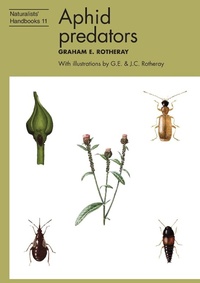
Aphid predators
Published on 1. June 2024
Book
Paperback/Softback
84 pages
978-1-78427-510-5 (ISBN)
Description
Aphids and their colonies are excellent arenas in which to observe predators in action. A range of insects come to eat or parasitise the aphids or to drink their honeydew.
9781784275105 and 9781784275167 are digital reprints of 9780855462697 (1989).
9781784275105 and 9781784275167 are digital reprints of 9780855462697 (1989).
More details
Series
Language
English
Place of publication
Exeter
United Kingdom
Target group
Professional and scholarly
Illustrations
Figures; Illustrations, black and white; 2 Plates, color
Dimensions
Height: 210 mm
Width: 148 mm
Thickness: 7 mm
Weight
178 gr
ISBN-13
978-1-78427-510-5 (9781784275105)
Copyright in bibliographic data and cover images is held by Nielsen Book Services Limited or by the publishers or by their respective licensors: all rights reserved.
Schweitzer Classification
Other editions
Previous edition
Graham E. Rotheray
Aphid predators
Book
01/1989
1st Edition
Richmond Publishing Co Ltd
€26.50
Article not available at the moment
Persons
As a child Graham Rotheray was intrigued by flies buzzing around his parents' vegetable garden, especially the hoverflies and their mimicking of wasps in order to evade birds. For his PhD he devised both laboratory and field experiments to investigate parasitic insects that attacked the larval stages of hoverflies. In 1980 he applied his expertise to a study of parasites of a major pest species in the eastern United States, the introduced gypsy moth, in an attempt to devise a biological means of controlling their spread. On returning to Britain, Graham was appointed Curator of Insects at the National Museums of Scotland in Edinburgh. He was charged with developing the collections of Diptera. He developed an interest in ancient Scottish woodlands and the hoverflies that occur there, such as the rare Callicera rufa.
Content
Introduction;
Natural History
Investigating predation
Identification: Guide to aphid species: Key I Major groups of insects found at aphid colonies; Key II Hoverflies; Key III Ladybirds; Key IV Aphid midges; Key V Flower bugs; Key VI Lacewings; Key VII Ants; Guide to ground and rove beetles
Techniques
Useful addresses; References and further reading.
Natural History
Investigating predation
Identification: Guide to aphid species: Key I Major groups of insects found at aphid colonies; Key II Hoverflies; Key III Ladybirds; Key IV Aphid midges; Key V Flower bugs; Key VI Lacewings; Key VII Ants; Guide to ground and rove beetles
Techniques
Useful addresses; References and further reading.