

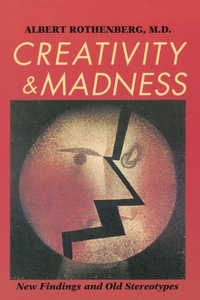
Creativity and Madness
New Findings and Old Stereotypes
Published on 27. October 1994
Book
Paperback/Softback
208 pages
978-0-8018-4977-0 (ISBN)
Description
Intrigued by history's list of "troubled geniuses,"Albert Rothenberg investigates how two such opposite conditions-outstanding creativity and psychosis-could coexist in the same individual. Rothenberg concludes that high-level creativity transcends the usual modes of logical thought-and may even superficially resemble psychosis. But he also discovers that all types of creative thinking generally occur in a rational and conscious frame of mind, not in a mystically altered or transformed state. Far from being the source-or the price-of creativity, Rothenberg discovers, psychosis and other forms of mental illness are actually hindrances to creative work. Disturbed writers and absent-minded professors make great characters in fiction, but Rothenberg has uncovered an even better story-the virtually infinite creative potential of healthy human beings.
Reviews / Votes
This intriguing theory will no doubt provoke lively debate both in and outside professional circles. For lay readers, however, the book's real pleasure lies in the substantive analyses of Sylvia Plath, August Strindberg, Emily Dickenson, Tennessee Williams, Eugene O'Neill, and William Faulkner. Wilson Library Bulletin Albert Rothenberg has devoted the major part of a distinguished career to a broad program of research on creativity. In his excellent, concise volume, he reports his current views on this fascinating subject... It is well-argued and judicious and, therefore, a useful introduction to the domain of creativity research. Journal of the American Medical AssociationMore details
Language
English
Place of publication
Baltimore, MD
United States
Target group
Professional and scholarly
Product notice
Paperback (trade)
Dimensions
Height: 229 mm
Width: 152 mm
Thickness: 13 mm
Weight
349 gr
ISBN-13
978-0-8018-4977-0 (9780801849770)
DOI
10.1353/book.98236
Copyright in bibliographic data and cover images is held by Nielsen Book Services Limited or by the publishers or by their respective licensors: all rights reserved.
Schweitzer Classification
Other editions
Additional editions
E-Book
10/1994
Johns Hopkins University Press
€19.49
Available for download

Book
10/1990
Johns Hopkins University Press
€52.19
Article not available for order
Person
Albert Rothenberg, M.D., is clinical professor of psychiatry at Harvard University and director of research at the Austen Riggs Center in Stockbridge, Massachusetts. His books include The Emerging Goddess: The Creative Process in Art, Science, and Other Fields.
Content
Acknowledgments
Chapter 1. A Scientist Looks at Creativity
Chapter 2. The Creative Process in Art and Science
Chapter 3. Inspiration and the Creative Process
Chapter 4. The Mystique of the Unconscious and Creativity
Chapter 5. Psychosis and the Creation of Poetry
Chapter 6. Self-Destruction and Self-Creation
Chapter 7. The Perils of Psychoanalyzing (or Scandalizing) Emily Dickinson
Chapter 8. The Psychosis and Triumph of August Strindberg
Chapter 9. Homosexuality and Creativity
Chapter 10. The Muse in the Bottle
Chapter 11. Eugene O'Neill's Creation of The Iceman Cometh
Chapter 12. Creativity and Mental Illness
Chapter 13. Psychotherapy and Creativity
Notes
Index
Chapter 1. A Scientist Looks at Creativity
Chapter 2. The Creative Process in Art and Science
Chapter 3. Inspiration and the Creative Process
Chapter 4. The Mystique of the Unconscious and Creativity
Chapter 5. Psychosis and the Creation of Poetry
Chapter 6. Self-Destruction and Self-Creation
Chapter 7. The Perils of Psychoanalyzing (or Scandalizing) Emily Dickinson
Chapter 8. The Psychosis and Triumph of August Strindberg
Chapter 9. Homosexuality and Creativity
Chapter 10. The Muse in the Bottle
Chapter 11. Eugene O'Neill's Creation of The Iceman Cometh
Chapter 12. Creativity and Mental Illness
Chapter 13. Psychotherapy and Creativity
Notes
Index