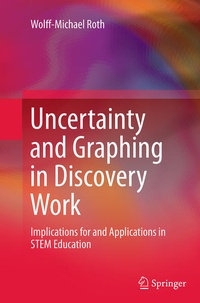
This book deals with uncertainty and graphing in scientific discovery work from a social practice perspective. It is based on a 5-year ethnographic study in an advanced experimental biology laboratory. The book shows how, in discovery work where scientists do not initially know what to make of graphs, there is a great deal of uncertainty and scientists struggle in trying to make sense of what to make of graphs. Contrary to the belief that scientists have no problem "interpreting" graphs, the chapters in this book make clear that uncertainty about their research object is tied to uncertainty of the graphs. It may take scientists several years of struggle in their workplace before they find out just what their graphs are evidence of. Graphs turn out to stand to the entire research in a part/whole relation, where scientists not only need to be highly familiar with the context from which their data are extracted but also with the entire process by means of which the natural world comes to be transformed and represented in the graph. This has considerable implications for science, technology, engineering, and mathematics education at the secondary and tertiary level, as well as in vocational training. This book discusses and elaborates these implications.
Edition
Softcover reprint of the original 1st ed. 2014
Language
Place of publication
Target group
Professional and scholarly
Illustrations
106 farbige Abbildungen, 43 s/w Abbildungen
XVII, 454 p. 149 illus., 106 illus. in color.
Dimensions
Height: 235 mm
Width: 155 mm
Thickness: 26 mm
Weight
ISBN-13
978-94-024-0103-5 (9789402401035)
DOI
10.1007/978-94-007-7009-6
Schweitzer Classification
Wolff-Michael Roth is Lansdowne Professor of Applied Cognitive Science at theUniversity of Victoria. His transdisciplinary research is concerned with knowing andlearning (cognition) across the lifespan, in formal and informal educational environments,workplace, and leisure settings. His body of work includes, among others, 60+co/authored and edited books, over 470 articles in peer-reviewed journals, and more than200 book chapters.
Preface.- PART A: INTRODUCTION.- 1. Toward a Dynamic Theory of Graphing.- PART B: GRAPHING IN A DISCOVERY SCIENCE.- 2. Radical Uncertainty in/of the Discovery Sciences.- 3. Uncertainties in/of Data Generation.- 4. Coping with Variability.- 5. Undoing Decontextualization.- 6. On Contradictions in Data Interpretation.- 7. A Scientific Revolution that Was Not.- 8. Some Lessons from Discovery Science.- PART C: RETHEORIZING GRAPHING.- 9. Graphing*-in-the-Making.- 10. Graphing in, for, and as Societal Relation.- PART D: UNCERTAINTY AND GRAPHING IN STEM EDUCATION.- 11. Uncertainty, Inquiry, Bricolage.-12. Data and Graphing in STEM Education.- PART D: EPILOGUE.- 13. Discovery Science and Authentic Learning.- Appendix.- References.- Index.