

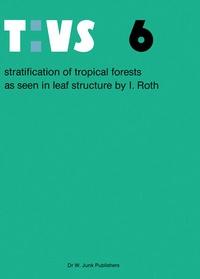
Stratification of tropical forests as seen in leaf structure
1st Edition
Published on 30. June 1984
Book
Hardback
VIII, 522 pages
978-90-6193-946-7 (ISBN)
Description
The studies presented in this volume are meant to The reason why we know relatively little about close some gaps in our knowledge of leaf anatomy inner leaf structure of trees from tropical humid of trees in tropical humid forests. Although xero forests is that the leaf anatomy of only a few species morphy of the foliage in tropical humid forests has or genera or - at the most - of an entire family has been much discussed, the statements have generally been studied in detail up to the present. Most of been based on sporadic anatomical studies of part i these studies are, therefore, of taxonomic interest. cular species or genera, a complete area of the size They cannot be included in this study because they of 155. 5 ha has certainly never been considered. do not supply the same information or amount of The present studies analyse an entire inventory of a data presented here. Anatomical studies are very time consuiming because the material first has to be given region in which the number of species and the number of individuals is very well known. This fact prepared and cut before observation can begin. In allows the elaboration of many ecological aspects, vestigation of about 50 characteristics in 230 species which was the main intention of the author.
More details
Series
Language
English
Place of publication
Dordrecht
Netherlands
Publishing group
Springer
Target group
College/higher education
Professional and scholarly
Research
Illustrations
VIII, 522 p.
Dimensions
Height: 260 mm
Width: 183 mm
Thickness: 33 mm
Weight
1183 gr
ISBN-13
978-90-6193-946-7 (9789061939467)
DOI
10.1007/978-94-009-6569-0
Schweitzer Classification
Other editions
Additional editions
E-Book
12/2012
Springer
€309.23
Available for download

Book
11/2011
Springer
€320.99
Shipment within 15-20 days
Content
1. Introduction.- 2. Source of the Material and Sample Collection.- 3. Preparation of Slides.- 4. General Observations.- Leaf morphology.- Innter leaf structure.- Structure in relation to function.- 5. Tables of the Families Studied Indicating Structural Characteristics.- Annonaceae - Capparidaceae - Violaceae - Flacourtiaceae - Vochysiaceae - Guttiferae - Quiinaceae - Sterculiaceae - Tiliaceae - Elaeocarpaceae - Humiriaceae - Malpighiaceae - Rutaceae - Simaroubaceae - Ochnaceae - Burseraceae - Meliaceae - Dichapetalaceae - Olacaceae - Opiliaceae - Celastraceae - Sapindaceae - Sabiaceae - Anacardiaceae - Mimosaceae - Caesalpiniaceae -Papilionaceae - Rosaceae - Combretaceae - Myrtaceae - Lecythidaceae - Melastomaceae - Araliaceae - Rubiaceae - Sapotaceae - Ebenaceae - Apocynaceae - Boraginaceae - Solanaceae - Bignoniaceae - Verbenaceae -.- Nyctaginaceae - Polygonaceae - Myristicaceae - Lauraceae - Euphorbiaceae - Moraceae - Lacistemaceae - Unidentified (Nigua).- 6. Description of the Families Studied Concerning Leaf Structure.- Annonaceae - Capparidaceae - Violaceae - Flacourtiaceae - Vochysiaceae - Guttiferae - Sterculiaceae - Tiliaceae - Elaeocarpaceae - Malpighiaceae - Rutaceae - Simaroubaceae - Ochnaceae - Burseraceae - Meliaceae - Dichapetalaceae - Opiliaceae - Celastraceae - Sapindaceae - Sabiaceae - Anacardiaceae - Mimosaceae - Caesalpiniaceae - Papilionaceae - Rosaceae - Combretaceae - Myrtaceae - Lecythidaceae - Melastomaceae - Rubiaceae - Sapotaceae - Ebenaceae - Apocynaceae - Boraginaceae - Solanaceae - Bignoniaceae - Verbenaceae - Nyctaginaceae - Polygonaceae - Myristicaceae - Lauraceae - Euphorbiaceae - Moraceae - Lacistemaceae.- 7. Developmental Aspects.- Development of crypts and "cornets" around the stomata - Formation of cork warts - Origin of theoblique position of palisade cells.- 8. Ecological Aspects.- Xeromorphy, succulence, and hygromorphy.- Sun and shade leaf type.- The significance of the different structural features and their ecological importance.- The progressive transformation of the hygromorphic shade leaf into the xeromorphic sun leaf.- Comparison with the cloud forest - The leathery leaf - Environmental conditions.- 9. Taxonomical Aspects.- 10. Phylogenetic Aspects.- 11. Discussion of the Most Important Results.- 12. Figures to the Text.- 13. Bibliography.- 14. Index of Scientific Plant Names.- 15. Index of vernacular plant names.- 16. General Index.