

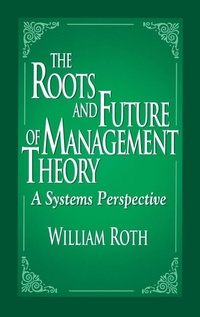
The Roots and Future of Management Theory
A Systems Perspective
1st Edition
Published on 31. August 1999
Book
Hardback
232 pages
978-1-57444-243-4 (ISBN)
Description
Interesting and easy-to-read, The Roots and Future of Management Theory: A Systems Approach provides a comprehensive overview of today's workplace -past, present ,and future. The author brings the key characters in the evolution of management theory to life. Not only will your students understand the roots of our current situation, how workplace change happens, and what forces are involved - they will see how it fits into changes in society as a whole.
There have obviously been many changes in the workplace from the Medieval Period to the present, and there will certainly be even more changes in the future. This book explores these changes and connects them to changes in: general philosophy (rationalism, empiricism, pragmatism); religious philosophy (Catholicism, Protestantism); social philosophy (Machiavellian Humanism, Christian Humanism); economic philosophy (laissez faire, Communism); and workplace philosophy (technology as a friend, technology as an enemy).
Battles have raged through the ages between these opposing forces, affecting management systems, the quality of working life, and life in general. The author discusses how this has lead to today's quest for a synthesis of the strengths of these forces, and suggests that it has been found in the systems approach. He describes what this synthesis - combined with the powers of the computer - could and should lead to in the future.
Written at a level that both graduate and undergraduate student will understand, The Roots and Future of Management Theory provides an overview of management theory. Comprehensive but not overwhelming, this textbook will give your students an understanding the changes in the workplace since the beginning of the industrial age, and offer them some insights into the changes most likely to occur in the 21st century.
There have obviously been many changes in the workplace from the Medieval Period to the present, and there will certainly be even more changes in the future. This book explores these changes and connects them to changes in: general philosophy (rationalism, empiricism, pragmatism); religious philosophy (Catholicism, Protestantism); social philosophy (Machiavellian Humanism, Christian Humanism); economic philosophy (laissez faire, Communism); and workplace philosophy (technology as a friend, technology as an enemy).
Battles have raged through the ages between these opposing forces, affecting management systems, the quality of working life, and life in general. The author discusses how this has lead to today's quest for a synthesis of the strengths of these forces, and suggests that it has been found in the systems approach. He describes what this synthesis - combined with the powers of the computer - could and should lead to in the future.
Written at a level that both graduate and undergraduate student will understand, The Roots and Future of Management Theory provides an overview of management theory. Comprehensive but not overwhelming, this textbook will give your students an understanding the changes in the workplace since the beginning of the industrial age, and offer them some insights into the changes most likely to occur in the 21st century.
More details
Language
English
Place of publication
London
United Kingdom
Publishing group
Taylor & Francis Ltd
Target group
Professional and scholarly
Professional and Professional Practice & Development
Dimensions
Height: 240 mm
Width: 161 mm
Thickness: 17 mm
Weight
523 gr
ISBN-13
978-1-57444-243-4 (9781574442434)
Copyright in bibliographic data and cover images is held by Nielsen Book Services Limited or by the publishers or by their respective licensors: all rights reserved.
Schweitzer Classification
Other editions
Additional editions
E-Book
12/2018
Routledge
€191.99
Available for download
E-Book
12/2018
Routledge
€191.99
Available for download
Person
William Roth is professor in the business department at Allentown College St. Francis de Sales. Along with Russell Ackoff, he is currently designing a Ph.D/DBA program in The Systems Approach to Organization Development. Recently, Roth was asked by the Association of Quality and Participation to take the lead in designing a national program that provides comprehensive training in the systems approach to quality improvement. He is also currently facilitating an effort to network systems thinkers and practitioners globally, as well as one to help integrate the efforts and resources of the Deming Institute, the ASQ, and the AQP in terms of community development.
Content
PART I: THE PRE-INDUSTRIAL REVOLUTION ERA
Medieval Period and the Renaissance: Developing the Basics
The Reformation: Opening the Door to Opportunity
The Enlightenment: Cornerstones for a New Socioeconomic Order
Bringing the Pre-Industrial Revolution Era into Perspective
PART II: THE INDUSTRIAL REVOLUTION
The Early Industrial Revolution: Europe Leads the Way
The Early Industrial Revolution: The United States Catches Up
The Late Industrial Revolution: Efficiency vs. Effectiveness
Bringing the Industrial Revolution Era into Perspective
PART III: THE POST-INDUSTRIAL REVOLUTION ERA
The Gathering Forces of Change
The Post-Industrial Revolution Era: Tying It All Together
The Post-Industrial Revolution Era: The Slowly Shifting Tide
Bringing the Forces That Have Driven the Evolution of Management Theory into Perspective
Bibliography
Index
Medieval Period and the Renaissance: Developing the Basics
The Reformation: Opening the Door to Opportunity
The Enlightenment: Cornerstones for a New Socioeconomic Order
Bringing the Pre-Industrial Revolution Era into Perspective
PART II: THE INDUSTRIAL REVOLUTION
The Early Industrial Revolution: Europe Leads the Way
The Early Industrial Revolution: The United States Catches Up
The Late Industrial Revolution: Efficiency vs. Effectiveness
Bringing the Industrial Revolution Era into Perspective
PART III: THE POST-INDUSTRIAL REVOLUTION ERA
The Gathering Forces of Change
The Post-Industrial Revolution Era: Tying It All Together
The Post-Industrial Revolution Era: The Slowly Shifting Tide
Bringing the Forces That Have Driven the Evolution of Management Theory into Perspective
Bibliography
Index