

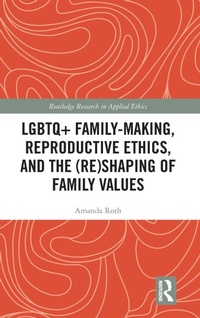
LGBTQ+ Family-Making, Reproductive Ethics, and the (Re)Shaping of Family Values
1st Edition
Will be published approx. on 29. December 2025
Book
Hardback
262 pages
978-1-032-42650-1 (ISBN)
Description
This book examines the ethical issues surrounding assisted reproductive technologies and queer family-making practices. By focusing on LGBTQ+ people and experiences in relation to procreative ethics, the book challenges dominant approaches and views in philosophical bioethics.
In Part 1 of the book, the author introduces the idea of queer epistemic privilege regarding issues of family and reproduction and applies this notion to the bioethical debates around donor conception. In Part 2, the author problematizes the typical philosophical conception of the debate over donor anonymity by centering queer perspectives and experiences. Drawing on social science research, she makes the case for "queer difference" in how donor conception is practiced and then employs this notion to show why the dominant ethical views opposing donor anonymity fail. Whereas most scholars view this issue as an issue of pure procreative/parental ethics, the book instead employs a queer perspective to draw out an alternative framing of the conflict-one between procreative/parental ethics and the moral responsibility to resist unjust social systems and norms, e.g. bionormativity. This broader framing offers a limited defense of some uses of anonymous donor gametes that is tied directly to the nature of ongoing LGBTQ+ family marginalization. Finally, in Part 3, the author draws attention to two aspects of donor conception that are common in the queer community but receive virtually no attention in the bioethical literature-known donation and donor sibling contact/relationships-and shows what we miss philosophically when these queer practices are erased from the bioethical discussions around donor conception.
LGBTQ+ Family-Making, Reproductive Ethics, and the (Re)Shaping of Family Values is an essential resource for researchers or advanced students working in Moral Philosophy-especially Reproductive Ethics, Feminist Philosophy, and LGBTQ+ philosophy-Bioethics, and Gender, Sexuality, and Women's Studies.
In Part 1 of the book, the author introduces the idea of queer epistemic privilege regarding issues of family and reproduction and applies this notion to the bioethical debates around donor conception. In Part 2, the author problematizes the typical philosophical conception of the debate over donor anonymity by centering queer perspectives and experiences. Drawing on social science research, she makes the case for "queer difference" in how donor conception is practiced and then employs this notion to show why the dominant ethical views opposing donor anonymity fail. Whereas most scholars view this issue as an issue of pure procreative/parental ethics, the book instead employs a queer perspective to draw out an alternative framing of the conflict-one between procreative/parental ethics and the moral responsibility to resist unjust social systems and norms, e.g. bionormativity. This broader framing offers a limited defense of some uses of anonymous donor gametes that is tied directly to the nature of ongoing LGBTQ+ family marginalization. Finally, in Part 3, the author draws attention to two aspects of donor conception that are common in the queer community but receive virtually no attention in the bioethical literature-known donation and donor sibling contact/relationships-and shows what we miss philosophically when these queer practices are erased from the bioethical discussions around donor conception.
LGBTQ+ Family-Making, Reproductive Ethics, and the (Re)Shaping of Family Values is an essential resource for researchers or advanced students working in Moral Philosophy-especially Reproductive Ethics, Feminist Philosophy, and LGBTQ+ philosophy-Bioethics, and Gender, Sexuality, and Women's Studies.
Reviews / Votes
"This book makes a crucial and overdue contribution to debates about donor conception. In this balanced philosophical discussion focused on the lived non-ideal reality of queer parenting, Roth gives voice to the overlooked perspective of lgbtq+ parents and families. In doing so, she draws crucial attention to the ways in which parenting is always political, and she highlights the importance of recognizing and resisting bionormativity when writing about and when making a family. As both a feminist scholar and a queer parent, I am so very grateful for her rigorous, original, and insightful discussion."Alice MacLachlan, York University, Canada
More details
Series
Language
English
Place of publication
London
United Kingdom
Publishing group
Taylor & Francis Ltd
Target group
College/higher education
Postgraduate and Undergraduate Advanced
Dimensions
Height: 235 mm
Width: 157 mm
Thickness: 20 mm
Weight
557 gr
ISBN-13
978-1-032-42650-1 (9781032426501)
Copyright in bibliographic data and cover images is held by Nielsen Book Services Limited or by the publishers or by their respective licensors: all rights reserved.
Schweitzer Classification
Other editions
Additional editions
E-Book
12/2025
Routledge
€60.49
Available for download
E-Book
12/2025
Routledge
€60.49
Available for download
Person
Amanda Roth is an Associate Professor at SUNY Geneseo in Philosophy and Gender, Sexuality, & Women's Studies. She has published on moral philosophy, queer issues, and reproductive ethics in Journal of Political Philosophy, Kennedy Institute of Ethics Journal, Hypatia, Journal of Social Philosophy, IJFAB, and Journal of Medical Ethics.
Content
Part 1: "Made with Love & Science": Making Queer Families 1. Introduction: A Queer/LGBTQ+ Perspective on Donor Conception and (Bio)Ethical Debate 2. Framing the Project of Queer Reproductive Ethics: Epistemology and Value Theory Part 2: Queer Family Values: Donor Conception, Family, and Anonymity
3. Queer Difference and Spectrums of Diversity in Donor Conception 4. The Anonymity vs. Openness Debate from a Queer Point of View 5. An Alternative Approach: Anonymous Donation as Resistance Part 3: Donor Conception and Queer Kinship 6. Queering Kinship: Known Donors and Philosophical Invisibility 7. Queering Kinship: Openness and Donor Siblings 8. Conclusion
3. Queer Difference and Spectrums of Diversity in Donor Conception 4. The Anonymity vs. Openness Debate from a Queer Point of View 5. An Alternative Approach: Anonymous Donation as Resistance Part 3: Donor Conception and Queer Kinship 6. Queering Kinship: Known Donors and Philosophical Invisibility 7. Queering Kinship: Openness and Donor Siblings 8. Conclusion