


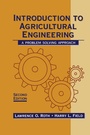
Introduction to Agricultural Engineering
2nd Edition
Published in November 1991
Book
Hardback
346 pages
978-0-442-00651-8 (ISBN)
Description
This thoroughly revised and updated second edition introduces readers to the basic principles involved in agricultural engineering and the typical problems inherent in managing the two biggest resources in any agricultural enterprise - land and mechanical devices. Air conditioning and refrigeration, materials handling, and wind and water erosion are some of the new topics that are featured. Emphasis throughout the book is on problem-solving techniques. For each topic, the authors provide basic principles and technical information and then present readers with a unique problem-solving approach. The book includes practice problems, along with necessary tables, conversion values, and equations, to aid understanding of complex problems. This book should be of interest to students of agriculture.
More details
Edition
2nd Revised edition
Language
English
Place of publication
Dordrecht
Netherlands
Publishing group
Kluwer Academic Publishers Group
Target group
College/higher education
Professional and scholarly
Edition type
Revised edition
Illustrations
8 black & white illustrations
Dimensions
Height: 230 mm
Width: 150 mm
Weight
740 gr
ISBN-13
978-0-442-00651-8 (9780442006518)
Copyright in bibliographic data is held by Nielsen Book Services Limited or its licensors: all rights reserved.
Schweitzer Classification
Other editions
Additional editions
Book
11/2012
Springer
€53.49
Shipment within 15-20 days
Persons
Content
Techniques of problem solving. Significant figures and standard form. Simple machines. Work, power, horsepower, and torque. Internal combustion engines. Power trains. Tractors and power units. Equipment efficiency and capacity. Equipment calibration. Economics of agricultural machinery. Sound and noise. Measuring distances. Land measurement. Angles and areas. Land descriptions. Surveying. Differential and profile. Topographic. Weather. Water runoff. Erosion: wind and water. Erosion control. Principles of irrigation. Management of irrigation systems. Handling, drying, and storage of biological products. Animal waste management. Heating and air conditioning. Insulation and heat transfer. Ventilation. Principles of electricity. Electrical circuits. Voltage drop and sizing conductors. Types of and selection of electric motors.