

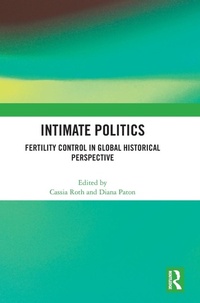
Intimate Politics
Fertility Control in Global Historical Perspective
1st Edition
Published on 23. August 2024
Book
Hardback
206 pages
978-1-032-81474-2 (ISBN)
Description
This book places the intimate experience of fertility control at the heart of political and social approaches toward women's bodies.
Across the globe, women have always controlled their fertility through intimate efforts ultimately tied to larger political processes and gendered power dynamics. Women's biological reproductive capabilities have been contested sites of power struggles, shaping the formation, rule, and dissolution of political regimes throughout history. Yet these intersections between the intimate and the political remain understudied in the historical literature. This book explores these questions from the perspective of multiple time periods, geographic locations, actors, and methods. Chapters analyze how women's individual practices of fertility control, including contraception, abortion, and infanticide, alongside methods for achieving conception and birth, intersected with larger political, economic, and cultural trends. Others problematize the ideas of 'control' in history. What did it mean to 'control one's fertility' in different historical periods and geographical regions? How did historical actors understand and practise what we now call fertility control? How can we expand conventional definitions of fertility control to interrogate ideas related to infertility, menstruation, and heteronormativity? Contributors also highlight how race, ethnicity, and class intersect with gender to shape if, and how, women and men approached fertility control. This book will be of great value to students and scholars of history including the history of the body, women's rights, and health equity, as well as the intersectionality of gender and health.
The chapters in this book were originally published as a special issue of Women's History Review.
Across the globe, women have always controlled their fertility through intimate efforts ultimately tied to larger political processes and gendered power dynamics. Women's biological reproductive capabilities have been contested sites of power struggles, shaping the formation, rule, and dissolution of political regimes throughout history. Yet these intersections between the intimate and the political remain understudied in the historical literature. This book explores these questions from the perspective of multiple time periods, geographic locations, actors, and methods. Chapters analyze how women's individual practices of fertility control, including contraception, abortion, and infanticide, alongside methods for achieving conception and birth, intersected with larger political, economic, and cultural trends. Others problematize the ideas of 'control' in history. What did it mean to 'control one's fertility' in different historical periods and geographical regions? How did historical actors understand and practise what we now call fertility control? How can we expand conventional definitions of fertility control to interrogate ideas related to infertility, menstruation, and heteronormativity? Contributors also highlight how race, ethnicity, and class intersect with gender to shape if, and how, women and men approached fertility control. This book will be of great value to students and scholars of history including the history of the body, women's rights, and health equity, as well as the intersectionality of gender and health.
The chapters in this book were originally published as a special issue of Women's History Review.
More details
Language
English
Place of publication
London
United Kingdom
Publishing group
Taylor & Francis Ltd
Target group
College/higher education
Postgraduate, Undergraduate Advanced, and Undergraduate Core
Dimensions
Height: 250 mm
Width: 175 mm
Thickness: 16 mm
Weight
564 gr
ISBN-13
978-1-032-81474-2 (9781032814742)
Copyright in bibliographic data and cover images is held by Nielsen Book Services Limited or by the publishers or by their respective licensors: all rights reserved.
Schweitzer Classification
Other editions
Additional editions
Book
approx. 12/2025
1st Edition
Routledge
€68.70
Not yet published
E-Book
08/2024
1st Edition
Routledge
€60.99
Available for download
E-Book
08/2024
1st Edition
Routledge
€60.99
Available for download
Persons
Cassia Roth is Associate Professor in the Department of Society, Environment, and Health Equity at the University of California, Riverside, USA. She is the author of A Miscarriage of Justice: Women's Reproductive Lives and the Law in Early Twentieth-Century Brazil and articles in Gender & History, Journal of Women's History, Slavery & Abolition, Medical History, and Historia, Ciencias, Saude - Manguinhos, among others. She has an MPH in Epidemiology and a PhD in History.
Diana Paton is William Robertson Professor of History at the University of Edinburgh. Her books include No Bond but the Law: Punishment, Race and Gender in Jamaican State Formation, 1780-1870, and The Cultural Politics of Obeah: Religion, Colonialism and Modernity in the Caribbean World.
Diana Paton is William Robertson Professor of History at the University of Edinburgh. Her books include No Bond but the Law: Punishment, Race and Gender in Jamaican State Formation, 1780-1870, and The Cultural Politics of Obeah: Religion, Colonialism and Modernity in the Caribbean World.
Content
Introduction 1. Fertility control in ancient Rome 2. Who's in control? Varying and changing translations of 'birth control' in Japan 3. 'Performing public piety:' Infanticide and reproductive agency in Reformation Spain 4. The many meanings of aborto: Pregnancy termination and the instability of a medical category over time 5. Debates on family planning and the contraceptive pill in the Irish magazine Woman's Way, 1963-1973 6. Bringing the law home: Abortion, reproductive coercion, and the family in early twentieth-century China 7. In the family way: Incest, fertility control, and the power of the patriarchal family in Brazil 8. 'It is impossible to judge the extent to which the crime is prevalent': Infanticide and the law in India, 1870-1926 9. Embodied sources: abortion, medicine, and the law in early twentieth-century British Guiana Afterword: Governing reproduction