

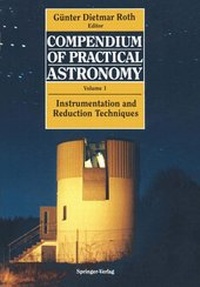
Compendium of Practical Astronomy
Volume 1: Instrumentation and Reduction Techniques
Published on 7. October 1994
Book
Paperback/Softback
XXIV, 540 pages
978-3-540-53596-6 (ISBN)
Description
It is a pleasure to present this work, which has been well received in German-speaking countries through four editions, to the English-speaking reader. We feel that this is a unique publication in that it contains valuable material that cannot easily-if at all-be found elsewhere. We are grateful to the authors for reading through the English version of the text, and for responding promptly (for the most part) to our queries. Several authors have supplied us, on their own initiative or at our suggestion, with revised and updated manuscripts and with supplementary English references. We have striven to achieve a translation of Handbuch for Sternfreunde which accurately presents the qualitative and quantitative scientific principles con tained within each chapter while maintaining the flavor of the original Ger man text. Where appropriate, we have inserted footnotes to clarify material which may have a different meaning and/or application in English-speaking countries from that in Germany. When the first English edition of this work, Astronomy: A Handbook (translated by the late A. Beer), appeared in 1975, it contained 21 chapters. This new edition is over twice the length and contains 28 authored chap ters in three volumes. At Springer's request, we have devised a new title, Compendium of Practical Astronomy, to more accurately reflect the broad spectrum of topics and the vast body of information contained within these pages.
More details
Language
English
Place of publication
Heidelberg
Germany
Publishing group
Springer Berlin
Target group
College/higher education
Illustrations
51
2 farbige Abbildungen, 51 s/w Tabellen
153 illustrations, 51 tables
Dimensions
Height: 24.4 cm
Width: 17 cm
Weight
1035 gr
ISBN-13
978-3-540-53596-6 (9783540535966)
DOI
10.1007/978-3-642-45688-6
Schweitzer Classification
Other editions
Additional editions
E-Book
12/2012
Springer
€82.38
Available for download
Persons
Content
of Volume 1.- 1 Introduction to Astronomical Literature and Nomenclature.- 1.1 Astronomy and the Observer.- 1.2 The Astronomy Library.- 1.3 Catalogues and Maps.- 1.4 Almanacs.- 1.5 Reduction of Observations.- 2 Fundamentals of Spherical Astronomy.- 2.1 Introduction.- 2.2 The Coordinates.- 2.2.1 Geographic Coordinates.- 2.2.2 Horizontal Coordinates.- 2.2.3 The Equatorial System, Vernal Equinox, and Sidereal Time.- 2.2.4 Transformation of Horizontal Coordinates into Equatorial Coordinates and Vice Versa.- 2.2.5 Other Coordinate Systems.- 2.3 Time and the Phenomena of Daily Motion.- 2.3.1 True and Mean Solar Time.- 2.3.2 The Relation Between Sidereal Time and Mean Time.- 2.3.3 Other Phenomena of Diurnal Motion.- 2.4 Changes in the Coordinates of a Star.- 2.4.1 Proper Motion.- 2.4.2 Precession and Nutation.- 2.4.3 Aberration.- 2.4.4 Parallax.- 2.4.5 Reduction of Mean Position to Apparent Position.- 2.5 Problems of the Calendar and Time Zones.- 2.5.1 The Calendar and the Measurement of Years.- 2.5.2 The Length and Beginning of the Year.- 2.5.3 The Julian Date and the Beginning of the Mean Day.- 2.5.4 Time Zones and the Date Line.- 2.6 The Variability of the Time Systems.- 2.6.1 Various Causes for Changes in the Length of the Day.- 2.6.2 Astronomical Effects of the Variable Rotation of the Earth.- 2.7 Spherical Trigonometry.- 2.7.1 Fundamental Equations.- 2.7.2 Derived Equations.- 2.7.3 The Right-Angled Spherical Triangle.- References.- 3 Applied Mathematics and Error Theory.- 3.1 Introduction.- 3.1.1 Pocket Calculators.- 3.1.2 Computers.- 3.2 The Theory of Errors.- 3.2.1 Direct Observations.- 3.2.2 Indirect Observations.- 3.3 Interpolation and Numerical Differentiation and Integration.- 3.4 Photographic Astrometry.- 3.5 Determination of the Position and Brightness of Planets and of the Planetographic Coordinates.- 3.6 The Reduction of Stellar Occultations.- References.- 4 Optical Telescopes and Instrumentation.- 4.1 Introduction.- 4.2 Basics of Optical Computation.- 4.2.1 Ray Tracing and Sign Convention.- 4.2.2 The Cardinal Points of an Optical System.- 4.2.3 Pupils and Stops.- 4.3 Imaging Errors.- 4.3.1 Seidel Formulae.- 4.3.2 The Primary Aberrations.- 4.3.3 Chromatic Aberrations.- 4.4 Methods of Optical Testing.- 4.4.1 Surface Manufacturing of Optical Quality Surfaces.- 4.4.2 Determination of Focal Length.- 4.4.3 The Hartmann Test.- 4.4.4 Foucault's Knife-Edge Test.- 4.4.5 Interferometric Tests.- 4.5 Telescope Systems.- 4.5.1 Refractors.- 4.5.2 The Newtonian Reflector.- 4.5.3 The Cassegrain Telescope.- 4.5.4 The Ritchey-Chrétien System.- 4.5.5 The Schiefspiegler.- 4.5.6 The Schmidt Camera.- 4.5.7 Schmidt-Cassegrain Systems.- 4.5.8 Maksutov Systems.- 4.5.9 Instruments for Solar Observations.- 4.6 Telescope Performance.- 4.6.1 Resolving Power.- 4.6.2 Magnification and Field of View.- 4.6.3 Image Brightness and Limiting Magnitude.- 4.7 Accessories.- 4.7.1 Eyepieces.- 4.7.2 The Barlow Lens.- 4.7.3 Tube and Dewcap.- 4.7.4 Finding and Guiding Telescopes.- 4.7.5 Eyepiece Micrometers.- 4.7.6 The Photometer.- 4.7.7 The Spectrograph and the Spectroscope.- 4.7.8 Sun Projection Screens.- 4.7.9 The Clock.- 4.8 Visual Observations.- 4.8.1 The Eye.- 4.8.2 Binoculars.- 4.9 Photographic Plates and Photoelectric Detectors.- 4.9.1 Astrophotographs and Their Limitations.- 4.9.2 Photomultipliers.- 4.9.3 Charge-Coupled Devices-CCDs.- 4.10 Services for Telescopes and Accessories.- References.- 5 Telescope Mountings, Drives, and Electrical Equipment.- 5.1 Introduction.- 5.2 Basic Types of Telescope Mountings.- 5.2.1 The Alt-Azimuthal or Horizontal Mounting.- 5.2.2 The Parallactic or Equatorial Mount.- 5.3 General Design Criteria.- 5.3.1 The General Mechanical Context and the Design Catechism.- 5.3.2 Basic Criteria for Telescope Mountings Regarding Statics, Kinetics, and Kinematics.- 5.4 Static Criteria of Telescope Mountings.- 5.4.1 Stiffness as the Static Characteristic of Telescope Mountings.- 5.4.2 Stiffness as a Design and Layout Quantity.- 5.4.3 The Modulus of Elasticity.- 5.5 Shafts and Bearings.- 5.5.1 Stiffness of Bearings.- 5.5.2 Stresses on the Declination Axis.- 5.5.3 Friction Bearings.- 5.5.4 Antifriction Bearings.- 5.5.5 Stiffness of Antifriction Bearings.- 5.5.6 Stiffness and Distance Between Bearings.- 5.6 The Foundation and Stability Against Tilting.- 5.7 Joining Elements.- 5.8 Measuring the Stiffness.- 5.9 Telescope Vibrations.- 5.9.1 Principles of Mechanical Oscillations.- 5.9.2 The Mounting as Oscillator Chain and Mechanical Low-Pass Filter.- 5.10 Kinematic Aspects of Telescope Mountings.- 5.10.1 General Criteria and Instrument Errors.- 5.10.2 The Accuracy of Manufacture of Mechanical Parts.- 5.11 Drives in Right Ascension and Declination.- 5.11.1 General Considerations.- 5.11.2 The Mechanics of Drives.- 5.11.3 Drive Motors.- 5.11.4 The Control Circuit of Telescope Drives.- 5.11.5 Control Electronics for Synchronous Motor Drives.- 5.11.6 Control Electronics for Stepping Motor Drives.- 5.11.7 Circuitry for Microstep Operation.- 5.11.8 Control Electronics for DC Operation.- 5.12 Photoelectric Guiding Systems.- 5.12.1 Direct and Off-Axis Guiding.- 5.12.2 The Guiding Head.- 5.12.3 Light Receivers.- 5.12.4 Signal Processing and Control Electronics.- 5.13 Adjust Elements and Telescope Alignment on the Celestial Pole.- 5.13.1 Adjustment Elements.- 5.13.2 Adjustment of the Axis System by the Scheiner Method.- 5.14 The Setting Circles and Their Adjustment.- 5.14.1 Setting Circles.- 5.14.2 Adjustment of the Circles.- 5.14.3 Digital Position Displays.- 5.15 Electrical Equipment.- 5.15.1 Power Sources and Safety Aspects.- 5.15.2 Batteries: Properties and Hazards.- 5.15.3 Power Supplies for Electronic Circuits.- 5.15.4 Illumination.- 5.15.5 The Dewcap and Its Heating.- 5.16 Comments on Literature Cited Here and in the Supplemental Reading List.- References.- 6 Astrophotography.- 6.1 Introduction.- 6.2 Cameras and Lenses.- 6.2.1 Single-Lens Reflex Cameras.- 6.2.2 Medium and Large-Sized Cameras.- 6.2.3 Other Cameras.- 6.2.4 Refractors.- 6.2.5 Reflectors.- 6.2.6 Special Optics for Astrophotography.- 6.2.7 Video Cameras, Image Intensifies, CCDs.- 6.3 General Considerations.- 6.3.1 Focusing.- 6.3.2 Modification of the Primary Focal Length.- 6.3.3 Guiding.- 6.3.4 Polar Alignment.- 6.3.5 Miscellaneous.- 6.4 Stationary Cameras.- 6.4.1 Trails, Constellations, Planetary Conjunctions.- 6.4.2 Atmospheric Phenomena.- 6.4.3 Meteors.- 6.4.4 Eclipses.- 6.4.5 Artificial Satellites.- 6.5 Tracking Cameras.- 6.5.1 Focal Lengths f ? 500.- 6.5.2 Lunar Halos.- 6.5.3 Planetary Moons.- 6.5.4 Comets and Minor Planets.- 6.5.5 Eclipses.- 6.5.6 Deep Sky.- 6.5.7 Spectrography.- 6.5.8 Zodiacal Light and Gegenschein.- 6.6 Long-Focus Astrophotography.- 6.6.1 Instrumental Requirements.- 6.6.2 Moon, Sun, and Planets.- 6.6.3 Moons of Planets.- 6.6.4 Comets.- 6.6.5 Deep Sky.- 6.7 Films for Astrophotography.- 6.7.1 Film Formats.- 6.7.2 Physical Composition of the Film and Formation of the Latent Image.- 6.7.3 The Characteristic Curve.- 6.7.4 Film Sensitivity.- 6.7.5 Astrophotography with Filters.- 6.7.6 Low-Intensity Reciprocity Failure (LIRF).- 6.7.7 Resolving Power.- 6.7.8 Recommended Films.- 6.7.9 Storage of Films.- 6.7.10 Film Development.- 6.7.11 Sensitization of Films.- 6.8 Advanced Darkroom Techniques.- 6.8.1 Darkroom Equipment.- 6.8.2 Black-and-White Paper.- 6.8.3 Color Processing.- 6.8.4 Special Techniques.- 6.9 Photographic Limiting Magnitude.- 6.9.1 Recorded Photographic Limiting Magnitude m.- 6.9.2 Maximum Photographic Magnitude Limit mlim.- 6.9.3 Maximum Exposure Time tmax.- 6.9.4 The Standard Sequence for Determining the Limiting Magnitude.- 6.10 Further Reading.- References.- 7 Fundamentals of Spectral Analysis.- 7.1 Introduction.- 7.2 The Theory of Spectra.- 7.2.1 The Laws of Radiation.- 7.2.2 The Line Spectrum.- 7.2.3 Excitation and Ionization.- 7.3 The Objects of Spectral Studies.- 7.3.1 Stars.- 7.3.2 The Sun.- 7.3.3 Planets and Moons.- 7.3.4 Comets.- 7.3.5 Meteors.- 7.4 Spectroscopic Instruments.- 7.4.1 The Methods of Spectral Dispersion.- 7.4.2 The Design of a Spectral Instrument.- 7.4.3 Radiation Detectors.- 7.4.4 Designs, Hints for Operation, and Accessories.- 7.5 The Analysis.- 7.5.1 Spectral Classification.- 7.5.2 Line Changes.- 7.5.3 Radial Velocities.- 7.5.4 Color Temperatures.- 7.5.5 Equivalent Widths and Line Profiles.- References.- 8 Principles of Photometry.- 8.1 Introduction.- 8.1.1 General Description and Historical Overview.- 8.1.2 Units of Brightness.- 8.1.3 The Receivers.- 8.2 Limits and Accuracies of Photometric Measurements.- 8.3 Astronomical Color Systems.- 8.4 The Technique and Planning of Observations.- 8.4.1 Point Photometry and Surface Photometry.- 8.4.2 Visual Photometry: Differential Observations.- 8.4.3 Photoelectric Photometry: Differential Observations.- 8.4.4 Absolute Photoelectric Photometry.- 8.4.5 Photometry of Occultations.- 8.4.6 Visual, Photographic, and Electronic Surface Photometry.- 8.5 Reduction Techniques.- 8.5.1 Reduction of Photometric Measurements-Generalities.- 8.5.2 Reduction of Photographic Observations-Generalities.- 8.5.3 Reduction of Digital Images-Generalities.- 8.5.4 The Reduction of Time: the Heliocentric Correction.- 8.5.5 Determination of Minimum Light Times and of Periods.- 8.6 Photometry of Different Astronomical Objects - Generalities.- 8.6.1 Photometry of Solar System Objects.- 8.6.2 Stellar Photometry.- 8.6.3 Surface Photometry.- 8.7 Construction or Purchase of Receivers and Equipment for Reductions.- 8.7.1 Advice on the Purchase of Photometers.- 8.7.2 Advice on the Construction of Photometers.- 8.8 General Literature on Photometry.- References.- 9 Fundamentals of Radio Astronomy.- 9.1 Introduction.- 9.2 Radio Radiation.- 9.2.1 Thermal Radiation.- 9.2.2 Nonthermal Radiation.- 9.3 Atmospheric Influences.- 9.3.1 The Ionosphere.- 9.3.2 The Troposphere.- 9.3.3 Artificial Interference and Protected Frequencies.- 9.4 Instrumentation.- 9.4.1 Antennas.- 9.4.2 Radio Receivers.- 9.4.3 The Computer.- 9.5 The Objects of Observation.- 9.5.1 Continuous Radiation.- 9.5.2 Spectral Lines.- 9.6 Tested Observing Systems.- 9.6.1 Solar Flare Monitoring.- 9.6.2 Jovian Bursts.- 9.6.3 A Model Interferometer.- 9.6.4 FM and Television Receivers.- 9.6.5 Satellite Receivers.- 9.6.6 Evaluation.- 9.7 Amateur Radio Astronomy Groups.- References.- 10 Modern Sundials.- 10.1 Introduction.- 10.2 The Equinoxial Dial.- 10.3 Horizontal Dials and Vertical East-West Dials.- 10.3.1 Computations.- 10.3.2 Graphical Construction.- 10.4 The Vertical Deviating Dial.- 10.4.1 Determination of the Azimuth of the Wall.- 10.4.2 Calculation of the Dial at the Wall.- 10.4.3 Construction of the Calculated Dial Face at the Wall.- 10.4.4 Inserting the Style.- 10.5 Designs for Higher Accuracy.- 10.5.1 Correction for Geographic Longitude.- 10.5.2 Correction for the Equation of Time.- References.- 11 An Historical Exploration of Modern Astronomy.- 11.1 Introduction.- 11.2 The Heliocentric System.- 11.3 Evolution of the Theory of Motions.- 11.4 Cataloguing the Stellar Sky.- 11.5 Astrophysics.- 11.5.1 Stellar Photometry.- 11.5.2 Spectroscopy of the Sun and Stars.- 11.5.3 Astronomical Photography.- 11.5.4 Large Telescopes.- 11.6 Stellar Evolution and Stellar Systems.- 11.6.1 Stellar Evolution.- 11.6.2 Stellar Systems.- 11.7 Observations at Invisible Wavelengths and Space Exploration.- 11.8 Research in Historical Astronomy.- 11.8.1 Research Problems.- 11.8.2 Sources.- 11.8.3 Processing.- References.- 12 Astronomy Education and Instructional Aids.- 12.1 Introduction.- 12.2 Formal Astronomy Education.- 12.2.1 The Education of Professional Astronomers: An Overview.- 12.2.2 Pre-College/University Preparation.- 12.2.3 Astronomy at the College/University Level.- 12.2.4 Astronomy at the Graduate Level.- 12.2.5 Postdoctoral Positions.- 12.2.6 Vocational Opportunities.- 12.2.7 Interdisciplinary Approaches to Astronomy.- 12.2.8 Comments on Astrology.- 12.3 Facilities and Services Available to Schools and the General Public.- 12.3.1 Planetariums, Museums, and Exhibits.- 12.3.2 Observatories and Research Laboratories.- 12.3.3 Lectures.- 12.3.4 Workshops and Other Programs.- 12.3.5 Where to Find Information on Astronomy as a Career.- 12.3.6 Films on Astronomy as a Career.- 12.3.7 Astronomical Societies and Clubs.- 12.3.8 Inns and Travel Tours.- 12.3.9 Astronomy Books for the Visually Handicapped.- 12.4 Educational Resources in Astronomy.- 12.4.1 Mechanical Models and Exhibit Items.- 12.4.2 Audio-visual Media.- 12.4.3 Broadcasting and Communications.- 12.4.4 Computers and Software.- 12.4.5 Printed Material.- 12.4.6 Games.- 12.4.7 Music.- References.- Appendix A: Educational Resources in Astronomy.- A.1 Planetariums, Museums, and Exhibits.- A.2 Observatories and Research Laboratories.- A.3 Astronomical Societies and Clubs.- A.4 General List of Sources for Mechanical Models and Exhibit Items.- A.5 General List of Sources for Audio-Visual Aids.- A.6 Telescopes and Observing Equipment.- A.7 Printed Materials.- Supplemental Reading List for Vol. 1.