

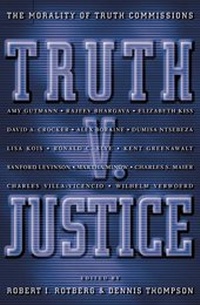
Truth v. Justice
The Morality of Truth Commissions
Published on 3. September 2000
Book
Hardback
296 pages
978-0-691-05071-3 (ISBN)
Description
The truth commission is an increasingly common fixture of newly democratic states with repressive or strife-ridden pasts. From South Africa to Haiti, truth commissions are at work with varying degrees of support and success. To many, they are the best - or only - way to achieve a full accounting of crimes committed against fellow citizens and to prevent future conflict. Others question whether a restorative justice that sets the guilty free, that cleanses society by words alone, can deter future abuses and allow victims and their families to heal. Here, leading philosophers, lawyers, social scientists, and activists representing several perspectives look at the process of truth commissioning in general and in post-apartheid South Africa. They ask whether the truth commission, as a method of seeking justice after conflict, is fair, moral, and effective in bringing about reconciliation. The authors weigh the virtues and failings of truth commissions, especially the South African Truth and Reconciliation Commission, in their attempt to provide restorative rather than retributive justice.
They examine, among other issues, the use of reparations as social policy and the granting of amnesty in exchange for testimony. Most of the contributors praise South Africa's decision to trade due process for the kinds of truth that permit closure. But they are skeptical that such revelations produce reconciliation, particularly in societies that remain divided after a compromise peace with no single victor, as in El Salvador. Ultimately, though, they find the truth commission to be a worthy if imperfect instrument for societies seeking to say "never again" with confidence. At a time when truth commissions have been proposed for Bosnia, Kosovo, Cyprus, East Timor, Cambodia, Nigeria, Palestine, and elsewhere, the authors' conclusion that restorative justice provides positive gains could not be more important. In addition to the editors, the contributors are Amy Gutmann, Rajeev Bhargava, Elizabeth Kiss, David A. Crocker, Andre du Toit, Alex Boraine, Dumisa Ntsebeza, Lisa Kois, Ronald C. Slye, Kent Greenawalt, Sanford Levinson, Martha Minow, Charles S. Maier, Charles Villa-Vicencio, and Wilhelm Verwoerd.
They examine, among other issues, the use of reparations as social policy and the granting of amnesty in exchange for testimony. Most of the contributors praise South Africa's decision to trade due process for the kinds of truth that permit closure. But they are skeptical that such revelations produce reconciliation, particularly in societies that remain divided after a compromise peace with no single victor, as in El Salvador. Ultimately, though, they find the truth commission to be a worthy if imperfect instrument for societies seeking to say "never again" with confidence. At a time when truth commissions have been proposed for Bosnia, Kosovo, Cyprus, East Timor, Cambodia, Nigeria, Palestine, and elsewhere, the authors' conclusion that restorative justice provides positive gains could not be more important. In addition to the editors, the contributors are Amy Gutmann, Rajeev Bhargava, Elizabeth Kiss, David A. Crocker, Andre du Toit, Alex Boraine, Dumisa Ntsebeza, Lisa Kois, Ronald C. Slye, Kent Greenawalt, Sanford Levinson, Martha Minow, Charles S. Maier, Charles Villa-Vicencio, and Wilhelm Verwoerd.
Reviews / Votes
This is an important book for those interested in contemporary efforts to deal with modern atrocities... Booklist Truth v. Justice focuses on the most promising device our civilization has invented to remedy that ... shortfall of justice. -- Geoffrey Best Times Literary Supplement The essays themselves are accessible [and]... the result is a comprehensive and thought-provoking analysis of the truth commission. -- Karen Newirth International Law and Politics A highly civilized, lively and provocative exchange between interesting people of diverse backgrounds and positions. -- Saul Smilansky Times Literary SupplementMore details
Series
Language
English
Place of publication
New Jersey
United States
Target group
Professional and scholarly
College/higher education
Product notice
Trade binding
Dimensions
Height: 229 mm
Width: 152 mm
Weight
595 gr
ISBN-13
978-0-691-05071-3 (9780691050713)
Copyright in bibliographic data and cover images is held by Nielsen Book Services Limited or by the publishers or by their respective licensors: all rights reserved.
Schweitzer Classification
Other editions
Additional editions
E-Book
06/2015
1st Edition
Princeton University Press
€199.95
Available for download
Persons
Robert I. Rotberg is President of the World Peace Foundation and Director of the Program on Intrastate Conflict at Harvard's Kennedy School. He is author or editor of dozens of books on Africa, Asia, and the Caribbean, including Creating Peace in Sri Lanka: Civil War and Reconciliation (1999), War and Peace in Southern Africa (1998), Vigilance and Vengeance: NGOs Preventing Ethnic Conflict in Divided Societies (1996), and The Founder: Cecil Rhodes and the Pursuit of Power (1988). Dennis Thompson is Alfred North Whitehead Professor of Political Philosophy and Director of the Program in Ethics and the Professions at Harvard University. He is author of Political Ethics and Public Office (1987) and coauthor, with Amy Gutmann, of Democracy and Disagreement (1996).
Content
Acknowledgments vii I. Truth Commissions and the Provision of Truth, Justice, and Reconciliation by Robert I. Rotbtrg 3 II. The Moral Foundations of Truth Commissions by Amy Gutmann and Dennis Thompson 22 III. Restoring Decency to Barbaric Societies by Rajeev Bhargava 45 IV Moral Ambition Within and Beyond Political Constraints: Reflections on Restorative Justice by Elizabeth Kiss 68 V Truth Commissions, Transitional Justice, and Civil Society by David A Crockcr 99 VI. The Moral Foundations of the South African TRC: Truth as Acknowledgment and Justice as Recognition by Andre du Toit 122 VII. Truth and Reconciliation in South Africa: The Third Way by Alex Boraine 141 VIII. The Uses of Truth Commissions: Lessons for the World by Dumisa B. Ntsebexa 158 IX. Amnesty, Truth, and Reconciliation: Reflections on the South African Amnesty Process by Ronald C. Slye 170 X. Amnesty's Justice by Kent Greenawalt 189 XI. Trials, Commissions, and Investigating Committees: The Elusive Search for Norms of Due Process by Sanford Levinson 211 XII. The Hope for Healing: What Can Truth Commissions Do? by Martha Minow 235 XIII. Doing History, Doing Justice: The Narrative of the Historian and of the Truth Commission by Charles S. Mater 261 XIV Constructing a Report: Writing Up the "Truth" by Charles Villa-Yicencio and Wilhelm Yerwoerd 279 The Contributors 295 Index 299