

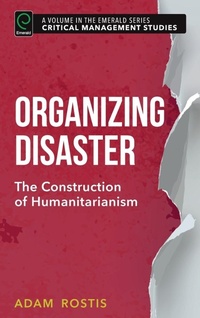
Organizing Disaster
The Construction of Humanitarianism
Published on 15. March 2016
Book
Hardback
168 pages
978-1-78560-685-4 (ISBN)
Description
This book challenges the taken-for-granted status of organizations such as the Red Cross and Medecins Sans Frontieres by problematizing humanitarianism. In the experience of the Author working with such organizations, they are selective of the type of suffering that receives attention. Empirical studies of humanitarianism note that the suffering it purports to alleviate is increasing although aid is now highly organized, funded, and globalized. These observations inform the key question of the book: what purpose does the humanitarian organization serve? Rostis explores this question through a Foucauldian genealogy of humanitarianism focusing on the European colonial era and the Biafra War. The role of colonialism in the humanitarian organization is made apparent, and facilitates an interpretation of the results of his inquiry using postcolonial theory. This unique contribution to organization studies re-reads humanitarianism to show that humanitarian organizations essentially serve as global disciplinary institutions. It will be essential reading for scholars in political science, international sociology, organization studies and international affairs.
Reviews / Votes
Rostis takes a postcolonial theoretical stance and includes a postcolonial analysis of the Red Cross and Medicins sans Frontieres as case studies in the emergence of organized global humanitarianism. By incorporating the discourse of humanitarianism into stakeholder theory and "business and society" research, he expands his investigation by problematizing what has been up to now an unproblematic conceptualization of the nonprofit organization as an unquestionable good. He elaborates on the discourse of humanitarianism demonstrating some counterintuitive behaviors of these two well-known humanitarianism organizations. He cites the impetus for his book as twofold: first, the need to understand the paradoxical behavior of humanitarian organizations that he observed while working for the International Red Cross in Africa; and, second, the lack of coverage by scholars of the humanitarian organization itself. He characterizes humanitarian responses as frequently late in coming and of being selective. While humanitarian aid is now more organized, funded, and globalized, he finds that the need to alleviate suffering can be trumped by the need to save political capital, economic resources and staff for areas of the world that are more central to national security interests. -- Annotation * (protoview.com) *More details
Series
Language
English
Place of publication
Bingley
United Kingdom
Publishing group
Emerald Publishing Limited
Target group
Professional and scholarly
College/higher education
Dimensions
Height: 235 mm
Width: 157 mm
Thickness: 14 mm
Weight
403 gr
ISBN-13
978-1-78560-685-4 (9781785606854)
Copyright in bibliographic data and cover images is held by Nielsen Book Services Limited or by the publishers or by their respective licensors: all rights reserved.
Schweitzer Classification
Other editions
Additional editions
E-Book
03/2016
Emerald Publishing Limited
€88.99
Available for download
Person
Content
1. Introduction and Outline of the Book
2. Methodology
3. Problematizing Humanitarianism
4. The Humanitarian Archive - The ICRC in Africa
5. MSF
6. Discussion
7. Conclusion
2. Methodology
3. Problematizing Humanitarianism
4. The Humanitarian Archive - The ICRC in Africa
5. MSF
6. Discussion
7. Conclusion