

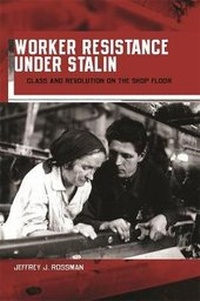
Worker Resistance under Stalin
Class and Revolution on the Shop Floor
Published on 1. November 2005
Book
Hardback
326 pages
978-0-674-01926-3 (ISBN)
Description
Challenging the claim that workers supported Stalin's revolution "from above" as well as the assumption that working-class opposition to a workers' state was impossible, Jeffrey Rossman shows how a crucial segment of the Soviet population opposed the authorities during the critical industrializing period of the First Five-Year Plan.
Marshaling an impressive range of archival evidence, Rossman recounts in vivid detail myriad individual and collective acts of protest, including mass demonstrations, food riots, strikes, slowdowns, violent attacks against officials, and subversive letters to the authorities. Male and female workers in one of Russia's oldest, largest, and "reddest" manufacturing centers--the textile plants of the Ivanovo Industrial Region--actively resisted Stalinist policies that consigned them to poverty, illness, and hunger.
In April 1932, 20,000 mill workers across the region participated in a wave of strikes. Seeing the event as a rebuke to his leadership, Stalin dispatched Lazar Kaganovich to quash the rebellion, resulting in bloodshed and repression. Moscow was forced to respond to the crisis on the nation's shop floors with a series of important reforms.
Rossman uncovers a new dimension to the relationship between the Soviet leadership and working class and makes an important contribution to the debate about the nature of resistance to the Stalinist regime.
Marshaling an impressive range of archival evidence, Rossman recounts in vivid detail myriad individual and collective acts of protest, including mass demonstrations, food riots, strikes, slowdowns, violent attacks against officials, and subversive letters to the authorities. Male and female workers in one of Russia's oldest, largest, and "reddest" manufacturing centers--the textile plants of the Ivanovo Industrial Region--actively resisted Stalinist policies that consigned them to poverty, illness, and hunger.
In April 1932, 20,000 mill workers across the region participated in a wave of strikes. Seeing the event as a rebuke to his leadership, Stalin dispatched Lazar Kaganovich to quash the rebellion, resulting in bloodshed and repression. Moscow was forced to respond to the crisis on the nation's shop floors with a series of important reforms.
Rossman uncovers a new dimension to the relationship between the Soviet leadership and working class and makes an important contribution to the debate about the nature of resistance to the Stalinist regime.
Reviews / Votes
With this challenging and deeply researched book, Jeffrey Rossman helps establish the paradigm of 'resistance' in Soviet historiography. He shows that among textile workers class consciousness and discourse continued to live well into the Soviet era. Rossman argues that collective memory of earlier struggles shaped social identity, political activism, indeed the entire relationship of workers to Soviet power in the Central Industrial Region. -- Daniel Orlovsky, Southern Methodist University This outstanding work challenges many of the more paradigmatic interpretations of the relationship between the Stalinist leadership and its working class. Worker Resistance under Stalin will make a major statement and provoke some much needed controversy around this question. -- Donald Filtzer, University of East London From roughly 1928 to 1932 the Ivanovo Industrial Region (IIR) became the epicenter of worker resistance to Stalin's "revolution from above." In this powerful and highly original study, Jeffrey Rossman narrates how the region's textile workers responded to Stalin's crash industrialization program with strikes, slowdowns, sabotage, and demonstrations, culminating in April 1932 in an "uprising" in Vichuga, when 17,500 strikers attacked the headquarters of the police, OGPU, and party, which resulted in two deaths and a couple of dozen injuries. On the basis of exhaustive work in local and national archives, including the regional archives of the Federal State Security Service, Rossman reconstructs with exemplary acuity the impact of intensified workloads, wage arrears, shutdowns, and the deterioration of equipment upon the lives of IIR textile workers...A fine study that vindicates the importance of 'resistance' as a category for understanding Soviet realities against certain recent efforts to deny its very possibility. -- S. A. Smith * Russian Review * This meticulously researched and clearly argued account of industrial relations during First Five-Year Plan emphasizes workers' own actions and sentiments and is therefore a refreshing addition to a field that has declined so markedly over the last decade. Jeffrey Rossman's Worker Resistance under Stalin challenges the largely pre-archival "revisionist" historiography that claimed proletarian support for Stalin's revolution...The power of this volume lies in its superb research and captivating narrative. Rossman worked extensively in eight archives (with citations from 160 files) but it is not so much the quantity of the research as its quality that is so impressive...A groundbreaking contribution to the field. Rossman has single-handedly destroyed the myth that it was impossible for workers to resist Stalin. He has also allowed workers' own voices to refute the absurd notion that they welcomed such brutal policies and supported Stalinism. Worker Resistance under Stalin provides the essential comparative baseline for understanding why the generalized working-class anger did not escalate into rebellion. -- Kevin Murphy * Revolutionary Russia * Jeffrey Rossman's well researched and passionately written book on the resistance of the textile workers to Stalin's industrialization contributes to a number of issues that are the subject of heated debate in the historiography of Stalinism: the mechanisms of a genesis of social resistance to the regime, its extent, effects, dimensions and limits, and the process and sources of the construction of identities. The book explores, among other major issues, the evolution of forms of worker protest; the emergence of patterns of resistance; the impact of workers's struggle on central power policies; the reasons for the failure of shopfloor resistance; the divisions between the workers caused by resistance; the role of a worker leader; and the degree of the (un)development of a political consciousness among workers, to name just a few...Rossman's thorough research in the regional and central archives of Russia has produced a wonderful result--a vivid, intense, colourful and complex story of the worker struggle not just for bread but also for the preservation of the shopfloor democracy and self preservation of the working class as a political group. -- Elena A. Osokina * International Review of Social History *More details
Series
Language
English
Place of publication
Cambridge, Mass
United States
Target group
Professional and scholarly
US School Grade: College Graduate Student
Illustrations
9 halftones, 2 maps
Dimensions
Height: 235 mm
Width: 156 mm
ISBN-13
978-0-674-01926-3 (9780674019263)
Copyright in bibliographic data and cover images is held by Nielsen Book Services Limited or by the publishers or by their respective licensors: all rights reserved.
Schweitzer Classification
Other editions
Additional editions
E-Book
07/2009
Harvard University Press
€65.49
Available for download
Person
Jeffrey J. Rossman is Associate Professor of History at the University of Virginia.
Content
Contents Illustrations Abbreviations Introduction 1. The Workers Mobilize 2. The Klepikov Affair 3. The Liulin Affair 4. Battle at the Point of Production 5. To the Brink of Rebellion 6. The Teikovo Strike 7. The Vichuga Uprising Conclusion Appendix. How Cloth Was Manufactured Archival Abbreviations Acknowledgments Index