

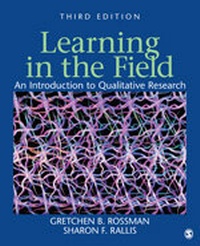
Learning in the Field
An Introduction to Qualitative Research
3rd Edition
Published on 31. August 2011
Book
Paperback/Softback
392 pages
978-1-4129-8048-7 (ISBN)
Description
The popular text that helped readers better understand and practice qualitative research has been completely updated and revised. To help readers better visualize and grasp the concepts, issues, and complexities of qualitative inquiry, the authors introduce each chapter with discussions among three 'characters'--students whose research projects demonstrate the challenges and excitement of qualitative research. Woven into the chapters and the characters' stories are three themes that make up the tapestry of qualitative research: First, research is a learning process. Second, research can and should be useful. Finally, a researcher needs to have a clear vision of the audience and purpose of a study.
Reviews / Votes
"I have reviewed a large number of qualitative research books. You learn quickly to decipher when a book's authors are simply writing conceptually versus when they are writing from solid fieldwork experience. Rossman and Rallis, out of their depth of real-world experience, illuminate qualitative research as the integration of science and art." -- Michael Quinn PattonMore details
Edition
3rd Revised edition
Language
English
Place of publication
Thousand Oaks
United States
Target group
College/higher education
Edition type
Revised edition
Dimensions
Height: 232 mm
Width: 187 mm
Weight
652 gr
ISBN-13
978-1-4129-8048-7 (9781412980487)
Copyright in bibliographic data and cover images is held by Nielsen Book Services Limited or by the publishers or by their respective licensors: all rights reserved.
Schweitzer Classification
Other editions
New editions
Book
06/2016
4th Edition
SAGE Publications Inc
€115.50
Shipment within 15-20 days
Persons
Gretchen B. Rossman is Professor Emerita of International Education and the Center for International Education at the University of Massachusetts Amherst. She received her PhD in education from the University of Pennsylvania, with a specialization in higher-education administration. She has served as a visiting professor at Harvard University's Graduate School of Education. Prior to coming to the University of Massachusetts, she was senior research associate at Research for Better Schools in Philadelphia. With an international reputation as a qualitative methodologist, she has expertise in qualitative research design and methods, mixed-methods monitoring and evaluation, and inquiry in education. Over the past 30+ years, she has coauthored 15 books, 2 of which are editions of major qualitative research texts (Learning in the Field, third edition, with Sharon F. Rallis, and the present seventh edition of Designing Qualitative Research, with Catherine Marshall and Gerardo L. Blanco-both widely used guides for qualitative inquiry). In addition, she has published a book titled The Research Journey: An Introduction to Inquiry (with Sharon Rallis). She has also authored or coauthored more than 50 articles, book chapters, and technical reports focused on methodological issues in qualitative research synthesis, mixed-methods evaluation, and ethical research practice, as well as the analysis and evaluation of educational reform efforts both in the United States and internationally.
Professor Rossman has served as principal investigator (PI) or co-PI on several large U.S. Agency for International Development-funded projects (in Palestine, the Southern Sudan, Malawi, Tanzania, and India); as co-PI on a World Bank-funded multigrade schooling project (Senegal and Gambia); as lead trainer for a Save the Children-funded participatory monitoring and evaluation of professional training (Azerbaijan); and as external evaluator on several domestic projects, including a Department of Education-funded reform initiative, a National Science Foundation-funded middle-grades science initiative, and a number of projects implementing more inclusive practices for students with disabilities.
Sharon F. Rallis is Dwight W. Allen Distinguished Professor of Education Policy and Reform at the University of Massachusetts at Amherst. Previously, she was professor of education at the University of Connecticut; lecturer on education at Harvard; and associate professor of educational leadership at Peabody College, Vanderbilt University. Her doctorate is from the Harvard Graduate School of Education. She has coauthored numerous books, including several on leadership: Principals of Dynamic Schools: Taking Charge of Change (with Ellen Goldring); Dynamic Teachers: Leaders of Change (with Gretchen Rossman); Leading Dynamic Schools: How to Create and Implement Ethical Policies (with Gretchen Rossman and others); and Leading With Inquiry and Action: How Principals Improve Teaching and Learning (with Matthew Militello and Ellen Goldring). Her numerous articles, book chapters, edited volumes, and technical reports address issues of research and evaluation methodology, ethical practice in research and evaluation, education policy and leadership, and school reform.
A past-president of the American Evaluation Association (2005) and current editor of the American Journal of Evaluation, Professor Rallis has been involved with education and evaluation for more than three decades. She has been a teacher, counselor, principal, researcher, program evaluator, director of a major federal school reform initiative, and an elected school board member. Currently, her teaching includes courses on inquiry, program evaluation, qualitative methodology, and organizational theory. Her research has focused on the local implementation of programs driven by federal, state, or district policies. As external evaluator or principal investigator (PI), she has studied a variety of domestic and international policy and reform efforts, such as alternative professional development for leaders; collaborations between agencies responsible for educating incarcerated or institutionalized youth; initiatives supporting inclusive education for children and youth with disabilities; local school governance and leadership; labor-management relations in school districts; and leadership development. Her work with students on evaluation and qualitative methodology has taken her as far as Afghanistan, Turkey, and Palestine.
Professor Rossman has served as principal investigator (PI) or co-PI on several large U.S. Agency for International Development-funded projects (in Palestine, the Southern Sudan, Malawi, Tanzania, and India); as co-PI on a World Bank-funded multigrade schooling project (Senegal and Gambia); as lead trainer for a Save the Children-funded participatory monitoring and evaluation of professional training (Azerbaijan); and as external evaluator on several domestic projects, including a Department of Education-funded reform initiative, a National Science Foundation-funded middle-grades science initiative, and a number of projects implementing more inclusive practices for students with disabilities.
Sharon F. Rallis is Dwight W. Allen Distinguished Professor of Education Policy and Reform at the University of Massachusetts at Amherst. Previously, she was professor of education at the University of Connecticut; lecturer on education at Harvard; and associate professor of educational leadership at Peabody College, Vanderbilt University. Her doctorate is from the Harvard Graduate School of Education. She has coauthored numerous books, including several on leadership: Principals of Dynamic Schools: Taking Charge of Change (with Ellen Goldring); Dynamic Teachers: Leaders of Change (with Gretchen Rossman); Leading Dynamic Schools: How to Create and Implement Ethical Policies (with Gretchen Rossman and others); and Leading With Inquiry and Action: How Principals Improve Teaching and Learning (with Matthew Militello and Ellen Goldring). Her numerous articles, book chapters, edited volumes, and technical reports address issues of research and evaluation methodology, ethical practice in research and evaluation, education policy and leadership, and school reform.
A past-president of the American Evaluation Association (2005) and current editor of the American Journal of Evaluation, Professor Rallis has been involved with education and evaluation for more than three decades. She has been a teacher, counselor, principal, researcher, program evaluator, director of a major federal school reform initiative, and an elected school board member. Currently, her teaching includes courses on inquiry, program evaluation, qualitative methodology, and organizational theory. Her research has focused on the local implementation of programs driven by federal, state, or district policies. As external evaluator or principal investigator (PI), she has studied a variety of domestic and international policy and reform efforts, such as alternative professional development for leaders; collaborations between agencies responsible for educating incarcerated or institutionalized youth; initiatives supporting inclusive education for children and youth with disabilities; local school governance and leadership; labor-management relations in school districts; and leadership development. Her work with students on evaluation and qualitative methodology has taken her as far as Afghanistan, Turkey, and Palestine.
Content
Chapter 1. Qualitative Research as Learning
Chapter 2. The Researcher as Learner
Chapter 3. The Researcher as Competent and Ethical
Chapter 4. Major Qualitative Research Genres
Chapter 5. Conceptualizing and Planning the Research
Chapter 6. Entering the Field
Chapter 7. Gathering Data in the Field
Chapter 8. Our Characters' Data
Chapter 9. Issues That Arise in the Field
Chapter 10. Analyzing and Interpreting Data
Chapter 11. Our Characters' Analyses
Chapter 12. Presenting the Learnings
Chapter 2. The Researcher as Learner
Chapter 3. The Researcher as Competent and Ethical
Chapter 4. Major Qualitative Research Genres
Chapter 5. Conceptualizing and Planning the Research
Chapter 6. Entering the Field
Chapter 7. Gathering Data in the Field
Chapter 8. Our Characters' Data
Chapter 9. Issues That Arise in the Field
Chapter 10. Analyzing and Interpreting Data
Chapter 11. Our Characters' Analyses
Chapter 12. Presenting the Learnings