

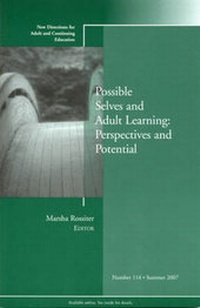
Possible Selves and Adult Learning: Perspectives and Potential
New Directions for Adult and Continuing Education, Number 114
Published on 5. June 2008
Book
Paperback/Softback
96 pages
978-0-470-18329-8 (ISBN)
Description
This issue introduces practitioners, scholars and students to the construct of possible selves and its potential applications in the field of adult education. The possible selves construct offers a useful and largely unexplored framework for understanding adult learning as the medium through which change, growth and goal achievement occur. The chapters in this volume outline in practical terms the research-based applications of possible selves that have relevance fo adult educators. Introduced by Hazel Markus and Paula Nurius in 1986, possible selves refer to the future-oriented components of an individual's self-concept; they are imagined future selves, including the selves that are ideal and hoped for. In the past twenty years, a substantial body of research has explored the connections between possible selves and life span development, race and gender, career development, and academic achievement. As a result, a variety of possible selves approaches has been applied in fields of practice corresponding to adult education, although the construct remains relative unknown in adult education itself.
This is the 114th issue of the Jossey-Bass quarterly report series New Directions for Adult and Continuing Education.
This is the 114th issue of the Jossey-Bass quarterly report series New Directions for Adult and Continuing Education.
More details
Series
Language
English
Place of publication
Chichester
United Kingdom
Publishing group
John Wiley and Sons Ltd
Target group
Professional and scholarly
Dimensions
Height: 230 mm
Width: 164 mm
Thickness: 7 mm
Weight
186 gr
ISBN-13
978-0-470-18329-8 (9780470183298)
Copyright in bibliographic data and cover images is held by Nielsen Book Services Limited or by the publishers or by their respective licensors: all rights reserved.
Schweitzer Classification