

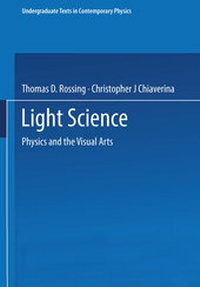
Light Science
Physics and the Visual Arts
Published on 1. December 2010
Book
Paperback/Softback
XVI, 442 pages
978-1-4419-3169-6 (ISBN)
Description
Intended for students in the visual arts and for others with an interest in art, but with no prior knowledge of physics, this book presents the science behind what and how we see. The approach emphasises phenomena rather than mathematical theories and the joy of discovery rather than the drudgery of derivations. The text includes numerous problems, and suggestions for simple experiments, and also considers such questions as why the sky is blue, how mirrors and prisms affect the colour of light, how compact disks work, and what visual illusions can tell us about the nature of perception. It goes on to discuss such topics as the optics of the eye and camera, the different sources of light, photography and holography, colour in printing and painting, as well as computer imaging and processing.
Reviews / Votes
.aspects of this book are gems and I felt almost driven to want to develop a course which might be based on sections of it.the authors show deep knowledge of and empathy for their material. It is fascinating and close to inspirational.the experiments are the crowning glory and make the book worth every penny for the university teacher of light and optics. This is brilliant stuff.
--The Physicist
More details
Series
Edition
Softcover reprint of hardcover 1st ed. 1999
Language
English
Place of publication
New York
United States
Target group
Professional and scholarly
Lower undergraduate
Illustrations
XVI, 442 p.
Dimensions
Height: 25.4 cm
Width: 17.8 cm
Weight
1236 gr
ISBN-13
978-1-4419-3169-6 (9781441931696)
DOI
10.1007/978-0-387-21698-0
Schweitzer Classification
Other editions
New editions
Book
01/2020
2nd Edition
Springer
€85.59
Shipment within 7-9 days
Additional editions
Book
09/1999
1st Edition
Springer
€90.94
Shipment within 5-7 days
Content
Our World of Light and Color.- The Mystery of Light.- Reflection.- Refraction.- Interference and Diffraction.- Light Sources.- Polarized Light.- Color Vision.- Holography.- Photography.- Computer Images.- Optical Recording, Communication and Photonics.- Symmetry in Art and Nature.- Visual Illusions.