

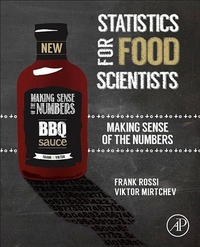
Statistics for Food Scientists
Making Sense of the Numbers
Published on 12. October 2015
Book
Paperback/Softback
184 pages
978-0-12-417179-4 (ISBN)
Description
The practical approached championed in this book have led to increasing the quality on many successful products through providing a better understanding of consumer needs, current product and process performance and a desired future state. In 2009, Frank Rossi and Viktor Mirtchev brought their practical statistical thinking forward and created the course "Statistics for Food Scientists?. The intent of the course was to help product and process developers increase the probability of their project's success through the incorporation of practical statistical thinking in their challenges. The course has since grown and has become the basis of this book.
Reviews / Votes
"...a useful guide for food researchers in R&D area, for food producers and quality managers, and for all those who work with statistics and data analysis even at the production line to meet consumers' demands." --Acta Alimentaria, Statistics for Food ScientistsMore details
Language
English
Place of publication
San Diego
United States
Publishing group
Elsevier Science Publishing Co Inc
Target group
Professional and scholarly
Their roles in Product Development, Product Quality, Manufacturing, Regulatory and Quality Assurance and their industry titles include Food Scientist, Food Engineer, Quality Manager and Product Developer.
Product notice
Paperback (trade)
Unsewn / adhesive bound
Dimensions
Height: 226 mm
Width: 150 mm
Thickness: 8 mm
Weight
318 gr
ISBN-13
978-0-12-417179-4 (9780124171794)
Copyright in bibliographic data and cover images is held by Nielsen Book Services Limited or by the publishers or by their respective licensors: all rights reserved.
Schweitzer Classification
Other editions
Additional editions
E-Book
10/2015
Academic Press
€89.95
Available for download
Persons
Frank Rossi is Associate Director of Statistics at Kraft Foods Group. Much of his career as an industrial statistician has been in the food industry, including positions at the Campbell Soup Company and General Foods Corporation. A frequent presenter at scientific symposiums related to the food industry, he is also a regular presenter at short courses for the consumer products industry. He is the author and co-author of a number of publications on statistics in sensory science and consumer research. He obtained a BS in Mathematics and an MA in Statistics from The Pennsylvania State University. Viktor Mirtchev is an Analytics Manager in the Consumer Insights and Strategy at Kraft Foods. During Viktor's professional tenure, he has held positions in Statistics, Marketing Analytics, Quality and Operations in the CPG, Pharmaceutical and Logistics industries while working at Kraft Foods, Baxter Healthcare and UPS. Over the years Viktor has shared his passion about statistics while teaching fundamentals, solving interesting problems and empowering teams with analytical capabilities. He is a Six Sigma Master Black Belt and holds a BS in Statistics & Computer Science, MS in Applied Statistics and an MBA.
Content
CHAPTER 1. Introduction
CHAPTER 2. Descriptive Statistics and Graphical Analysis
CHAPTER 3. Hypothesis Testing
CHAPTER 4. Analysis of Variance (ANOVA)
CHAPTER 5. Measurement Systems Analysis (MSA)
CHAPTER 6. Regression and Correlation
CHAPTER 7. Statistical Process Control (SPC)
CHAPTER 8. Sampling
CHAPTER 9. Process Capability
CHAPTER 10. Design of Experiments Foundation
CHAPTER 11. Screening Experimental Designs
CHAPTER 12. Response Surface (Optimization) Experimental Designs
CHAPTER 13. Mixture Experimental Design
CHAPTER 14. Wrapping It All Up!
CHAPTER 2. Descriptive Statistics and Graphical Analysis
CHAPTER 3. Hypothesis Testing
CHAPTER 4. Analysis of Variance (ANOVA)
CHAPTER 5. Measurement Systems Analysis (MSA)
CHAPTER 6. Regression and Correlation
CHAPTER 7. Statistical Process Control (SPC)
CHAPTER 8. Sampling
CHAPTER 9. Process Capability
CHAPTER 10. Design of Experiments Foundation
CHAPTER 11. Screening Experimental Designs
CHAPTER 12. Response Surface (Optimization) Experimental Designs
CHAPTER 13. Mixture Experimental Design
CHAPTER 14. Wrapping It All Up!