

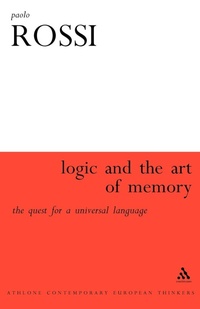
Logic and the Art of Memory
The Quest for a Universal Language
2nd Edition
Published on 3. January 2006
Book
Paperback/Softback
362 pages
978-0-8264-8861-9 (ISBN)
Description
A brilliant translation of this classic account of the art of memory and the logic of linkage and combination, the two traditions deriving from the Classical world and the late medieval period, and becoming intertwined in the 16th Century. From this intertwining emerged a new tradition, a grandiose project for an 'alphabet of the world' or 'Clavis Universalis'. Translated with an Introduction by Stephen Clucas.
Reviews / Votes
"'A pioneering work.' Frances Yates 'The best history of universal languages.' Hans Aarsleff 'Bellissimo.' Umberto Eco"More details
Series
Edition
2. Auflage
Language
English
Place of publication
London
United Kingdom
Publishing group
Bloomsbury Publishing PLC
Target group
College/higher education
Professional and scholarly
Dimensions
Height: 216 mm
Width: 140 mm
Thickness: 20 mm
Weight
456 gr
ISBN-13
978-0-8264-8861-9 (9780826488619)
Copyright in bibliographic data and cover images is held by Nielsen Book Services Limited or by the publishers or by their respective licensors: all rights reserved.
Schweitzer Classification
Other editions
Additional editions
E-Book
01/2006
1st Edition
Continuum International Publishing Group Ltd.
€100.99
Available for download
Persons
Paolo Rossi is Emeritus Professor of the History of Philosophy at the University of Florence, and Fellow of the Accademia Nazionale dei Lincei. Stephen Clucas is lecturer in English and Humanities at Birkbeck College, University of London.
Content
Translator's Introduction; Preface; Preface to the second edition; I The Power of Images and the Places of Memory; II Encyclopaedism and Combinatoria in the Sixteenth Century; III Theatres of the World; IV The Imaginative Logic of Giordano Bruno; V Artificial Memory and the New Scientific Method: Ramus, Bacon, Descartes; VI Encyclopaedism and pansophia; VII The Construction of a Universal Language; VIII The Sources of Leibniz's Universal Character; Appendices; I The Liber ad memoriam confirmandam of Ramon Lull; II An anonymous vernacular treatise of the fourteenth century; III Two fifteenth-century manuscripts on the ars memorativa; IV Documents on the activities of Pietro da Ravenna; V Three late sixteenth-century manuscripts on the ars memorativa; VI Petrarch as teacher of the art of memory; VII An unpublished text by Giulio Camillo. VIII memory exercises in seventeenth-century Germany; IX The article on 'L'art mnemonique' from Diderot's encyclopaedia; X D'Alembert and 'real characters'; Notes; Index.