

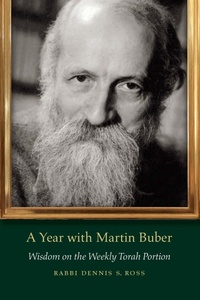
A Year with Martin Buber
Wisdom on the Weekly Torah Portion
Published on 1. December 2021
Book
Paperback/Softback
320 pages
978-0-8276-1465-9 (ISBN)
Description
2022 Top Ten Book from Academy of Parish Clergy
The teachings of the great twentieth-century Jewish thinker Martin Buber empower us to enter a spiritual dimension that often passes unnoticed in the daily routine. In A Year with Martin Buber, the first Torah commentary to focus on his life's work, we experience the fifty-four weekly Torah portions and eleven Jewish holidays through Buber's eyes.
While best known for the spiritual concept of the I-Thou relationship between people, Buber graced us with other fundamentals, including Over Against, Afterglow, Will and Grace, Reification, Inclusion, and Imagine the Real. And his life itself-including his defiance of the Nazis, his call for Jewish-Arab reconciliation, and his protest of Adolf Eichmann's execution-modeled these teachings in action.
Rabbi Dennis S. Ross demonstrates Buber's roots in Jewish thought and breaks new ground by explaining the broader scope of Buber's life and work in a clear, conversational voice. He quotes from the weekly Torah portion; draws lessons from Jewish commentators; and sets Buber's related words in context with Buber's remarkable life story, Hasidic tales, and writing. A wide variety of anecdotal illustrations from Buber as well as the author's life encourages each of us to "hallow the everyday" and seek out spirituality "hiding in plain sight."
The teachings of the great twentieth-century Jewish thinker Martin Buber empower us to enter a spiritual dimension that often passes unnoticed in the daily routine. In A Year with Martin Buber, the first Torah commentary to focus on his life's work, we experience the fifty-four weekly Torah portions and eleven Jewish holidays through Buber's eyes.
While best known for the spiritual concept of the I-Thou relationship between people, Buber graced us with other fundamentals, including Over Against, Afterglow, Will and Grace, Reification, Inclusion, and Imagine the Real. And his life itself-including his defiance of the Nazis, his call for Jewish-Arab reconciliation, and his protest of Adolf Eichmann's execution-modeled these teachings in action.
Rabbi Dennis S. Ross demonstrates Buber's roots in Jewish thought and breaks new ground by explaining the broader scope of Buber's life and work in a clear, conversational voice. He quotes from the weekly Torah portion; draws lessons from Jewish commentators; and sets Buber's related words in context with Buber's remarkable life story, Hasidic tales, and writing. A wide variety of anecdotal illustrations from Buber as well as the author's life encourages each of us to "hallow the everyday" and seek out spirituality "hiding in plain sight."
Reviews / Votes
"This fresh innovative approach to the Torah portion of the week is appealing and insightful, which is why I carry it with me to read in synagogue on Shabbat mornings, either before or after the reading of the Torah portion. It enlightens and enervates my Shabbat morning experience."-Rabbi Ron Kronish, Jerusalem Report "Rabbi Ross superbly distills the theology of Martin Buber . . . , a consequential Jewish thinker whose focus on making human interactions meaningful influenced Martin Luther King Jr.'s 'Letter from a Birmingham Jail.' . . . An invaluable entry point to a humanist thinker who sought to identify, build, and preserve 'holiness in our daily routines' by putting people, rather than objects, first."-Publishers Weekly "Ross makes Buber's writings eminently readable even as he treats them with full scholarly integrity. And by bringing himself into the story, Ross allows us to go from pure text study to an individual life, as Buber himself would have wanted."-Rabbi Thomas M. Alpert, Temple Etz Chaim in Franklin, Massachusetts "What a pleasure A Year with Martin Buber is! People of all faiths with an interest in the Bible and bringing 'divine wonder to the routine of daily life' will delight in having this inspirational book as a companion."-Rev. Debra W. Haffner, Unitarian Universalist Church in Reston, Virginia "This richly textured book will send the reader back, time and again, to revisit its teachings and insights."-Rabbi Bernard Mehlman, senior scholar, Temple Israel in Boston, MassachusettsMore details
Series
Language
English
Place of publication
Philadelphia
United States
Product notice
Paperback (trade)
Dimensions
Height: 228 mm
Width: 149 mm
Thickness: 17 mm
Weight
438 gr
ISBN-13
978-0-8276-1465-9 (9780827614659)
Copyright in bibliographic data and cover images is held by Nielsen Book Services Limited or by the publishers or by their respective licensors: all rights reserved.
Schweitzer Classification
Other editions
Additional editions
E-Book
12/2021
Jewish Publication Society
€26.99
Available for download
E-Book
12/2021
Jewish Publication Society
€26.99
Available for download
Person
Rabbi Dennis S. Ross serves as an Intentional Interim Rabbi in the greater New York City area. He is the author of several books, including God in Our Relationships: Spirituality between People from the Teachings of Martin Buber and All Politics Is Religious: Speaking Faith to the Media, Policy Makers, and Community.
Content
Acknowledgments
Introduction
I. Genesis (Bere’shit)
Bere’shit: Standing Over Against
Noä: Learning to Be Present
Lekh Lekha: Eternal Thou
Va-yera’: Many Forms of Candor
H¿ayyei Sarah: Rising from Grief
Toledot: How Conflict Begins
Va-yetse’: When Time and Space Become Secondary
Va-yishlah¿: Holy Insecurity
Va-yeshev: On the Narrow Ridge
Mikkets: Trapped in a Dream
Va-yiggash: Learning to Put Feelings into Words
Va-yeh¿i: The Importance of Supportive Relationship
II. Exodus (Shemot)
Shemot: Get Off the Road
Va-’era’: Reification
Bo’: History as Strangers, Responsibility as Redeemers
Be-shallah¿: Daily Spiritual Practice
Yitro: All of Us, Together at Sinai
Mishpatim: Respecting Religious Difference
Terumah: Not Within, Between
Tetsavveh: The Sanctity of Decision Making
Ki Tissa’: Eclipse of God
Va-yak’hel: Shabbat as Cornerstone
Pekudei: There Is No Sin in Having Money
III. Leviticus (Va-yikra’)
Va-yikra’: Will and Grace
Tsav: The Afterglow
Shemini: Learning from Loss
Tazriä: Healing through Meeting
Metsorä: Faith and Science Together
’Ah¿arei Mot: The Curtain Will Part
Kedoshim: Hebrew Humanism
’Emor: Magic, Manipulation, and Prayer
Be-har: Intersection of Land and Justice
Be-h¿ukkotai: Mountains in Time
IV. Numbers (Be-midbar)
Be-midbar: Holiness in Time
Naso’: Words That Bless Children
Be-häalotekha: Eternal Thou
Shelä-Lekha: People Want Proof
Korah¿: When Politics Take a Horrible Turn
H¿ukkat: On Jewish Law
Balak: Quick and Decisive Punishment
Pinh¿as: Evolving Jewish Law
Mattot: “Imagine the Real”
Mase¿ei: Interfaith Relations
V. Deuteronomy (Devarim)
Devarim: Dealing with Anger
Va-’eth¿annan: Chosenness and Universalism
¿Ekev: Spirituality of Eating
Re’eh: Privilege and Responsibility
Shofetim: Ends and Means
Ki Tetse’: Animal Well-Being
Ki Tavo’: The Fugitives
Nitsavim: Equality in Labor
Va-yelekh: Wanting More Time
Ha’azinu: Children in Poetry
Ve-zo’t Ha-berakhah: When There Are No Words
VI. Holidays
Rosh Hashanah: Where Are You?
Yom Kippur: New Thinking
Sukkot: The Holiday
Shemini Atzeret: Sudden Stop
Sim¿at Torah: When You Come to the End
Hanukkah: Because We Never Really Get There
Purim: A Day Like Yom Kippur
Pesach: “Education of Character”
Yom ha-Shoah: Nuance in Reconciliation
Yom ha-Atzmaut: A Growing Outcome
Shavuot: Revelation, Then and Now
Epigraph Source Acknowledgments
Notes
Selected Bibliography
Introduction
I. Genesis (Bere’shit)
Bere’shit: Standing Over Against
Noä: Learning to Be Present
Lekh Lekha: Eternal Thou
Va-yera’: Many Forms of Candor
H¿ayyei Sarah: Rising from Grief
Toledot: How Conflict Begins
Va-yetse’: When Time and Space Become Secondary
Va-yishlah¿: Holy Insecurity
Va-yeshev: On the Narrow Ridge
Mikkets: Trapped in a Dream
Va-yiggash: Learning to Put Feelings into Words
Va-yeh¿i: The Importance of Supportive Relationship
II. Exodus (Shemot)
Shemot: Get Off the Road
Va-’era’: Reification
Bo’: History as Strangers, Responsibility as Redeemers
Be-shallah¿: Daily Spiritual Practice
Yitro: All of Us, Together at Sinai
Mishpatim: Respecting Religious Difference
Terumah: Not Within, Between
Tetsavveh: The Sanctity of Decision Making
Ki Tissa’: Eclipse of God
Va-yak’hel: Shabbat as Cornerstone
Pekudei: There Is No Sin in Having Money
III. Leviticus (Va-yikra’)
Va-yikra’: Will and Grace
Tsav: The Afterglow
Shemini: Learning from Loss
Tazriä: Healing through Meeting
Metsorä: Faith and Science Together
’Ah¿arei Mot: The Curtain Will Part
Kedoshim: Hebrew Humanism
’Emor: Magic, Manipulation, and Prayer
Be-har: Intersection of Land and Justice
Be-h¿ukkotai: Mountains in Time
IV. Numbers (Be-midbar)
Be-midbar: Holiness in Time
Naso’: Words That Bless Children
Be-häalotekha: Eternal Thou
Shelä-Lekha: People Want Proof
Korah¿: When Politics Take a Horrible Turn
H¿ukkat: On Jewish Law
Balak: Quick and Decisive Punishment
Pinh¿as: Evolving Jewish Law
Mattot: “Imagine the Real”
Mase¿ei: Interfaith Relations
V. Deuteronomy (Devarim)
Devarim: Dealing with Anger
Va-’eth¿annan: Chosenness and Universalism
¿Ekev: Spirituality of Eating
Re’eh: Privilege and Responsibility
Shofetim: Ends and Means
Ki Tetse’: Animal Well-Being
Ki Tavo’: The Fugitives
Nitsavim: Equality in Labor
Va-yelekh: Wanting More Time
Ha’azinu: Children in Poetry
Ve-zo’t Ha-berakhah: When There Are No Words
VI. Holidays
Rosh Hashanah: Where Are You?
Yom Kippur: New Thinking
Sukkot: The Holiday
Shemini Atzeret: Sudden Stop
Sim¿at Torah: When You Come to the End
Hanukkah: Because We Never Really Get There
Purim: A Day Like Yom Kippur
Pesach: “Education of Character”
Yom ha-Shoah: Nuance in Reconciliation
Yom ha-Atzmaut: A Growing Outcome
Shavuot: Revelation, Then and Now
Epigraph Source Acknowledgments
Notes
Selected Bibliography