


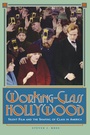
Working-Class Hollywood
Silent Film and the Shaping of Class in America
Published on 11. January 1998
Book
Hardback
392 pages
978-0-691-03234-4 (ISBN)
Description
Telling the story of American film-making in the early 20th-century, this book documents the rise of a working-class film movement that challenged the dominant political ideas of the day. Between 1907 and 1930, worker filmmakers repeatedly clashed with censors, film industry leaders and federal agencies over what images and subjects audiences would be allowed to see. The victors of these battles got to shape the meaning of class in 20th-century America. Surveying several hundred films made by or about working men and women, this book shows how filmmakers were far more concerned with class conflict during the silent era than at any other time. Directors such as Charlie Chaplin, D.W. Griffith and William de Mille made films that defended working people and chastised their enemies. Worker filmmakers also produced films such as " A Martyr to His Cause" (1911) and "The Gastonia Textile Strike" (1929), that depicted a unified working class using strikes, unions and socialism to transform a nation. J. Edgar Hoover considered these class-conscious productions so dangerous that he assigned secret agents to spy on worker filmmakers.
Liberal and radical films declined in the 1920s as an emerging Hollywood studio system, pressured by censors and Wall Street investors, pushed American film in increasingly conservative directions. Appealing to people's dreams of luxury and upward mobility, studios produced lavish fantasy films that shifted popular attention away from the problems of the workplace and toward the pleasures of the new consumer society. While worker filmmakers were trying to heighten class consciousness, Hollywood producers were suggesting that class no longer mattered. This book shows how silent films helped shape the belief that America is a classless nation.
Liberal and radical films declined in the 1920s as an emerging Hollywood studio system, pressured by censors and Wall Street investors, pushed American film in increasingly conservative directions. Appealing to people's dreams of luxury and upward mobility, studios produced lavish fantasy films that shifted popular attention away from the problems of the workplace and toward the pleasures of the new consumer society. While worker filmmakers were trying to heighten class consciousness, Hollywood producers were suggesting that class no longer mattered. This book shows how silent films helped shape the belief that America is a classless nation.
Reviews / Votes
"Winner of the 1999 Book Award, Theatre Library Association" "One of Los Angeles Times's Best Nonfiction Books for 1998" "One of the satisfactions in reading Working-Class Hollywood is that the author is as happily polemical as his subjects and not afraid to take sides. This gives his impressively researched and annotated book a scrappy, personal tone that is refreshing to find in a work of such academic weight." * Los Angeles Times * "A breakthrough volume in terms of American film history." * Vancouver Sun * "A rigorously researched and refreshingly accessible book." * The Nation * "Working-Class Hollywood is ... a meticulous and beautifully accomplished re-creation of the lost world of labor and radical films.... No one reading this masterly new study can look at nearly a century of movie making in quite the same way again." * Journal of American History * "Working-class Hollywood, Steven J. Ross has gone a long way to show, is an oxymoron. Ross has uncovered a lively scene of decentralized, diversified production in the early motion picture business."---Michael Rogin, American Historical Review "A vividly written chronicle of multi-faceted struggles over the meaning of class in American life as they took shape in silent film. . . . By analyzing the range of perspectives on class in early feature films, Ross provides a nuanced picture of the ways class issues and class relations were defined for movie audiences. . . . [A] rich, well-researched monograph . . . [and a] provocative and informative book."---Kathryn J. Oberdeck, Reviews in American History "An impassioned celebration of a movement that depicted social issues at the birth of the big screen. . . . A valuable addition to cinema history. . . ." * Kirkus Review * "Steeped in labor and class history, sweetened by a perceptive moviegoer's parsing of onscreen images, Working-Class Hollywood is a fascinating study of how movies make us." * Washington Post Book World * "Steven J. Ross spent a decade laboring on Working-Class Hollywood, and it shows on every page. It is a phenomenally well-researched study . . . And yet is highly readable, without a hint of droning pedantry."---Ben Singer, Modernism/Modernity "Steven J. Ross has an important story to tell, and he tells it with great passion and conviction."---Peter Kramer, Labour History ReviewMore details
Language
English
Place of publication
New Jersey
United States
Target group
College/higher education
Professional and scholarly
Product notice
Trade binding
Illustrations
38 halftones
Dimensions
Height: 254 mm
Width: 197 mm
Weight
709 gr
ISBN-13
978-0-691-03234-4 (9780691032344)
Copyright in bibliographic data is held by Nielsen Book Services Limited or its licensors: all rights reserved.
Schweitzer Classification
Other editions
Additional editions
E-Book
02/2021
1st Edition
Princeton University Press
€53.99
Available for download
Person
Steven J. Ross is Professor of History at the University of Southern California, where he teaches courses in American Social History and popular culture. He is the author of Workers on the Edge: Work, Leisure, and Politics in Industrializing Cincinnati, 1788-1890, and has published numerous articles on film history, labor history, and social history.