

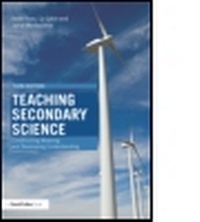
Teaching Secondary Science
Constructing Meaning and Developing Understanding
3rd Edition
Published on 22. February 2010
Book
Hardback
272 pages
978-0-415-56804-3 (ISBN)
Description
Now fully updated in its third edition Teaching Secondary Science is a comprehensive guide to all aspects of science teaching, providing a wealth of information and ideas about different approaches. With guidance on how children understand scientific ideas and the implications this has on teaching, teachers are encouraged to construct their own meanings and become reflective in their practice. Relating science to government agendas, such as the National Strategies, Assessment for Learning and Every Child Matters, this new edition reflects and maps to changes in national standards.
Key features include:
illustrative examples for use in the classroom
theoretical grounding linked to practical application
the pros and cons of different approaches
M Level support materials
additional section on earth, atmosphere and space
advice on teaching `difficult ideas'
education for sustainable development
managing the science classroom and health and safety
support for talk for learning, and advice on numeracy in science.
Presenting an environmentally sustainable, global approach to science teaching, this book emphasises the need to build on and challenge children's existing ideas so they better understand the world in which they live. Essential reading for all students and practising teachers, this invaluable book will support those undertaking secondary science PGCEs and provides material suitable for those studying at M Level.
Key features include:
illustrative examples for use in the classroom
theoretical grounding linked to practical application
the pros and cons of different approaches
M Level support materials
additional section on earth, atmosphere and space
advice on teaching `difficult ideas'
education for sustainable development
managing the science classroom and health and safety
support for talk for learning, and advice on numeracy in science.
Presenting an environmentally sustainable, global approach to science teaching, this book emphasises the need to build on and challenge children's existing ideas so they better understand the world in which they live. Essential reading for all students and practising teachers, this invaluable book will support those undertaking secondary science PGCEs and provides material suitable for those studying at M Level.
Reviews / Votes
"This is a very pleasing new edition of the book looking at all aspects of science teaching. It contains some really good material on children's ideas on science, practical explanations and a very readable theoretical grounding. It's an ideal book for someone on a PGCE, GTP, SCITT or similar course" - School Science Review, June 2011More details
Edition
3rd New edition
Language
English
Place of publication
London
United Kingdom
Publishing group
Taylor & Francis Ltd
Target group
Professional and scholarly
Primary & secondary/elementary & high school
Edition type
New edition
Product notice
Paper over boards
Illustrations
55 s/w Abbildungen, 21 s/w Tabellen
21 Tables, black and white; 55 Illustrations, black and white
Dimensions
Height: 246 mm
Width: 171 mm
Weight
612 gr
ISBN-13
978-0-415-56804-3 (9780415568043)
Copyright in bibliographic data and cover images is held by Nielsen Book Services Limited or by the publishers or by their respective licensors: all rights reserved.
Schweitzer Classification
Other editions
New editions
Keith Ross | Liz Lakin | Janet McKechnie
Teaching Secondary Science
Constructing Meaning and Developing Understanding
Book
06/2015
4th Edition
Routledge
€207.98
Shipment within 10-20 days
Additional editions
Keith Ross | Liz Lakin | Janet McKechnie
Teaching Secondary Science
Constructing Meaning and Developing Understanding
Book
02/2010
3rd Edition
Routledge
€50.94
Article exhausted; check for reprint
Persons
Keith Ross is a former teaching fellow in Science Education at the University of Gloucestershire, and now, partly retired, helps to run the www.scitutors.org.uk website.
Liz Lakin is Lecturer in Science Education at the University of Cumbria, Lancaster.
Janet McKechnie is Secondary Science Leader for the Secondary Science PGCE at GITEP at the University of Gloucestershire. She also teaches physics as an AST at Pate's Grammar School, Gloucestershire.
Liz Lakin is Lecturer in Science Education at the University of Cumbria, Lancaster.
Janet McKechnie is Secondary Science Leader for the Secondary Science PGCE at GITEP at the University of Gloucestershire. She also teaches physics as an AST at Pate's Grammar School, Gloucestershire.
Content
Preface Part I: Science and Why We Teach It Introduction 1. What makes a good science teacher? 2. How Science Works 3. Science education and sustainability Part II: How Children Make Sense of Their World Introduction 4. Learning through language and observation 5. Elicitation: children's ideas of the world 6. A constructivist approach to learning 7. Active learning techniques 8. Children learning through talking 9. Children learning through reading 10. Children learning through writing 11. Numeracy in science Part III: Knowledge and Understanding Introduction 12. Difficult ideas in chemistry 13. Difficult ideas in physics 14. Difficult ideas in biology 15. Difficult ideas in earth science and astronomy Part IV: Planning, Assessment, Teaching and Class Management Introduction 16. Planning for progression 17. Assessment for Learning in science 18. Assessment of `How Science Works' 19. Managing pupils in science lessons 20. Health, safety and laboratory management 21. Teaching and learning at 14-19 Part V: Professional values and the wider world Introduction 22. Inclusion and science for all: every child matters 23. Learning outside the classroom 24. Becoming a professional science teacher List of abbreviations and acronyms References Index