

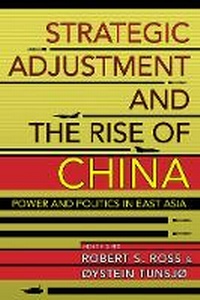
Strategic Adjustment and the Rise of China
Power and Politics in East Asia
Published on 20. June 2017
Book
Hardback
316 pages
978-1-5017-0918-0 (ISBN)
Description
Strategic Adjustment and the Rise of China demonstrates how structural and domestic variables influence how East Asian states adjust their strategy in light of the rise of China, including how China manages its own emerging role as a regional great power. The contributors note that the shifting regional balance of power has fueled escalating tensions in East Asia and suggest that adjustment challenges are exacerbated by the politics of policymaking. International and domestic pressures on policymaking are reflected in maritime territorial disputes and in the broader range of regional security issues created by the rise of China.Adjusting to power shifts and managing a new regional order in the face of inevitable domestic pressure, including nationalism, is a challenging process. Both the United States and China have had to adjust to China's expanded capabilities. China has sought an expanded influence in maritime East Asia; the United States has responded by consolidating its alliances and expanding its naval presence in East Asia. The region's smaller countries have also adjusted to the rise of China. They have sought greater cooperation with China, even as they try to sustain cooperation with the United States. As China continues to rise and challenge the regional security order, the contributors consider whether the region is destined to experience increased conflict and confrontation.ContributorsIan Bowers, Norwegian Defence University College and Norwegian Institute for Defence Studies
Daniel W. Drezner, Tufts University, Brookings Institution, and Washington Post
Taylor M. Fravel, Massachusetts Institute of Technology
Bjorn Elias Mikalsen Gronning, Norwegian Defence University College and Norwegian Institute for Defence Studies
Chung-in Moon, Yonsei University and Chairman, Presidential Committee on Northeast Asia Cooperation Initiative, Republic of Korea
James Reilly, University of Sydney
Robert S. Ross, Boston College and Harvard University
Randall L. Schweller, The Ohio State University
ystein Tunsjo, Norwegian Defence University College and the Norwegian Institute for Defence Studies
Wang Dong, Peking University
Daniel W. Drezner, Tufts University, Brookings Institution, and Washington Post
Taylor M. Fravel, Massachusetts Institute of Technology
Bjorn Elias Mikalsen Gronning, Norwegian Defence University College and Norwegian Institute for Defence Studies
Chung-in Moon, Yonsei University and Chairman, Presidential Committee on Northeast Asia Cooperation Initiative, Republic of Korea
James Reilly, University of Sydney
Robert S. Ross, Boston College and Harvard University
Randall L. Schweller, The Ohio State University
ystein Tunsjo, Norwegian Defence University College and the Norwegian Institute for Defence Studies
Wang Dong, Peking University
Reviews / Votes
Enhances our understanding of power and politics in East Asia, and will help policymakers, researchers, and students of international relations to follow the power transition caused by the rise of China.(Journal of Chinese Political Science) Fills some major gaps in strategy studies, and can serve either as a reference for policy makers and Asian specialists, or as a supplementary text for teachers and college students.
(PACIFIC AFFAIRS)
More details
Series
Language
English
Place of publication
Ithaca
United States
Product notice
Paper over boards
Illustrations
- 1 Tables, black and white
Dimensions
Height: 229 mm
Width: 152 mm
Thickness: 28 mm
Weight
907 gr
ISBN-13
978-1-5017-0918-0 (9781501709180)
Copyright in bibliographic data and cover images is held by Nielsen Book Services Limited or by the publishers or by their respective licensors: all rights reserved.
Schweitzer Classification
Other editions
Additional editions
Robert S. Ross | Oystein Tunsjo
Strategic Adjustment and the Rise of China
Power and Politics in East Asia
E-Book
06/2017
Cornell University Press
€28.49
Available for download
Persons
Robert S. Ross is Professor of Political Science at Boston College and Associate at the John King Fairbank Center for Chinese Studies, Harvard University. He is the author of Chinese Security Policy: Structure, Power, and Politics, coauthor of The Great Wall and the Empty Fortress: China's Search for Security, and coeditor of China's Ascent: Power, Security, and the Future of International Politics (also from Cornell), among many other books. Oystein Tunsjo is Professor of International Politics at the Norwegian Defence University College and the Norwegian Institute for Defence Studies. He is the author of Security and Profit in China's Energy Security Policy: Hedging against Risk and US Taiwan Policy: Constructing the Triangle.
Content
Introduction1. Domestic Politics and Nationalism in East Asian Security, Randall L. Schweller2. U.S.-China Relations From Unipolar Hedging toward Bipolar Balancing, Oystein Tunsjo3. Perception, Misperception, and Sensitivity: Chinese Economic Power and Preferences afte rhte 2008 Financial Crisis, Daniel W. Drezner4. Two Asias? China's Rise, Dual Structure, and the Alliance System in East Asia, Wang DongPart II Japan, South Korea, and the Rise of China: National Security and Nationalism5. Protecting the Status Quo: Japan's Response to the Rise of China, Ian bowers and Bjorn Elias Mikasen Gronning6. Popular Nationalism and Economic Interests in China's Japan Policy, James Reilly7. China's Rise and Security Dynamics on the Korean Peninsula, Chung-in MoonPart III Great Power Relations and Regional Conflict8. Threading the Needle: The South China Sea Disputes and U.S. China Relations9. The United States and China in Northeast Asia: Third-Party Coercion and Alliance Relations, Robert S. RossConclusion: East Asia at the Center: Power Shifts and Theory, Oystein Tunsjo