

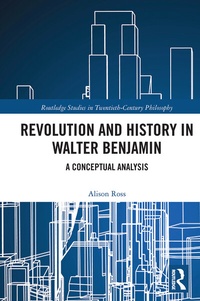
Revolution and History in Walter Benjamin
A Conceptual Analysis
1st Edition
Published on 30. September 2020
Book
Paperback/Softback
156 pages
978-0-367-66470-1 (ISBN)
Description
This book places Benjamin's writing on revolution in the context of his conception of historical knowledge. The fundamental problem that faces any analysis of Benjamin's approach to revolution is that he deploys notions that belong to the domain of individual experience. His theory of modernity with its emphasis on the disintegration of collective experience further aggravates the problem. Benjamin himself understood the problem of revolution to be primarily that of the conceptualization of collective experience (its possibility and sites) under the conditions of modern bourgeois society. The novelty of his approach to revolution lies in the fact that he directly connects it with historical experience. Benjamin's conception of revolution thus constitutes an integral part of his distinctive theory of historical knowledge, which is also essentially a theory of experience. Through a detailed study of Benjamin's writings on the topics of the child and the dream, and an analysis of his ideas of history, the fulfilled wish, similitude and communist society, this book shows how the conceptual analysis of his corpus can get to the heart of Benjamin's conception of revolutionary experience and distil its difficulties and mechanisms.
Reviews / Votes
"This is an excellent and original book on Benjamin's idea of revolution. Ross strives to develop a reading that is philosophically informed and as it were willing to follow Benjamin by clarifying his pronouncements rigorously rather than taking them to be merely suggestive." - Eli Friedlander, Tel-Aviv University"Alison Ross' new book is another major contribution to Benjamin scholarship. It shows convincingly that Benjamin's conceptions of revolution and historical knowledge rely upon an idiosyncratic, theologically-based theory of experience that is not fully consistent in some of its key conceptual features. In turn, as the book illuminates brilliantly, this has major ramifications for contemporary projects in critical social theory." - Jean-Philippe Deranty, Macquarie University
"Alison Ross provides the first comprehensive account of the concept of revolution in Walter Benjamin's work. A must-read not only for Benjamin scholars, but for everyone interested in radical collective agency today." - Daniel Loick, Goethe-University Frankfurt
"Alison Ross' book brilliantly inquires into Benjamin's conception of politics and experience and their entanglement. As Ross points out, Benjamin's understanding of revolutionary experience is based in individual experience, and it raises the problem of how the new concrete collective experience and practice he envisages can emerge." - Massimiliano Tomba, University of California, Santa Cruz
More details
Series
Language
English
Place of publication
London
United Kingdom
Publishing group
Taylor & Francis Ltd
Target group
College/higher education
Postgraduate and Undergraduate
Dimensions
Height: 229 mm
Width: 152 mm
Weight
453 gr
ISBN-13
978-0-367-66470-1 (9780367664701)
Copyright in bibliographic data and cover images is held by Nielsen Book Services Limited or by the publishers or by their respective licensors: all rights reserved.
Schweitzer Classification
Other editions
Additional editions
E-Book
11/2018
1st Edition
Routledge
€63.49
Available for download
Book
11/2018
1st Edition
Routledge
€205.90
Shipment within 15-20 days
E-Book
11/2018
Routledge
€63.49
Available for download
Person
Alison Ross is Associate Professor of Philosophy at Monash University, Australia. She is the author of Walter Benjamin's Concept of the Image (Routledge, 2015) and The Aesthetic Paths of Philosophy: Presentation in Kant, Heidegger, Lacoue-Labarthe and Nancy (2007). She is also the author of the Oxford Bibliography Online entry on Walter Benjamin.
Content
Introduction: Revolutionary Experience
1. The Child
2. The Dream Metaphor
3. Meaning and "Complete Security of Existence"
4. Benjamin's Theory of Historical Knowledge
5. Revolution and Society
Conclusion: The Revolutionary Standstill
1. The Child
2. The Dream Metaphor
3. Meaning and "Complete Security of Existence"
4. Benjamin's Theory of Historical Knowledge
5. Revolution and Society
Conclusion: The Revolutionary Standstill