

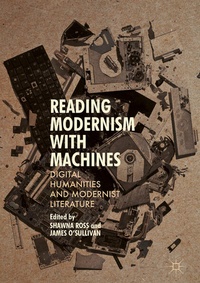
Reading Modernism with Machines
Description
This book uses the discipline-specific, computational methods of the digital humanities to explore a constellation of rigorous case studies of modernist literature.
From data mining and visualization to mapping and tool building and beyond, the digital humanities offer new ways for scholars to questions of literature and culture. With the publication of a variety of volumes that define and debate the digital humanities, we now have the opportunity to focus attention on specific periods and movements in literary history. Each of the case studies in this book emphasizes literary interpretation and engages with histories of textuality and new media, rather than dwelling on technical minutiae. Reading Modernism with Machines thereby intervenes critically in ongoing debates within modernist studies, while also exploring exciting new directions for the digital humanities-ultimately reflecting on the conjunctions and disjunctions between the technological cultures of the modernist era and our own digital present.
Reviews / Votes
" Reading Modernism with Machines attains one of the most elusive of all digital humanities objectives: it demonstrates - with actual findings - how scholars can use computational methods to produce new literary critical insights. It compels us to recognize that DH has much to offer modernist studies - and vice versa. With the publication of this collection digital modernist studies has at last arrived. Reading Modernism with Machines will transform the field of modernist studies and move digital humanities research into the literary critical mainstream. And it's about time." (Stephen Ross, Associate Professor of English, University of Victoria, Canada)
"Reading Modernism with Machines is a smart and diverse collection of essays that examines digital methodologies as they work with and against key moments in Modernist Studies. This work is an important step forward for both Digital Humanists and Modernists alike. Contributors engage a variety of digital interventions to provide useful insights and revealing studies of several literary touchstones of the early-twentieth century." (Erin E. Templeton, Associate Professor of English, Converse College, USA)
More details
Other editions
Additional editions
Persons
Shawna Ross is an assistant professor in the Department of English at Texas A&M University, USA, where she researches and teaches British modernism, the digital humanities, oceanic studies, and Henry James.
James O'Sullivan is the Digital Humanities Research Associate at the Humanities Research Institute at the University of Sheffield, UK, where he researches digital culture and modernity, digital poetics, and electronic literature.
Content
Introduction; Shawna Ross.- Chapter 1. ModLabs; Dean Irvine.- Chapter 2. Modeling Modernist Dialogism; Adam Hammond, Julian Brooke and Graeme Hirst.- 3. Mapping Modernism's Z-Axis; Alex Christie and Katie Tanigawa.- Chapter 4. Textbase as Machine; Kathryn Holland and Jana Smith Elford.- Chapter 5. Remediation and Development of Modernist Forms in The Western Home Monthly ; Hannah McGregor and Nicholas van Orden.- Chapter 6. Stylistic Perspective Across Kenneth Fearing's Poetry; Wayne Arnold.- Chapter 7. In the End Was the Word; Adam James Bradley.- Chapter 8. A Macro-Etymological Analysis of James Joyce's The Portrait of the Artist as a Young Man ; Jonathan Reeve.- Chapter 9. Body Language; Kurt Cavender, Jamey E. Graham, Robert P. Fox, Jr., Richard Flynn and Kenyon Cavender.- Chapter 10. "We twiddle.and turn into machines"; Andrew Pilsch.- Chapter 11. CGI Monstrosities; Eunsong Kim.