

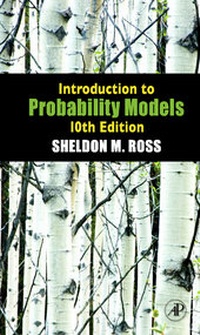
Introduction to Probability Models
10th Edition
Published on 11. December 2009
Book
Hardback
800 pages
978-0-12-375686-2 (ISBN)
Description
Introduction to Probability Models, Tenth Edition, provides an introduction to elementary probability theory and stochastic processes. There are two approaches to the study of probability theory.
One is heuristic and nonrigorous, and attempts to develop in students an intuitive feel for the subject that enables him or her to think probabilistically. The other approach attempts a rigorous development of probability by using the tools of measure theory. The first approach is employed in this text.
The book begins by introducing basic concepts of probability theory, such as the random variable, conditional probability, and conditional expectation. This is followed by discussions of stochastic processes, including Markov chains and Poison processes. The remaining chapters cover queuing, reliability theory, Brownian motion, and simulation. Many examples are worked out throughout the text, along with exercises to be solved by students.
This book will be particularly useful to those interested in learning how probability theory can be applied to the study of phenomena in fields such as engineering, computer science, management science, the physical and social sciences, and operations research. Ideally, this text would be used in a one-year course in probability models, or a one-semester course in introductory probability theory or a course in elementary stochastic processes.
One is heuristic and nonrigorous, and attempts to develop in students an intuitive feel for the subject that enables him or her to think probabilistically. The other approach attempts a rigorous development of probability by using the tools of measure theory. The first approach is employed in this text.
The book begins by introducing basic concepts of probability theory, such as the random variable, conditional probability, and conditional expectation. This is followed by discussions of stochastic processes, including Markov chains and Poison processes. The remaining chapters cover queuing, reliability theory, Brownian motion, and simulation. Many examples are worked out throughout the text, along with exercises to be solved by students.
This book will be particularly useful to those interested in learning how probability theory can be applied to the study of phenomena in fields such as engineering, computer science, management science, the physical and social sciences, and operations research. Ideally, this text would be used in a one-year course in probability models, or a one-semester course in introductory probability theory or a course in elementary stochastic processes.
Reviews / Votes
Praise from Reviewers:"I think Ross has done an admirable job of covering the breadth of applied probability. Ross writes fantastic problems which really force the students to think divergently...The examples, like the exercises are great." --Matt Carlton, California Polytechnic Institute
"This is a fascinating introduction to applications from a variety of disciplines. Any curious student will love this book." --Jean LeMaire, University of Pennsylvania
"This book may be a model in the organization of the education process. I would definitely rate this text to be the best probability models book at its level of difficulty...far more sophisticated and deliberate than its competitors." --Kris Ostaszewski, University of Illinois
More details
Edition
10th edition
Language
English
Place of publication
San Diego
United States
Publishing group
Elsevier Science Publishing Co Inc
Target group
College/higher education
Professionals and students in actuarial science, engineering, operations research, and other fields in applied probability.
Dimensions
Height: 229 mm
Width: 152 mm
Weight
1170 gr
ISBN-13
978-0-12-375686-2 (9780123756862)
Copyright in bibliographic data and cover images is held by Nielsen Book Services Limited or by the publishers or by their respective licensors: all rights reserved.
Schweitzer Classification
Other editions
New editions

Sheldon M. Ross
Introduction to Probability Models
Book
03/2014
11th Edition
Academic Press
€91.60
Article exhausted; check for reprint
Additional editions
Sheldon M. Ross
Introduction to Probability Models
E-Book
12/2006
10th Edition
Academic Press
€70.95
Available for download
Previous edition
Sheldon M. Ross
Introduction to Probability Models
Book
12/2006
9th Edition
Academic Press
€71.79
Article exhausted; check for reprint
Person
Dr. Sheldon M. Ross is a professor in the Department of Industrial and Systems Engineering at the University of Southern California. He received his PhD in statistics at Stanford University in 1968. He has published many technical articles and textbooks in the areas of statistics and applied probability. Among his texts are A First Course in Probability, Introduction to Probability Models, Stochastic Processes, and Introductory Statistics. Professor Ross is the founding and continuing editor of the journal Probability in the Engineering and Informational Sciences. He is a Fellow of the Institute of Mathematical Statistics, a Fellow of INFORMS, and a recipient of the Humboldt US Senior Scientist Award.
Content
Preface
Introduction to Probability Theory;
Random Variables
Conditional Probability and Conditional Expectation
Markov Chains
The Exponential Distribution and the Poisson Process
Continuous-Time Markov Chains
Renewal Theory and Its Applications
Queueing Theory
Reliability Theory
Brownian Motion and Stationary Processes
Simulation
Appendix: Solutions to Starred ExercisesIndex
Introduction to Probability Theory;
Random Variables
Conditional Probability and Conditional Expectation
Markov Chains
The Exponential Distribution and the Poisson Process
Continuous-Time Markov Chains
Renewal Theory and Its Applications
Queueing Theory
Reliability Theory
Brownian Motion and Stationary Processes
Simulation
Appendix: Solutions to Starred ExercisesIndex