

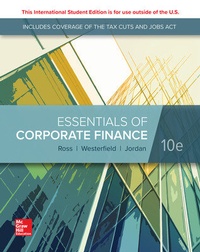
ISE Essentials of Corporate Finance
10th Edition
Published on 29. March 2019
Book
Paperback/Softback
1376 pages
978-1-260-56556-0 (ISBN)
Description
Ross, Essentials of Corporate Finance, 10e, focuses on what undergraduate students with widely varying backgrounds and interests need to carry away from a core course in business or corporate finance. The goal is to convey the most important concepts and principles at a level that is approachable for the widest possible audience. To achieve this goal, subjects are distilled down to its bare essentials (hence, the name of this book), while retaining a decidedly modern approach to finance. Also, understanding the "why" is just as important, if not more so, than understanding the "how" - especially in an introductory course.
Readability and pedagogy are key. Essentials is written in a relaxed, conversational style that invites the students to join in the learning process rather than being a passive information absorber. Essentials downplays purely theoretical issues and minimizes the use of extensive and elaborate calculations to illustrate points that are either intuitively obvious or of limited practical use.
There are three basic themes visible throughout Essentials: emphasis on intuition/commonsense, a unified valuation approach, and a managerial focus.
Readability and pedagogy are key. Essentials is written in a relaxed, conversational style that invites the students to join in the learning process rather than being a passive information absorber. Essentials downplays purely theoretical issues and minimizes the use of extensive and elaborate calculations to illustrate points that are either intuitively obvious or of limited practical use.
There are three basic themes visible throughout Essentials: emphasis on intuition/commonsense, a unified valuation approach, and a managerial focus.
More details
Edition
10th edition
Language
English
Place of publication
OH
United States
Target group
College/higher education
US School Grade: From College Freshman to College Graduate Student
Illustrations
87 Illustrations
Dimensions
Height: 249 mm
Width: 185 mm
Thickness: 28 mm
Weight
953 gr
ISBN-13
978-1-260-56556-0 (9781260565560)
Copyright in bibliographic data and cover images is held by Nielsen Book Services Limited or by the publishers or by their respective licensors: all rights reserved.
Schweitzer Classification
Persons
Stephen A. Ross was the Franco Modigliani Professor of Financial Economics at the Sloan School of Management, Massachusetts Institute of Technology. One of the most widely published authors in finance and economics. Professor Ross is recognized for his work in developing the arbitrage pricing theory, along with his substantial contributions to the discipline through his research in signaling, agency theory, option pricing, and the theory of the term structure of interest rates, among other topics. A past president of the American Finance Association, he also served as an associate editor of several academic and practitioner journals, and was a trustee of CalTech.
Randolph W. Westerfield is Dean Emeritus of the University of Southern Californias Marshall School of Business and is the Charles B. Thornton Professor of Finance Emeritus. Professor Westerfield came to USC from the Wharton School, University of Pennsylvania, where he was the chairman of the finance department and member of the finance faculty for 20 years. He is a member of the Board of Trustees of Oaktree Capital Mutual Funds. His areas of expertise include corporate financial policy, investment management, and stock market price behavior.
Bradford D. Jordan is Visiting Scholar at the University of Florida. He previously held the duPont Endowed Chair in Banking and Financial Services at the University of Kentucky, where he was department chair for many years. He specializes in corporate finance and securities valuation. He has published numerous articles in leading finance journals, and he has received a variety of research awards, including the Fama/DFA Award in 2010.Dr. Jordan is coauthor of Corporate Finance 13e, Corporate Finance: Core Principles and Applications 7e, Fundamentals of Corporate Finance 13e, and Essentials of Corporate Finance 1le, which collectively are the most widely used business finance textbooks in the world, along with Fundamentals of Investments: Valuation and Management 10e, a popular investments text.
Randolph W. Westerfield is Dean Emeritus of the University of Southern Californias Marshall School of Business and is the Charles B. Thornton Professor of Finance Emeritus. Professor Westerfield came to USC from the Wharton School, University of Pennsylvania, where he was the chairman of the finance department and member of the finance faculty for 20 years. He is a member of the Board of Trustees of Oaktree Capital Mutual Funds. His areas of expertise include corporate financial policy, investment management, and stock market price behavior.
Bradford D. Jordan is Visiting Scholar at the University of Florida. He previously held the duPont Endowed Chair in Banking and Financial Services at the University of Kentucky, where he was department chair for many years. He specializes in corporate finance and securities valuation. He has published numerous articles in leading finance journals, and he has received a variety of research awards, including the Fama/DFA Award in 2010.Dr. Jordan is coauthor of Corporate Finance 13e, Corporate Finance: Core Principles and Applications 7e, Fundamentals of Corporate Finance 13e, and Essentials of Corporate Finance 1le, which collectively are the most widely used business finance textbooks in the world, along with Fundamentals of Investments: Valuation and Management 10e, a popular investments text.
Content
Table of Contents
Part One: Overview of Financial Management
Ch. 1 Introduction to Financial Management?
Part Two: Understanding Financial Statements and Cash Flow?
Ch. 2 Financial Statements, Taxes, and Cash Flow?
Ch. 3 Working with Financial Statements?
Part Three: Valuation of Future Cash Flows
Ch. 4 Introduction to Valuation: The Time Value of Money?
Ch. 5 Discounted Cash Flow Valuation?
Part Four: Valuing Stocks and Bonds
Ch. 6 Interest Rates and Bond Valuation?
Ch. 7 Equity Markets and Stock Valuation?
Part Five: Capital Budgeting?
Ch. 8 Net Present Value and Other Investment Criteria?
Ch. 9 Making Capital Investment Decisions?
Part Six: Risk and Return?
Ch. 10 Some Lessons from Capital Market History?
Ch. 11 Risk and Return?
Part Seven: Long-Term Financing?
Ch. 12 Cost of Capital?
Ch. 13 Leverage and Capital Structure?
Ch. 14 Dividends and Dividend Policy?
Ch. 15 Raising Capital?
Part Eight: Short-Term Financial Management?
Ch. 16 Short-Term Financial Planning?
Ch. 17 Working Capital Management?
Part Nine: Topics in Business Finance?
Ch. 18 International Aspects of Financial Management?
Appendices?
Appendix A: Mathematical Tables??
Appendix B: Key Equations??
Appendix C: Answers to Selected End-of-Chapter Problems??
Appendix D: Using the HP-10B and TI BA II Plus Financial Calculators
Part One: Overview of Financial Management
Ch. 1 Introduction to Financial Management?
Part Two: Understanding Financial Statements and Cash Flow?
Ch. 2 Financial Statements, Taxes, and Cash Flow?
Ch. 3 Working with Financial Statements?
Part Three: Valuation of Future Cash Flows
Ch. 4 Introduction to Valuation: The Time Value of Money?
Ch. 5 Discounted Cash Flow Valuation?
Part Four: Valuing Stocks and Bonds
Ch. 6 Interest Rates and Bond Valuation?
Ch. 7 Equity Markets and Stock Valuation?
Part Five: Capital Budgeting?
Ch. 8 Net Present Value and Other Investment Criteria?
Ch. 9 Making Capital Investment Decisions?
Part Six: Risk and Return?
Ch. 10 Some Lessons from Capital Market History?
Ch. 11 Risk and Return?
Part Seven: Long-Term Financing?
Ch. 12 Cost of Capital?
Ch. 13 Leverage and Capital Structure?
Ch. 14 Dividends and Dividend Policy?
Ch. 15 Raising Capital?
Part Eight: Short-Term Financial Management?
Ch. 16 Short-Term Financial Planning?
Ch. 17 Working Capital Management?
Part Nine: Topics in Business Finance?
Ch. 18 International Aspects of Financial Management?
Appendices?
Appendix A: Mathematical Tables??
Appendix B: Key Equations??
Appendix C: Answers to Selected End-of-Chapter Problems??
Appendix D: Using the HP-10B and TI BA II Plus Financial Calculators