

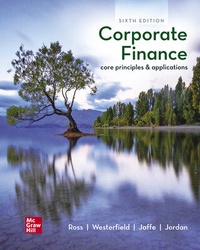
ISE Corporate Finance: Core Principles and Applications
6th Edition
Published on 4. March 2020
Book
Paperback/Softback
736 pages
978-1-260-57112-7 (ISBN)
Description
Corporate Finance: Core was developed for the graduate (MBA) level as a concise, up-to-date, and to-the-point product, the majority of which can be realistically covered in a single term or course. To achieve the objective of reaching out to the many different types of students and the varying course settings, corporate finance is distilled down to its core, while maintaining a decidedly modern approach. Purely theoretical issues are downplayed, and the use of extensive and elaborate calculations is minimized to illustrate points that are either intuitively obvious or of limited practical use. The goal was to focus on what students really need to carry away from a principles course. A balance is struck by introducing and covering the essentials, while leaving more specialized topics to follow-up courses. Net present value is treated as the underlying and unifying concept in corporate finance. Every subject covered is firmly rooted in valuation, and care is taken throughout to explain how particular decisions have valuation effects. Also, the role of the financial manager as decision maker is emphasized, and the need for managerial input and judgment is stressed.
More details
Edition
6th edition
Language
English
Place of publication
OH
United States
Target group
College/higher education
US School Grade: From College Freshman to College Graduate Student
Illustrations
160 Illustrations
Weight
1098 gr
ISBN-13
978-1-260-57112-7 (9781260571127)
Copyright in bibliographic data and cover images is held by Nielsen Book Services Limited or by the publishers or by their respective licensors: all rights reserved.
Schweitzer Classification
Persons
Stephen A. Ross was the Franco Modigliani Professor of Financial Economics at the Sloan School of Management, Massachusetts Institute of Technology. One of the most widely published authors in finance and economics. Professor Ross is recognized for his work in developing the arbitrage pricing theory, along with his substantial contributions to the discipline through his research in signaling, agency theory, option pricing, and the theory of the term structure of interest rates, among other topics. A past president of the American Finance Association, he also served as an associate editor of several academic and practitioner journals, and was a trustee of CalTech.
Randolph W. Westerfield is Dean Emeritus of the University of Southern California's Marshall School of Business and is the Charles B. Thornton Professor of Finance Emeritus. Professor Westerfield came to USC from the Wharton School, University of Pennsylvania, where he was the chairman of the finance department and member of the finance faculty for 20 years. He is a member of the Board of Trustees of Oaktree Capital Mutual Funds. His areas of expertise include corporate financial policy, investment management, and stock market price behavior.
Jeffrey F. Jaffe has been a frequent contributor to finance and economic literature in such journals as the Quarterly Economic Journal, The Journal of Finance, The Journal of Financial and Quantitative Analysis, The Journal of Financial Economics, and The Financial Analysts Journal. His best-known work concerns insider trading, where he showed both that corporate insiders earn abnormal profits from their trades and that regulation has little effect on these profits. He has also made contributions concerning initial public offerings, the regulation of utilities, the behavior of market makers, the fluctuation of gold prices, the theoretical effect of inflation on the interest rate, the empirical effect of inflation on capital asset prices, the relationship between small-capitalization stocks and the January effect, and the capital structure decision.
Bradford D. Jordan is Visiting Scholar at the University of Florida. He previously held the duPont Endowed Chair in Banking and Financial Services at the University of Kentucky, where he was department chair for many years. He specializes in corporate finance and securities valuation. He has published numerous articles in leading finance journals, and he has received a variety of research awards, including the Fama/DFA Award in 2010.Dr. Jordan is coauthor of Corporate Finance 13e, Corporate Finance: Core Principles and Applications 7e, Fundamentals of Corporate Finance 13e, and Essentials of Corporate Finance 1le, which collectively are the most widely used business finance textbooks in the world, along with Fundamentals of Investments: Valuation and Management 10e, a popular investments text.
Randolph W. Westerfield is Dean Emeritus of the University of Southern California's Marshall School of Business and is the Charles B. Thornton Professor of Finance Emeritus. Professor Westerfield came to USC from the Wharton School, University of Pennsylvania, where he was the chairman of the finance department and member of the finance faculty for 20 years. He is a member of the Board of Trustees of Oaktree Capital Mutual Funds. His areas of expertise include corporate financial policy, investment management, and stock market price behavior.
Jeffrey F. Jaffe has been a frequent contributor to finance and economic literature in such journals as the Quarterly Economic Journal, The Journal of Finance, The Journal of Financial and Quantitative Analysis, The Journal of Financial Economics, and The Financial Analysts Journal. His best-known work concerns insider trading, where he showed both that corporate insiders earn abnormal profits from their trades and that regulation has little effect on these profits. He has also made contributions concerning initial public offerings, the regulation of utilities, the behavior of market makers, the fluctuation of gold prices, the theoretical effect of inflation on the interest rate, the empirical effect of inflation on capital asset prices, the relationship between small-capitalization stocks and the January effect, and the capital structure decision.
Bradford D. Jordan is Visiting Scholar at the University of Florida. He previously held the duPont Endowed Chair in Banking and Financial Services at the University of Kentucky, where he was department chair for many years. He specializes in corporate finance and securities valuation. He has published numerous articles in leading finance journals, and he has received a variety of research awards, including the Fama/DFA Award in 2010.Dr. Jordan is coauthor of Corporate Finance 13e, Corporate Finance: Core Principles and Applications 7e, Fundamentals of Corporate Finance 13e, and Essentials of Corporate Finance 1le, which collectively are the most widely used business finance textbooks in the world, along with Fundamentals of Investments: Valuation and Management 10e, a popular investments text.
Content
PART ONE: Overview
Ch. 1 Introduction to Corporate Finance
Ch. 2 Financial Statements and Cash Flow
Ch. 3 Financial Statements Analysis and Financial Models
PART TWO: Valuation and Capital Budgeting
Ch. 4 Discounted Cash Flow Valuation
Ch. 5 Interest Rates and Bond Valuation
Ch. 6 Stock Valuation
Ch. 7 Net Present Value and Other Investment Rules
Ch. 8 Making Capital Investment Decisions
Ch. 9 Risk Analysis, Real Options, and Capital Budgeting
PART THREE: Risk and Return
Ch. 10 Risk and Return: Lessons from Market History
Ch. 11 Return and Risk: The Capital Asset Pricing Model (CAPM)
Ch. 12 Risk, Cost of Capital, and Valuation
PART FOUR: Capital Structure and Dividend Policy
Ch. 13 Efficient Capital Markets and Behavioral Challenges
Ch. 14 Capital Structure: Basic Concepts
Ch. 15 Capital Structure: Limits to the Use of Debt
Ch. 16 Dividends and Other Payouts
PART FIVE: Special Topics
Ch. 17 Options and Corporate Finance
Ch. 18 Short-Term Finance and Planning
Ch. 19 Raising Capital
Ch. 20 International Corporate Finance
Ch. 21 Mergers and Acquisitions (web only)
Ch. 1 Introduction to Corporate Finance
Ch. 2 Financial Statements and Cash Flow
Ch. 3 Financial Statements Analysis and Financial Models
PART TWO: Valuation and Capital Budgeting
Ch. 4 Discounted Cash Flow Valuation
Ch. 5 Interest Rates and Bond Valuation
Ch. 6 Stock Valuation
Ch. 7 Net Present Value and Other Investment Rules
Ch. 8 Making Capital Investment Decisions
Ch. 9 Risk Analysis, Real Options, and Capital Budgeting
PART THREE: Risk and Return
Ch. 10 Risk and Return: Lessons from Market History
Ch. 11 Return and Risk: The Capital Asset Pricing Model (CAPM)
Ch. 12 Risk, Cost of Capital, and Valuation
PART FOUR: Capital Structure and Dividend Policy
Ch. 13 Efficient Capital Markets and Behavioral Challenges
Ch. 14 Capital Structure: Basic Concepts
Ch. 15 Capital Structure: Limits to the Use of Debt
Ch. 16 Dividends and Other Payouts
PART FIVE: Special Topics
Ch. 17 Options and Corporate Finance
Ch. 18 Short-Term Finance and Planning
Ch. 19 Raising Capital
Ch. 20 International Corporate Finance
Ch. 21 Mergers and Acquisitions (web only)