

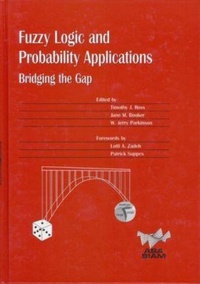
Fuzzy Logic and Probability Applications
Bridging the Gap
Published on 1. January 1987
Book
Hardback
429 pages
978-0-89871-525-5 (ISBN)
Description
Probabilists and fuzzy enthusiasts tend to disagree about which philosophy is best and they rarely work together. As a result, textbooks usually suggest only one of these methods for problem solving, but not both. This book is an exception. The authors, investigators from both fields, have combined their talents to provide a practical guide showing that both fuzzy logic and probability have their place in the world of problem solving. They work together with mutual benefit for both disciplines, providing scientists and engineers with examples of and insight into the best tool for solving problems involving uncertainty. Fuzzy Logic and Probability Applications: Bridging the Gap makes an honest effort to show both the shortcomings and benefits of each technique, and even demonstrates useful combinations of the two. It provides clear descriptions of both fuzzy logic and probability, as well as the theoretical background, examples.
More details
Content
Preface; Section I. Fundamentals; 1. Introduction; 2. Fuzzy Set Theory, Fuzzy Logic, and Fuzzy Systems; 3. Probability Theory; 4. Bayesian Methods; 5. Considerations for Using Fuzzy Set Theory and Probability Theory; 6. Guidelines for Eliciting Expert Judgment as Probabilities or Fuzzy Logic; Section II. Applications; 7. Image Enhancement. Probability Versus Fuzzy Expert Systems; 8. Engineering Process Control; 9. Structural Safety Analysis. A Combined Fuzzy and Probability Approach; 10. Aircraft Integrity and Reliability; 11. Auto Reliability Project; 12. Control Charts for Statistical Process Control; 13. Fault Tree Logic Models; 14. Uncertainty Distributions Using Fuzzy Logic; 15. Signal Validation Using Bayesian Belief Networks and Fuzzy Logic.