

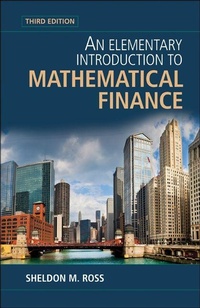
An Elementary Introduction to Mathematical Finance
3rd Edition
Published on 28. February 2011
Book
Hardback
322 pages
978-0-521-19253-8 (ISBN)
Description
This textbook on the basics of option pricing is accessible to readers with limited mathematical training. It is for both professional traders and undergraduates studying the basics of finance. Assuming no prior knowledge of probability, Sheldon M. Ross offers clear, simple explanations of arbitrage, the Black-Scholes option pricing formula, and other topics such as utility functions, optimal portfolio selections, and the capital assets pricing model. Among the many new features of this third edition are new chapters on Brownian motion and geometric Brownian motion, stochastic order relations and stochastic dynamic programming, along with expanded sets of exercises and references for all the chapters.
Reviews / Votes
'... an excellent introduction to the subject ... the book is ideally suited for self-study and provides a very accessible entry point to this fascinating field.' ISI Short Book Reviews '... this excellent text achieves its aim to provide a highly accessible and at the same time accurate presentation of the subject. I would recommend it.' The Statistician '... an excellent introduction to the mathematics of finance ... very useful as a text for an introductory course.' Zentralblatt Math '... provides an accessible and relatively deep insight into basic and advanced topics of mathematical finance ... The lucid style of the exposition will be appreciated by readers interested in the topic, and by researchers, students, and practitioners.' European Maths Society Journal 'Of the many books I have seen about quantitative finance, this is the most useful to students with limited mathematical training. It is accessible to students with knowledge of basic calculus and algebra.' Thomas Miller, Northwestern UniversityMore details
Edition
3rd Revised edition
Language
English
Place of publication
Cambridge
United Kingdom
Target group
College/higher education
Professional and scholarly
Edition type
Revised edition
Illustrations
Worked examples or Exercises; 9 Tables, unspecified; 19 Line drawings, unspecified
Dimensions
Height: 235 mm
Width: 157 mm
Thickness: 22 mm
Weight
619 gr
ISBN-13
978-0-521-19253-8 (9780521192538)
Copyright in bibliographic data and cover images is held by Nielsen Book Services Limited or by the publishers or by their respective licensors: all rights reserved.
Schweitzer Classification
Other editions
Additional editions

Sheldon M. Ross
An Elementary Introduction to Mathematical Finance
E-Book
05/2011
3rd Edition
Cambridge University Press
€58.99
Available for download

Sheldon M. Ross
Elementary Introduction to Mathematical Finance
E-Book
02/2011
Cambridge University Press
€50.49
Available for download
Book
11/2002
2nd Edition
Cambridge University Press
€44.57
Article exhausted; check for reprint
Previous edition
Book
11/2002
2nd Edition
Cambridge University Press
€44.57
Article exhausted; check for reprint
Person
Sheldon M. Ross is the Epstein Chair Professor at the Department of Industrial and Systems Engineering, University of Southern California. He received his Ph.D. in statistics at Stanford University in 1968 and was formerly a Professor at the University of California, Berkeley, from 1976 until 2004. He has published more than 100 articles and a variety of textbooks in the areas of statistics and applied probability, including Topics in Finite and Discrete Mathematics (2000), Introduction to Probability and Statistics for Engineers and Scientists, 4th edition (2009), A First Course in Probability, 8th edition (2009), and Introduction to Probability Models, 10th edition (2009), among others. Dr Ross serves as the editor for Probability in the Engineering and Informational Sciences.
Content
1. Probability; 2. Normal random variables; 3. Geometric Brownian motion; 4. Interest rates and present value analysis; 5. Pricing contracts via arbitrage; 6. The Arbitrage Theorem; 7. The Black-Scholes formula; 8. Additional results on options; 9. Valuing by expected utility; 10. Stochastic order relations; 11. Optimization models; 12. Stochastic dynamic programming; 13. Exotic options; 14. Beyond geometric motion models; 15. Autoregressive models and mean reversion.