

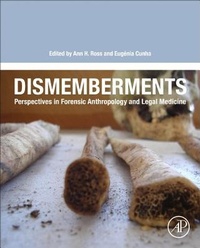
Dismemberments
Perspectives in Forensic Anthropology and Legal Medicine
Published on 29. November 2018
Book
Hardback
212 pages
978-0-12-811912-9 (ISBN)
Description
Dismemberments: Perspectives in Forensic Anthropology and Legal Medicine is the only volume in the field to address the complexities of interpreting dismemberment trauma, the different tools used, and the sociocultural motives behind dismemberments. The book's goal is to provide the reader with a comprehensive assessment that covers all aspects of dismemberment, from means and motive, to toolmark and instrument identification, to disarticulation and re-association of body parts. Each chapter is written by internationally known, expert contributors from around the world. Users will find this to be is a great resource for those involved in the analysis of recovered human remains.
More details
Language
English
Place of publication
San Diego
United States
Publishing group
Elsevier Science Publishing Co Inc
Target group
Professional and scholarly
Forensic Anthropologists, Forensic Pathologists, Medical Examiners and those working on medico-legal cases, such as lawyers, law enforcement and criminalists.
Product notice
sewn/stitched
Cloth over boards
Dimensions
Height: 241 mm
Width: 198 mm
Thickness: 25 mm
Weight
590 gr
ISBN-13
978-0-12-811912-9 (9780128119129)
Copyright in bibliographic data and cover images is held by Nielsen Book Services Limited or by the publishers or by their respective licensors: all rights reserved.
Schweitzer Classification
Other editions
Additional editions
E-Book
11/2018
Academic Press
€69.95
Available for download
Persons
Dr. Ross is a Board Certified forensic anthropologist and professor of forensic anthropology and skeletal biology at NC State University. She is also internationally certified and a Fellow of the American Academy of Forensic Sciences. Dr. Ross has extensive case experience and court testimony on dismemberment cases. In addition to teaching and testifying, Dr. Ross has written many forensic anthropology journal articles and published a book, The Juvenile Skeleton in Forensic Abuse Investigations, with Springer in 2011. Dr. Cunha is an Internationally Certified forensic anthropologist and a full professor at University of Coimbra since 2003. She acts as a National Consultant for Forensic Anthropology at the National Institute of Legal Medicine and Forensic Sciences in Portugal since 1997. Dr. Cunha is a member of the American Academy of Forensic Sciences in the Physical Anthropology Section since 2002. She was nominated president of FASE in 2009. Her research interests cover age and sex estimation methods, skeletal pathologies and trauma analysis. She has published extensively in this area and testified in over 140 international cases.
Content
1. Criminal dismemberments: a discussion of their multi-disciplinary nature and guide to best practice
2. Dismemberment of victims in Colombia: a perspective from practice
3. Dismemberment in Brazil: from early colonization to present days
4. Postmortem Criminal Mutilation in Panama
5. Dismemberment in South Africa: Case studies
6. A dismemberment case from Portugal: How a dozen bones can tell the story
7. The potential of histological analysis in dismemberment cases
8. Dismemberment and Toolmark Analysis On Bone: A Microscopic Analysis Of The Walls Of Cut Marks
9. Skeletal Evidence of Sharp-Force Disarticulation and Tissue Flensing in 54 Cases Exhibiting Approximately 4200 Bone Strike Injuries
10. Intentional Body Dismemberment Following Non-Homicidal Deaths: A Retrospective Study of Body Packer Cases in New York City
11. Tool mark identification on bone: Best Practice
12. The Pattern of violence, punishment and aggression
2. Dismemberment of victims in Colombia: a perspective from practice
3. Dismemberment in Brazil: from early colonization to present days
4. Postmortem Criminal Mutilation in Panama
5. Dismemberment in South Africa: Case studies
6. A dismemberment case from Portugal: How a dozen bones can tell the story
7. The potential of histological analysis in dismemberment cases
8. Dismemberment and Toolmark Analysis On Bone: A Microscopic Analysis Of The Walls Of Cut Marks
9. Skeletal Evidence of Sharp-Force Disarticulation and Tissue Flensing in 54 Cases Exhibiting Approximately 4200 Bone Strike Injuries
10. Intentional Body Dismemberment Following Non-Homicidal Deaths: A Retrospective Study of Body Packer Cases in New York City
11. Tool mark identification on bone: Best Practice
12. The Pattern of violence, punishment and aggression