

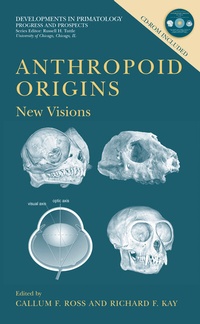
Anthropoid Origins
New Visions
Published on 19. April 2013
Book
Paperback/Softback
XXIX, 749 pages
978-1-4613-4700-2 (ISBN)
Description
The study ofanthropoid origins continues to be a lightning rod for research in paleoanthropology. Issuessurrounding anthropoid origins impact the higher leveltaxonomy ofprimates, adaptivescenariosfor basalprimate radiations, and the timing of origination of the major primate clades. Basic questions about anthropoid evolution remain unanswered. Where do anthropoids fit phyloge- netically among primates? Where and when did the group originate? What functional and adaptive innovations characterize anthropoids today and what is the adaptive significanceand phylogenetic history ofthese innovations? The fossil record of early anthropoid evolution has greatly improved in recent years. Developments in systematictechniques and theory, as well as the burgeoning molecular evidence, make this an ideal time for these fossil discoveries to be placed in the context of data on the relationships among living primates. There isan improved understandingoffunction and adaptation in the visual system, brain, and masticatory apparatus, key anatomical systems where anthropoid synapomorphies are concentrated.
New methods for estimating visualacuity and activitypatterns in fossil primates are providing insights into the evolution ofthe visualsystem. The rapid accumulation ofinformation on color vision in primates, including new genetic evidence of possible trichro- macyin strepsirrhines, and new behavioraldata on the benefitsofcolor vision, makes this an exciting time to evaluate the role of chromatic perception in anthropoid evolution. Research into the primate visualsystem by neuroscien- tists has generated a plethoraofimportant data in recent years, making this an ideal time to bring these researchers together with anthropologists.
New methods for estimating visualacuity and activitypatterns in fossil primates are providing insights into the evolution ofthe visualsystem. The rapid accumulation ofinformation on color vision in primates, including new genetic evidence of possible trichro- macyin strepsirrhines, and new behavioraldata on the benefitsofcolor vision, makes this an exciting time to evaluate the role of chromatic perception in anthropoid evolution. Research into the primate visualsystem by neuroscien- tists has generated a plethoraofimportant data in recent years, making this an ideal time to bring these researchers together with anthropologists.
More details
Series
Edition
Softcover reprint of the original 1st ed. 2004
Language
English
Place of publication
New York
United States
Target group
Professional and scholarly
Research
Illustrations
XXIX, 749 p.
Dimensions
Height: 235 mm
Width: 155 mm
Thickness: 43 mm
Weight
1183 gr
ISBN-13
978-1-4613-4700-2 (9781461347002)
DOI
10.1007/978-1-4419-8873-7
Schweitzer Classification
Other editions
Additional editions
Book
05/2004
1st Edition
Kluwer Academic/Plenum Publishers
€85.55
Article exhausted; check different version
Content
1: Introduction.- 1. Evolving Perspectives of Anthropoidea.- 2: Anthropoid Evolutionary Relationships.- Molecular Phylogeny and Dating of Early Primate Divergences.- Molecular Cladistic Markers and the Infraordinal Phylogenetic Relationships of Primates.- The Ancestral Genomes in Primate Phylogeny and Origins: A Molecular Cytogenetic Perspective.- Anthropoid Origins: A Phylogenetic Analysis.- 3: Fossil Anthropoids and the Biogeography of Anthropoid Origins.- Does Overlap Among the Adaptive Radiations of Omomyoids, Adapoids, and Early Anthropoids Cloud our Understanding of Anthropoid Origins?.- 7. Phylogenetic, Biogeographic, and Adaptive Implications of New Fossil Evidence Bearing on Crown Anthropoid Origins and Early Stem Catarrhine Evolution.- 8. The Cranium and Adaptations of Parapithecus grangeri a Stem Anthropoid from the Fayum Oligocene of Egypt.- 9. The Primate-Bearing Pondaung Formation in the Upland Area, Northwest of Central Myanmar.- 10. A Review of the Large-Bodied Pondaung Primates of Myanmar.- 11. Eocene Large-Bodied Primates of Myanmar and Thailand: Morphological Considerations and Phylogenetic Affinities.- 12. The Pondaung Primates, Enigmatic "Possible Anthropoids" from the Latest Middle Eocene, Central Myanmar.- The Morphology of Two Maxillae of Pondaung Primates (Pondaungia cotteri and Amphipithecus mogaungensis) (middle Eocene, Myanmar).- Siamopithecus eocaenus, Anthropoid Primate from the Late Eocene of Krabi, Thailand.- 15. Anthropoid Origins: Postcranial Evidence from the Eocene of Asia.- 4: Evolution of Anthropoid Adaptations.- 16. Evidence for Early Anthropoid Social Behavior.- function and Fusion of the Mandibular Symphysis in Mammals: A Comparative and Experimental Perspective.- 18. The Distribution and Size of Retinal Ganglion Cells inMicrocebus murinus, Cheirogaleus medius, and Tavsius syrichta: Implications for the Evolution of Sensory Systems in Primates.- The Tarsier Fovea: Functionless Vestige or Nocturnal Adaptation?.- 20. The Evolution of High Visual Acuity in the Anthropoidea.- 21. Endocranial Volume and Optic Foramen Size in Pampithecus grangeri.- Color as an Indicator of Food Quality to Anthropoid Primates: Ecological Evidence and an Evolutionary Scenario.- 23. Photopigment Variations and the Evolution of Anthropoid Vision.- 24. Mosaic Evolution of Activity Pattern, Diet, and Color Vision in Haplorhine Primates.- 5: The Future of Anthropoid Origins.- Anthropoid origins: Retrospective and Prospective.