

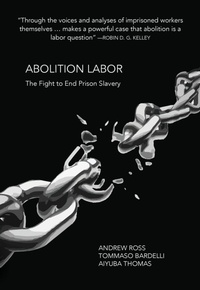
Abolition Labor
The Fight Against Prison Slavery
Published on 8. August 2024
Book
Paperback/Softback
270 pages
978-1-68219-398-3 (ISBN)
Description
Abolition Labor chronicles the national movement to end forced labor, much of it unpaid, in American prisons. It draws on interviews with formerly incarcerated persons in Alabama, Texas, Georgia and New York to give a more holistic picture of these work conditions, and it covers the new prisoner rights movement that began with system-wide work strikes involving more than 50,000 people in the 2010s.
Incarcerated people work for penny wages (15 cents an hour is not unusual), and, in several states, for nothing at all, as cooks, dishwashers, janitors, groundskeepers, barbers, painters, or plumbers; in laundries, kitchens, factories, and hospitals. They provide vital public services such as repairing roads, fighting wildfires, or clearing debris after hurricanes. They manufacture products like office furniture, mattresses, license plates, dentures, glasses, traffic signs, garbage cans, athletic equipment, and uniforms. And they harvest crops, work as welders and carpenters, and labor in meat and poultry processing plants.
Abolition Labor provides a wealth of insights into what has become a vast underground economy. It draws connections between the risky trade forced on prisoners who hustle to survive on the inside and the precarious economy on the outside. And it argues that, far from being quarantined off from society, prisons and their forced work regime have a sizable impact on the economic and social lives of millions of American households.
Incarcerated people work for penny wages (15 cents an hour is not unusual), and, in several states, for nothing at all, as cooks, dishwashers, janitors, groundskeepers, barbers, painters, or plumbers; in laundries, kitchens, factories, and hospitals. They provide vital public services such as repairing roads, fighting wildfires, or clearing debris after hurricanes. They manufacture products like office furniture, mattresses, license plates, dentures, glasses, traffic signs, garbage cans, athletic equipment, and uniforms. And they harvest crops, work as welders and carpenters, and labor in meat and poultry processing plants.
Abolition Labor provides a wealth of insights into what has become a vast underground economy. It draws connections between the risky trade forced on prisoners who hustle to survive on the inside and the precarious economy on the outside. And it argues that, far from being quarantined off from society, prisons and their forced work regime have a sizable impact on the economic and social lives of millions of American households.
Reviews / Votes
"This is an essential guide for those who want to abolish the last vestiges of legal slavery in the US and build a world without prisons."-Alex Vitale
"Through the voices and analyses of imprisoned workers themselves . . . makes a powerful case that abolition is a labor question."
-Robin D.G. Kelley
"This is a startling-and often inspiring-account of the pernicious persistence of prison slavery. It is that rare book which will galvanize a reform movement and, therefore, make for a better world."
-Gerald Horne
"It's a story that needs to be shared widely."
-Labour Hub
More details
Language
English
Place of publication
New York
United States
Product notice
Paperback (trade)
Illustrations
Illustrations
Dimensions
Height: 203 mm
Width: 140 mm
Thickness: 17 mm
Weight
363 gr
ISBN-13
978-1-68219-398-3 (9781682193983)
Copyright in bibliographic data and cover images is held by Nielsen Book Services Limited or by the publishers or by their respective licensors: all rights reserved.
Schweitzer Classification
Other editions
Additional editions
E-Book
06/2024
OR Books
€9.49
Available for download
Persons
Andrew Ross?is a social activist and Professor of Social and Cultural Analysis at NYU, where he also directs the Prison Research Lab. A contributor to the?Guardian, the?New York Times,?The Nation, and?Al Jazeera, he is the author or editor of more than twenty-five books, including, most recently, Cars and Jails: Freedom Dreams, Debt, and Carcerality.
Tommaso Bardelli is a Research Fellow at the NYU Prison Education Program Research Lab, where he conducts research on mass incarceration, financial debt, and their intersections. He holds a PhD in Political Science from Yale University.
Aiyuba Thomas is a recent MA graduate from NYU's Gallatin School of Individualized Study, and a justice impacted affiliate of the NYU Prison Research Lab. He is currently the project manager for "Movements Against Mass Incarceration," an archival oral history project at Columbia University.
Tommaso Bardelli is a Research Fellow at the NYU Prison Education Program Research Lab, where he conducts research on mass incarceration, financial debt, and their intersections. He holds a PhD in Political Science from Yale University.
Aiyuba Thomas is a recent MA graduate from NYU's Gallatin School of Individualized Study, and a justice impacted affiliate of the NYU Prison Research Lab. He is currently the project manager for "Movements Against Mass Incarceration," an archival oral history project at Columbia University.