

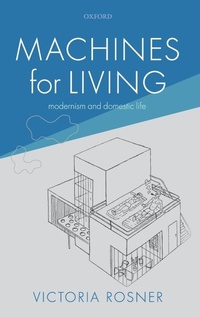
Machines for Living
Modernism and Domestic Life
Published on 4. February 2020
Book
Hardback
308 pages
978-0-19-884519-5 (ISBN)
Description
Changes in the routines of domestic life were among the most striking social phenomena of the period between the two World Wars, when the home came into focus as a problem to be solved: re-imagined, streamlined, electrified, and generally cleaned up. Modernist writers understood themselves to be living in an epochal moment when the design and meaning of home life were reconceived. Moving among literature, architecture, design, science, and technology, Machines for Living shows how the modernization of the home led to profound changes in domestic life and relied on a set of emergent concepts, including standardization, scientific method, functionalism, efficiency science, and others, that form the basis of literary modernism and stand at the confluence of modernism and modernity.
Even as modernist writers criticized the expanding reach of modernization into the home, they drew on its conceptual vocabulary to develop both the thematic and formal commitments of literary modernism. Rosner's work develops a new methodology for interdisciplinary modernist studies and shows how the reinvention of domestic life is central to modernist literature.
Even as modernist writers criticized the expanding reach of modernization into the home, they drew on its conceptual vocabulary to develop both the thematic and formal commitments of literary modernism. Rosner's work develops a new methodology for interdisciplinary modernist studies and shows how the reinvention of domestic life is central to modernist literature.
Reviews / Votes
The study is well built, justifying its own necessity throughout; the chapters build seamlessly on each other, and every sentence displays a kind of artisanal care. In this regard, it is probably one of the book's strengths that it does not allow itself to get derailed in rehearsing * Vaclav Paris, James Joyce Quarterly * Rosner (Columbia Univ.) offers a fresh, interdisciplinary, and prodigiously researched examination of the connection between modernism and the changes in household design and private life that occurred in the 1920s and 1930s...Recommended. Upper-division undergraduates through faculty. * L. Simon, CHOICE * Rosner establishes clear and persuasive connections between developments in domestic architecture and design and many of the key formal and stylistic characteristics of modernist literature... [Rosner] conclusively demonstrates the centrality of new ideas and theories of the domestic space to modernist literature, and which, in doing so, makes a vital contribution to modernist criticism. * Emma Short, Women: A Cultural Review *More details
Language
English
Place of publication
Oxford
United Kingdom
Target group
Professional and scholarly
Illustrations
24 Illustrations
Dimensions
Height: 240 mm
Width: 161 mm
Thickness: 21 mm
Weight
628 gr
ISBN-13
978-0-19-884519-5 (9780198845195)
Copyright in bibliographic data and cover images is held by Nielsen Book Services Limited or by the publishers or by their respective licensors: all rights reserved.
Schweitzer Classification
Other editions
Additional editions
E-Book
02/2020
1st Edition
OUP eBook
€21.99
Available for download
E-Book
02/2020
1st Edition
OUP eBook
€21.99
Available for download
Person
Victoria Rosner is Dean of the New York University Gallatin School and Professor of Humanities and English. Rosner is the author of Modernism and the Architecture of Private Life (2005), winner of the Modernist Studies Association Book Prize. She is also the editor of The Cambridge Companion to the Bloomsbury Group ( 2014) and The Global and the Intimate: Feminism in Our Time (2012; with Geraldine Pratt). She is co-editor of the Gender and Culture series, published by Columbia University Press, as well as founding co-editor of the web-based archive Pioneering Women of American Architecture, a project that recovers the histories of US women architects born before 1940.
Content
1: Introduction: Machine Age Homes
2: Minimum Writing
3: "Fear in a Handful of Dust:" Modernism and Germ Theory
4: "Regular Hours and Regular Ideas:" Originality in the Age of Standardization
5: Modernism's Missing Children: Mass Production and Human Reproduction
6: The House that Virginia Woolf Built (and Rebuilt)
2: Minimum Writing
3: "Fear in a Handful of Dust:" Modernism and Germ Theory
4: "Regular Hours and Regular Ideas:" Originality in the Age of Standardization
5: Modernism's Missing Children: Mass Production and Human Reproduction
6: The House that Virginia Woolf Built (and Rebuilt)