

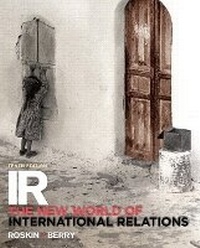
IR
The New World of International Relations Plus MySearchLab with Pearson eText -- Access Card Package
10th Edition
Published on 27. November 2014
Book
Mixed media product
384 pages
978-0-13-380147-7 (ISBN)
Description
&>
A down-to-earth approach to contemporary international relations
IR: The New World of International Relations provides students with a direct and down-to-earth understanding of contemporary international relations. This text surveys key events in world history as well as fundamental theoretical concepts to trace the international system's evolution and to assess its future. Putting the behavior of global actors into more complete context, IR helps students think critically about the challenges faced by the United States in an era of globalization.
ALERT: Before you purchase, check with your instructor or review your course syllabus to ensure that you select the correct ISBN. Several versions of Pearson's MyLab & Mastering products exist for each title, including customized versions for individual schools, and registrations are not transferable. In addition, you may need a CourseID, provided by your instructor, to register for and use Pearson's MyLab & Mastering products.
Packages
Access codes for Pearson's MyLab & Mastering products may not be included when purchasing or renting from companies other than Pearson; check with the seller before completing your purchase.
Used or rental books
If you rent or purchase a used book with an access code, the access code may have been redeemed previously and you may have to purchase a new access code.
Access codes
Access codes that are purchased from sellers other than Pearson carry a higher risk of being either the wrong ISBN or a previously redeemed code. Check with the seller prior to purchase.
A down-to-earth approach to contemporary international relations
IR: The New World of International Relations provides students with a direct and down-to-earth understanding of contemporary international relations. This text surveys key events in world history as well as fundamental theoretical concepts to trace the international system's evolution and to assess its future. Putting the behavior of global actors into more complete context, IR helps students think critically about the challenges faced by the United States in an era of globalization.
ALERT: Before you purchase, check with your instructor or review your course syllabus to ensure that you select the correct ISBN. Several versions of Pearson's MyLab & Mastering products exist for each title, including customized versions for individual schools, and registrations are not transferable. In addition, you may need a CourseID, provided by your instructor, to register for and use Pearson's MyLab & Mastering products.
Packages
Access codes for Pearson's MyLab & Mastering products may not be included when purchasing or renting from companies other than Pearson; check with the seller before completing your purchase.
Used or rental books
If you rent or purchase a used book with an access code, the access code may have been redeemed previously and you may have to purchase a new access code.
Access codes
Access codes that are purchased from sellers other than Pearson carry a higher risk of being either the wrong ISBN or a previously redeemed code. Check with the seller prior to purchase.
More details
Edition
10th edition
Language
English
Place of publication
United States
Publishing group
Pearson Education (US)
Target group
College/higher education
Weight
726 gr
ISBN-13
978-0-13-380147-7 (9780133801477)
Copyright in bibliographic data and cover images is held by Nielsen Book Services Limited or by the publishers or by their respective licensors: all rights reserved.
Schweitzer Classification
Other editions
Previous edition
Book
05/2011
9th Edition
Pearson
€109.12
Article exhausted; check for reprint
Persons
Michael G. Roskin is Professor Emeritus of Political Science at Lycoming College.
Content
PART I. Approaches to IR
Chapter 1. Power and Systems in Transformation
Chapter 2. IR Theories in a Complex World
PART II. THE COLD WAR COME AND GONE
Chapter 3. America's Changing National Interests
Chapter 4. Vietnam and the Warping of National Interest
Chapter 5. Russia and Geopolitics
Chapter 6. Can the United States Lead the World?
PART III. THE GLOBAL SOUTH
Chapter 7. From Colonialism to Decolonization
Chapter 8. Eternal Warfare in the Holy Land
Chapter 9. Oil and Turmoil in the Persian Gulf
Chapter 10. Trouble and Hope in Latin America
Chapter 11. Development in Rich and Poor Countries
PART IV. THE ETERNAL THREATS
Chapter 12. The Causes of Interstate Conflict
Chapter 13. The Pursuit of National Security
Chapter 14. The Politics of Nuclear Bombs
Chapter 15. The Challenge of Asymmetrical Conflict
PART V. ECONOMIC BLOCS
Chapter 16. Europe Unifies
Chapter 17. Asia Awakes
Chapter 18. The United States and Globalization
PART VI. THE POLITICS OF A NEW WORLD
Chapter 19. Diplomacy Is Still Alive
Chapter 20. The Uses of International Law
Chapter 21. The Reach of the United Nations
Chapter 22. Finite F.E.W.(Food/Energy/Water)
Chapter 1. Power and Systems in Transformation
Chapter 2. IR Theories in a Complex World
PART II. THE COLD WAR COME AND GONE
Chapter 3. America's Changing National Interests
Chapter 4. Vietnam and the Warping of National Interest
Chapter 5. Russia and Geopolitics
Chapter 6. Can the United States Lead the World?
PART III. THE GLOBAL SOUTH
Chapter 7. From Colonialism to Decolonization
Chapter 8. Eternal Warfare in the Holy Land
Chapter 9. Oil and Turmoil in the Persian Gulf
Chapter 10. Trouble and Hope in Latin America
Chapter 11. Development in Rich and Poor Countries
PART IV. THE ETERNAL THREATS
Chapter 12. The Causes of Interstate Conflict
Chapter 13. The Pursuit of National Security
Chapter 14. The Politics of Nuclear Bombs
Chapter 15. The Challenge of Asymmetrical Conflict
PART V. ECONOMIC BLOCS
Chapter 16. Europe Unifies
Chapter 17. Asia Awakes
Chapter 18. The United States and Globalization
PART VI. THE POLITICS OF A NEW WORLD
Chapter 19. Diplomacy Is Still Alive
Chapter 20. The Uses of International Law
Chapter 21. The Reach of the United Nations
Chapter 22. Finite F.E.W.(Food/Energy/Water)