

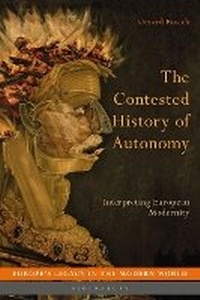
The Contested History of Autonomy
Interpreting European Modernity
Published on 30. April 2020
Book
Paperback/Softback
240 pages
978-1-350-15926-6 (ISBN)
Description
The Contested History of Autonomy examines the concept of autonomy in modern times. It presents the history of modernity as constituted by the tension between sovereignty and autonomy and offers a critical interpretation of European modernity from a global perspective.
The book shows, in contrast to the standard view of its invention, that autonomy (re)emerged as a defining quality of modernity in early modern Europe. Gerard Rosich looks at how the concept is first used politically, in opposition to the rival concept of sovereignty, as an attribute of a collective-self in struggle against imperial domination. Subsequently the book presents a range of historical developments as significant events in the history of imperialism which are connected at once with the consolidation of the concept of sovereignty and with a western view of modernity. Additionally, the book provides an interpretation of the history of globalization based on this connection.
Rosich discusses the conceptual shortcomings and historical inadequacy of the traditional western view of modernity against the background of recent breakthroughs in world history. In doing so, it reconstructs an alternative interpretation of modernity associated with the history of autonomy as it appeared in early modern Europe, before looking to the present and the ongoing tension between 'sovereignty' and 'autonomy' that exists.
This is a groundbreaking study that will be of immense value to scholars researching modern Europe and its relationship with the World.
The book shows, in contrast to the standard view of its invention, that autonomy (re)emerged as a defining quality of modernity in early modern Europe. Gerard Rosich looks at how the concept is first used politically, in opposition to the rival concept of sovereignty, as an attribute of a collective-self in struggle against imperial domination. Subsequently the book presents a range of historical developments as significant events in the history of imperialism which are connected at once with the consolidation of the concept of sovereignty and with a western view of modernity. Additionally, the book provides an interpretation of the history of globalization based on this connection.
Rosich discusses the conceptual shortcomings and historical inadequacy of the traditional western view of modernity against the background of recent breakthroughs in world history. In doing so, it reconstructs an alternative interpretation of modernity associated with the history of autonomy as it appeared in early modern Europe, before looking to the present and the ongoing tension between 'sovereignty' and 'autonomy' that exists.
This is a groundbreaking study that will be of immense value to scholars researching modern Europe and its relationship with the World.
Reviews / Votes
This book, written with passion, confidence, and clarity, embodies an ambitious intellectual project that aims to challenge ideas about the political as formulated by liberal and neo-liberal thinkers in the age of globalization. Its consistent engagement with post-colonial scholarship gives Rosich's argument a global sense of relevance and urgency. * Dipesh Chakrabarty, Lawrence A. Kimpton Distinguished Service Professor, University of Chicago, USA *More details
Series
Language
English
Place of publication
London
United Kingdom
Publishing group
Bloomsbury Publishing PLC
Target group
College/higher education
Dimensions
Height: 234 mm
Width: 156 mm
Weight
340 gr
ISBN-13
978-1-350-15926-6 (9781350159266)
Copyright in bibliographic data and cover images is held by Nielsen Book Services Limited or by the publishers or by their respective licensors: all rights reserved.
Schweitzer Classification
Other editions
Additional editions
E-Book
10/2018
1st Edition
Bloomsbury Academic
€37.49
Available for download
E-Book
10/2018
1st Edition
Bloomsbury Academic
€37.49
Available for download
Person
Gerard Rosich is Postdoctoral Researcher in the Department of World Cultures at the University of Helsinki, Finland. He is the co-editor, along with Peter Wagner, of The Trouble with Democracy: Political Modernity in the 21st Century (2016).
Content
Acknowledgements
1. Introduction: Modernity-Autonomy-Europe
Part I: A Politico-Conceptual History of Autonomy
2. The Greek Invention of Autonomy
3. The Modern Sources of Autonomy
4. Autonomy and the Holy Roman Empire
5. The Modern Reinterpretation of Autonomy
6. Autonomy and the Formation of European Modernity
7. Historicizing Political Modernity
8. Autonomy and the Place of Europe in Modern History
Part II: The Contested Legacy of Europe and the History of Modernity
9. The Narrative of Modernity
10. Europe and the Idea of History
11. The Constitution of a Global Order
12. Varieties of Modernity
13. Conclusion
Bibliography
Index
1. Introduction: Modernity-Autonomy-Europe
Part I: A Politico-Conceptual History of Autonomy
2. The Greek Invention of Autonomy
3. The Modern Sources of Autonomy
4. Autonomy and the Holy Roman Empire
5. The Modern Reinterpretation of Autonomy
6. Autonomy and the Formation of European Modernity
7. Historicizing Political Modernity
8. Autonomy and the Place of Europe in Modern History
Part II: The Contested Legacy of Europe and the History of Modernity
9. The Narrative of Modernity
10. Europe and the Idea of History
11. The Constitution of a Global Order
12. Varieties of Modernity
13. Conclusion
Bibliography
Index