

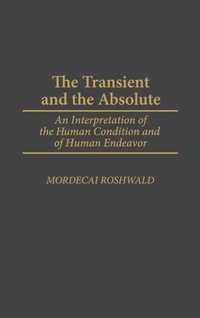
The Transient and the Absolute
An Interpretation of the Human Condition and of Human Endeavor
Published on 30. March 1999
Book
Hardback
208 pages
978-0-313-30936-6 (ISBN)
Description
The two principles of the Transient and the Absolute are fundamental to man's self-perception. While we perceive ourselves as transient biological phenomena, with a limited span of existence, we also view ourselves as immaterial creatures whose personalities persist and are not subject to change. This original philosophical essay surveys the totality of human experience from this dual perspective, showing the presence and the constant interaction of the two principles in the civilizational endeavors of humanity. The author analyzes our constant search for the absolute among transient manifestations in diverse domains, such as religion, philosophy, art, society, and politics. This volume offers a unifying view of the great diversity of human experience, based on the author's insight into man's self-perception.
More details
Language
English
Place of publication
United States
Publishing group
Bloomsbury Publishing Plc
Target group
College/higher education
Professional and scholarly
Dimensions
Height: 235 mm
Width: 157 mm
Thickness: 17 mm
Weight
496 gr
ISBN-13
978-0-313-30936-6 (9780313309366)
Copyright in bibliographic data and cover images is held by Nielsen Book Services Limited or by the publishers or by their respective licensors: all rights reserved.
Schweitzer Classification
Other editions
Additional editions
Mordecai Roshwald
The Transient and the Absolute
An Interpretation of the Human Condition and of Human Endeavor
E-Book
03/1999
1st Edition
Praeger Publishers Inc
€82.49
Available for download
Person
MORDECAI ROSHWALD is Professor Emeritus of Humanities at the University of Minnesota, where he taught for twenty-five years. He has published numerous scholarly articles and several books, including Humanism in Practice (1955), Level Seven (1959), and Modern Technology: The Promise and the Menace (1999).
Content
Introduction Personal Experience Theoretical Questioning Individual Activity Crucial Changes in Life Religion Philosophy The Order of Nature The Collective Political Authority Aesthetic Expression Conclusions Bibliography Index