

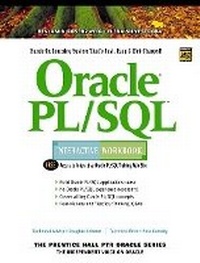
Oracle PL/SQL Interactive Workbook
Published on 17. April 2000
Book
Paperback/Softback
447 pages
978-0-13-015743-0 (ISBN)
Description
Part of the PH PTR Interactive's ground-breaking Interactive Workbook Series. This is the first of four entries in the Oracle Interactive Workbook Series. This book focuses on PL/SQL. PL/SQL is a programming language used in Oracle Tools (such as Oracle Developer) and in the database itself as stored procedures. It is essential for oracle DBAs and Oracle Developers to learn this language to work in the Oracle environment.
More details
Language
English
Place of publication
Upper Saddle River
United States
Publishing group
Pearson Education (US)
Target group
College/higher education
Dimensions
Width: 234 mm
Thickness: 31 mm
Weight
914 gr
ISBN-13
978-0-13-015743-0 (9780130157430)
Copyright in bibliographic data and cover images is held by Nielsen Book Services Limited or by the publishers or by their respective licensors: all rights reserved.
Schweitzer Classification
Other editions
New editions
Benjamin Rosenzweig | Elena Silvestrova
Oracle PL/SQL Interactive Workbook
Book
11/2002
2nd Edition
Prentice Hall
€37.13
Article exhausted; check for reprint
Persons
Benjamin Rosenzweig and Elena Silvestrova are faculty members at the Columbia University School of Continuing Education. Series Technical Advisor Douglas Scherer is a certified Oracle database administrator, and President and Founder of Core Paradigm, Inc. He has been an Oracle specialist, database architect, and consultant to a wide range of leading companies, including Deutsche Bank. He is also a member of the faculty at the Columbia University School of Continuing Education.
Content
1. programming concepts. Lab 1.1 The Nature of a Computer Program and Programming Languages. Lab 1.2 good Programming Practices. Structured Programming. CHAPTER 1 Test Your Thinking. 2. pl/sql concepts. Lab 2.1 pl/sql in Client-Server Architecture. Lab 2.2 PL/SQL in SQL*Plus. CHAPTER 2 Test Your Thinking. 3. General Programming Language Fundamentals. Lab 3.1 PL/SQL Programming Fundamentals. CHAPTER 3 Test Your Thinking. 4. SQL in PL/SQL. Lab 4.1 Making use of DML in PL/QL. Lab 4.2 Making Use of Savepoint. CHAPTER 4 Test Your Thinking. 5. conditional Control. Lab 5.1 if Statements. Lab 5.2 Elsif Statements. Lab 5.3 Nested If Statements. CHAPTER 5 Test Your Thinking. 6. Exception Handling and Built-In Exceptions. Lab 6.1 Handling Errors. Lab 6.2 Built-in Exceptions. CHAPTER 6 Test Your Thinking. 7. Iterative Control. Lab 7.1 Simple LOOPs. Lab 7.2 WHILE LOOPs. Lab 7.3 Numeric for LOOPs. Lab 7.4 Nested LOOPs. CHAPTER 7 Test Your Thinking. 8. Introduction to Cursors. Lab 8.1 Cursor Manipulation. Lab 8.2 Using Cursor for Loops and Nesting Cursors. Lab 8.3 Using PARAMETERS with Cursors and For Update Cursors. CHAPTER 8 Test Your Thinking. 9. Exceptions. Lab 9.1 Exception Scope. Lab 9.2 USER-DEFINED Exceptions. Lab 9.3 Exception Propagation. CHAPTER 9 Test Your Thinking. 10. exceptions: Advanced Concepts. Lab 10.1 raise_application_error. Lab 10.2 exception_init pragma. Lab 10.3 sqlcode and sqlerrm. CHAPTER 10 Test Your Thinking. 11. Procedures. Lab 11.1 Creating Procedures. Lab 11.2 Passing parameters in and out of Procedures. CHAPTER 11 Test Your Thinking. 12. functions. Lab 12.1 Creating and USING Functions. CHAPTER 12 Test Your Thinking. 13. Packages. Lab 13.1 The Benefits of Utilizing Packages. CHAPTER 13 Test Your Thinking. 14. Stored Code. Lab 14.1 Advanced Features of Stored Code. CHAPTER 14 Test Your Thinking. 15. triggers. Lab 15.1 What Triggers Are. Lab 15.2 Types of Triggers. Lab 15.3 Mutating Table Issues. CHAPTER 15 Test Your Thinking. 16. PL/SQL Tables. Lab 16.1 Making Use of PL/SQL Tables. CHAPTER 16 Test Your Thinking. Appendix A: Answers to Self-Review Questions. Appendix B: PL/SQL Formatting Guide. Appendix C: Student Database Scheme. Index.