

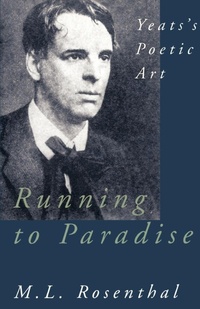
Running to Paradise
Yeats's Poetic Art
Published on 2. October 1997
Book
Paperback/Softback
384 pages
978-0-19-511391-4 (ISBN)
Description
In Running to Paradise, M.L. Rosenthal, hailed by the Times Literary Supplement as "one of the most important critics of twentieth-century poetry," leads us through the lyric poetry and poetic drama of our century's greatest poet in English. His readings shed new, vivid light on Yeats's daring uses of tradition, his love poetry, and the way he faced the often tragic realities of revolution and civil war. Running to Paradise describes
Yeats's whole effort--sometimes leavened by wild humor--to convey, with high poetic integrity, his passionate sense of his own life and of his chaotic era. Himself a noted poet, Rosenthal stresses Yeats's artistry and
psychological candor. The book ranges from his early exquisite lyrical poems and folklore-rooted plays, through the tougher-minded, more confessional mature work (including the sublime achievement of The Tower), and then to the sometimes "mad" yet often brilliant tragic or comic writing of his last years. Quoting extensively from Yeats, Rosenthal charts the gathering force with which the poet confronted his major life-issues: his art's demands, his persistent but hopeless love for one
woman, the complexities of marriage to another woman at age 52, and his distress during Ireland's "Troubles." Yeats's deep absorption in female sensibility, in the cycles of history and human thought, and in
supernaturalism and "the dead" comes strongly into play as well.
Yeats's whole effort--sometimes leavened by wild humor--to convey, with high poetic integrity, his passionate sense of his own life and of his chaotic era. Himself a noted poet, Rosenthal stresses Yeats's artistry and
psychological candor. The book ranges from his early exquisite lyrical poems and folklore-rooted plays, through the tougher-minded, more confessional mature work (including the sublime achievement of The Tower), and then to the sometimes "mad" yet often brilliant tragic or comic writing of his last years. Quoting extensively from Yeats, Rosenthal charts the gathering force with which the poet confronted his major life-issues: his art's demands, his persistent but hopeless love for one
woman, the complexities of marriage to another woman at age 52, and his distress during Ireland's "Troubles." Yeats's deep absorption in female sensibility, in the cycles of history and human thought, and in
supernaturalism and "the dead" comes strongly into play as well.
Reviews / Votes
It posseses distinctive strengths which make it a useful and thought-provoking contribution to critical debate...a consistently lucid and engaging performance, whose ideas and observations can prompt fruitful disagreement...All those working on modern poetry have ample reason to be grateful for M. L. Rosenthal's work over the years, and it is a matter of some satisfaction that the critic has produced a book on Yeats which will remain of solid interest and value, provoking further study and consideration of centrally important poetic issues. * Review of English Studies *More details
Language
English
Place of publication
New York
United States
Target group
Professional and scholarly
Illustrations
frontispiece, halftones
Dimensions
Height: 216 mm
Width: 140 mm
Thickness: 22 mm
Weight
535 gr
ISBN-13
978-0-19-511391-4 (9780195113914)
Copyright in bibliographic data and cover images is held by Nielsen Book Services Limited or by the publishers or by their respective licensors: all rights reserved.
Schweitzer Classification
Other editions
Additional editions
E-Book
04/1997
1st Edition
OUP eBook
€36.99
Available for download
Person
M.L. Rosenthal was Professor Emeritus at New York University and lectured and read around the world. His many books include The Modern Poets: A Critical Introduction, The Modern Poetic Sequence: The Genius of Modern Poetry (with Sally M. Gall) The Poet's Art, and Our Life in Poetry, and As for Love: Poems and Translations.